AI replacing coding is no longer just a prediction—it is becoming a reality in modern software development. With advanced tools automating repetitive tasks, developers must adapt and learn new skills to stay relevant.
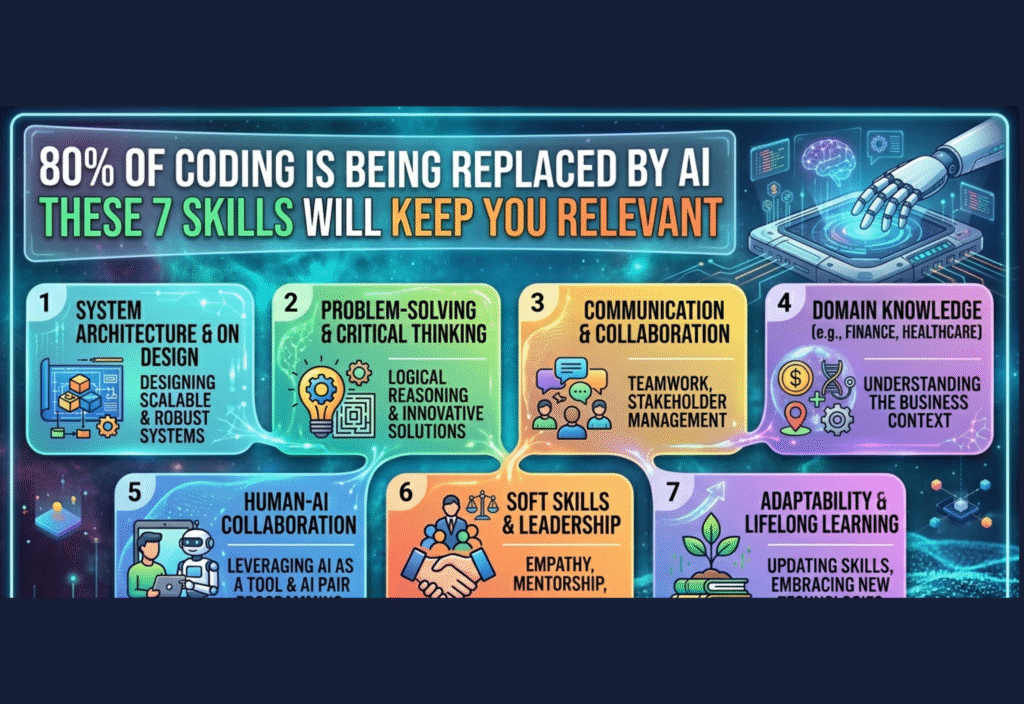
This has led to a bold and widely discussed claim: “80% of coding is being replaced by AI.”
While this statement may sound dramatic, it reflects a deeper reality—AI is automating a large portion of routine programming tasks. But instead of eliminating developers, it is reshaping their role.
In this detailed article, we will explore what this shift really means and the seven essential skills you must develop to stay relevant in the AI-driven future.
The Reality Behind AI Replacing Coding
AI is exceptionally good at handling tasks that are:
- Repetitive
- Pattern-based
- Well-documented
For example, AI can now:
- Generate boilerplate code
- Suggest code completions
- Fix common bugs
- Translate code between languages
- Write basic documentation
Tools like GitHub Copilot can even predict entire functions, while ChatGPT and Claude can build small applications from simple instructions.
However, AI still struggles with:
- Complex decision-making
- Understanding business context
- Creative problem-solving
- Long-term system design
This means developers are not being replaced—they are being upgraded.
The Shift: From Coders to Problem Solvers
In the past, developers were valued for:
- Writing clean code
- Memorizing syntax
- Implementing logic
Now, the focus is shifting toward:
- Designing solutions
- Understanding user needs
- Managing AI tools
- Building scalable systems
The future developer is not just a coder—they are a strategic thinker and AI collaborator.
The 7 Skills That Will Keep You Relevant
1. Advanced Problem-Solving and Analytical Thinking
AI can generate code, but it cannot fully understand complex real-world challenges. Businesses deal with messy, ambiguous problems that require human judgment.
Developers must learn to:
- Break down large problems into smaller parts
- Evaluate multiple solutions
- Optimize for performance and scalability
The ability to think deeply and solve problems creatively will always be valuable.
2. Mastery of AI Tools and Prompt Engineering
Instead of fearing AI, developers must learn how to control and guide it.
Using tools like:
- GitHub Copilot
- ChatGPT
- Claude
you can:
- Generate code faster
- Automate repetitive tasks
- Improve productivity
But the real skill lies in:
- Writing precise prompts
- Giving clear instructions
- Iterating on AI responses
This is known as prompt engineering, and it is becoming a critical skill.
3. System Design and Software Architecture
AI can write functions, but designing an entire system requires human expertise.
You should understand:
- How different components interact
- How to scale applications
- How to ensure reliability and performance
Key areas include:
- Microservices architecture
- Cloud computing
- API design
- Distributed systems
Companies value developers who can design complete systems, not just write code snippets.
4. Code Review, Debugging, and Optimization
AI-generated code is not always perfect. It can:
- Contain bugs
- Be inefficient
- Introduce security vulnerabilities
Developers must:
- Review code critically
- Identify hidden issues
- Optimize performance
The future developer is not just a creator, but also a code evaluator and optimizer.
5. Strong Fundamentals in Computer Science
Even in an AI-driven world, fundamentals remain essential.
You must understand:
- Data structures and algorithms
- Time and space complexity
- Databases and query optimization
- Networking basics
Without these, you cannot:
- Validate AI output
- Debug complex issues
- Build efficient systems
AI can assist you, but fundamentals give you authority.
6. Communication and Cross-Functional Collaboration
Software development is a team effort. Developers must work with:
- Designers
- Product managers
- Clients
- Stakeholders
Important skills include:
- Explaining technical concepts clearly
- Writing clean documentation
- Collaborating effectively
AI cannot replace human interaction, empathy, and communication.
7. Continuous Learning and Adaptability
Technology is evolving faster than ever, and AI is accelerating that pace.
To stay relevant, you must:
- Learn new tools regularly
- Stay updated with industry trends
- Adapt to changing technologies
The most successful developers are those who never stop learning.
The Risks of Relying Too Much on AI
While AI is powerful, over-dependence can be dangerous.
Some risks include:
- Reduced problem-solving ability
- Blind trust in incorrect code
- Security vulnerabilities
- Lack of deep understanding
Developers must use AI as a tool, not a replacement for thinking.
New Opportunities in the AI Era
The rise of AI is also creating new career paths:
- AI application developer
- Prompt engineer
- Automation specialist
- AI system architect
Developers who adapt can unlock more opportunities than ever before.
The Future of Coding
Coding is not disappearing—it is evolving.
In the future:
- AI will handle repetitive tasks
- Humans will focus on strategy and creativity
- Development will become faster and more efficient
The role of developers will shift from writing code to directing intelligence.
Final Thoughts
The statement “80% of coding is being replaced by AI” is not a threat—it is a signal of change.
Developers who resist this change may struggle, but those who adapt will thrive in ways never seen before.
Conclusion
AI is not here to replace you—it is here to amplify your abilities. By focusing on the right skills, you can stay relevant, competitive, and successful in the modern tech landscape.
The future belongs to developers who:
- Think critically
- Learn continuously
- Use AI wisely
The key to survival is simple: evolve with technology, not against it.