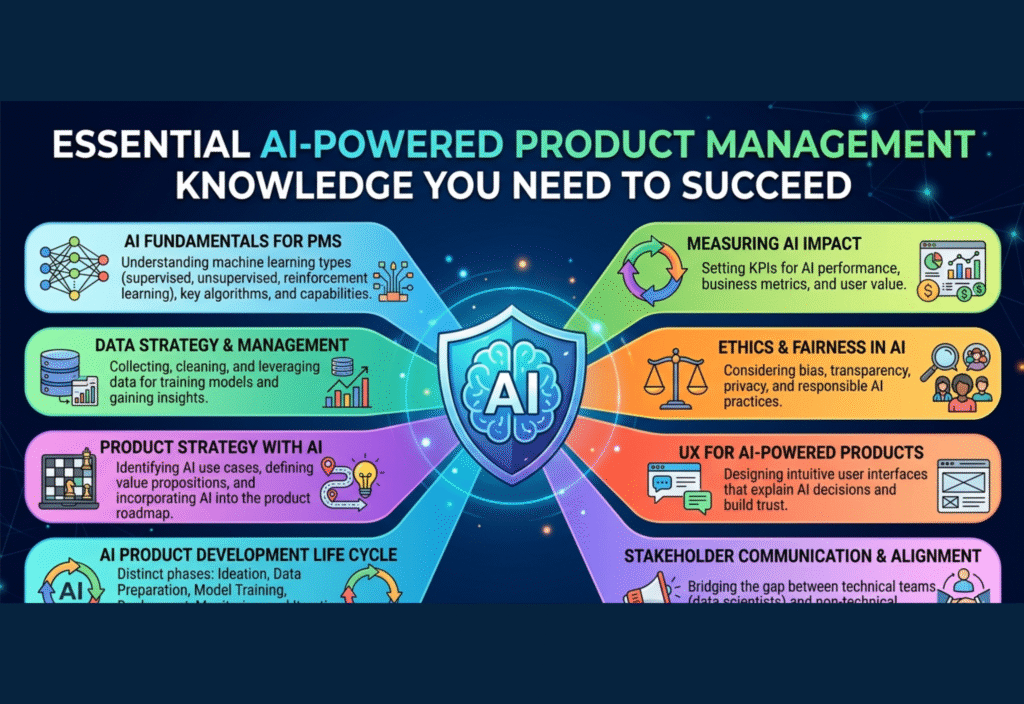
AI-powered product management is transforming how modern products are built and managed. In today’s competitive landscape, understanding AI-powered product management is essential to create smarter, data-driven products and make better product decisions.
This comprehensive guide explains the essential knowledge required to succeed as an AI-powered product manager, written in a clear, original, and practical way.
Understanding AI in Product Management
AI-powered product management refers to using artificial intelligence technologies to improve product decisions, automate processes, and create smarter user experiences.
Unlike traditional product management, where features are manually designed and static, AI-driven products:
- Learn from data over time
- Improve automatically with usage
- Adapt to user behavior
- Make predictions and recommendations
This shift changes the role of a product manager. Instead of just managing features, you are now managing systems that learn and evolve.
Why AI Knowledge is Essential for Product Managers
In today’s competitive environment, companies rely heavily on AI to gain an advantage. As a product manager, understanding AI helps you:
- Build data-driven product strategies
- Communicate effectively with technical teams
- Identify valuable AI use cases
- Avoid unrealistic expectations
- Deliver smarter and more scalable products
Without this knowledge, it becomes difficult to lead modern product teams effectively.
Core AI Concepts Every Product Manager Should Know
You don’t need to become a machine learning engineer, but you must understand the fundamentals.
1. Machine Learning
Machine learning enables systems to learn from data and improve over time without explicit programming.
2. Supervised Learning
Models learn from labeled data to make predictions.
3. Unsupervised Learning
Models discover hidden patterns in data without labels.
4. Natural Language Processing (NLP)
Allows machines to understand and generate human language.
5. Computer Vision
Enables machines to analyze images and videos.
Understanding these concepts helps you evaluate what is possible and what is not.
The Importance of Data in AI Products
Data is the backbone of every AI system. Without good data, even the most advanced models fail.
As a product manager, you must ensure:
- Data quality is high
- Data is relevant and unbiased
- Data pipelines are reliable
- Privacy regulations are followed
Key questions to ask:
- Is the data clean and structured?
- Is it sufficient to train a model?
- Are there biases in the dataset?
- How is the data collected and stored?
Strong data strategy leads to strong product outcomes.
Problem Framing for AI Solutions
One of the biggest mistakes in AI product management is using AI where it is not needed.
Before implementing AI, ask:
- Does this problem require prediction or automation?
- Can traditional rules solve this problem better?
- What is the business impact of solving this problem?
AI is best suited for:
- Predictions (e.g., demand forecasting)
- Personalization (e.g., recommendations)
- Automation (e.g., chatbots, workflows)
Proper problem framing ensures resources are used effectively.
Working with Cross-Functional Teams
AI product development involves multiple teams working together:
- Data scientists
- Engineers
- Designers
- Business stakeholders
Your role as a product manager is to:
- Translate business goals into technical requirements
- Ensure alignment across teams
- Manage timelines and expectations
- Facilitate communication
Clear communication is especially important in AI projects because outcomes can be uncertain.
Understanding the AI Model Lifecycle
AI products go through a continuous lifecycle, unlike traditional products.
Key stages include:
- Data collection
- Data preprocessing
- Model training
- Evaluation and testing
- Deployment
- Monitoring
- Retraining
Product managers must track:
- Model performance
- Accuracy and errors
- User feedback
- System behavior over time
AI is not a one-time build—it is an ongoing process of improvement.
Metrics for AI-Powered Products
In addition to standard product metrics, AI products require model-specific metrics.
Product Metrics:
- User engagement
- Retention rate
- Conversion rate
Model Metrics:
- Accuracy
- Precision and recall
- Latency
- Error rate
Balancing both types of metrics is crucial. A highly accurate model is useless if it is too slow or expensive to run.
Ethics and Responsible AI
AI must be developed responsibly. Product managers play a key role in ensuring ethical use.
Important considerations include:
- Fairness and bias prevention
- Transparency in decision-making
- User privacy protection
- Accountability for outcomes
Questions to ask:
- Is the model treating all users fairly?
- Can users understand how decisions are made?
- Are we protecting sensitive data?
Ethical AI builds trust and long-term success.
AI and User Experience (UX)
AI changes how users interact with products. A well-designed AI experience should be:
- Simple
- Transparent
- Reliable
- User-friendly
Best practices:
- Explain AI decisions clearly
- Provide user control and feedback options
- Handle errors gracefully
- Avoid overcomplicating the interface
The goal is to enhance user experience, not confuse users.
Tools and Platforms for AI Product Managers
There are many tools available to support AI-powered product development.
These include:
- No-code platforms for rapid prototyping
- AI frameworks for custom development
- Automation tools for workflows
- Enterprise platforms for large-scale systems
The key is not the tool itself, but how effectively it solves the problem.
Experimentation and Iteration
AI product development relies heavily on experimentation.
As a product manager, you should:
- Run experiments
- Test assumptions
- Analyze results
- Iterate based on feedback
A/B testing is commonly used to compare different models or features.
Failure is part of the process—learning from it is what drives success.
Future of AI in Product Management
AI will continue to evolve rapidly, and product managers must stay ahead of the curve.
Emerging trends include:
- Autonomous AI agents
- Multi-agent systems
- Advanced personalization
- AI-driven decision-making systems
Future product managers will not just manage products—they will manage intelligent systems.
Key Skills for AI-Powered Product Managers
To succeed in this field, you should develop:
- Analytical thinking
- Data literacy
- Basic AI understanding
- Communication skills
- Strategic decision-making
- Experimentation mindset
You don’t need to code, but you must understand how AI works and how to apply it.
Conclusion
AI-powered product management is the future of building products. It combines technology, data, strategy, and user experience into one powerful discipline.
To succeed, you must:
- Understand AI fundamentals
- Focus on data quality
- Frame problems correctly
- Collaborate with teams
- Continuously learn and experiment
Product managers who master AI will lead the next generation of innovative products and digital experiences.