
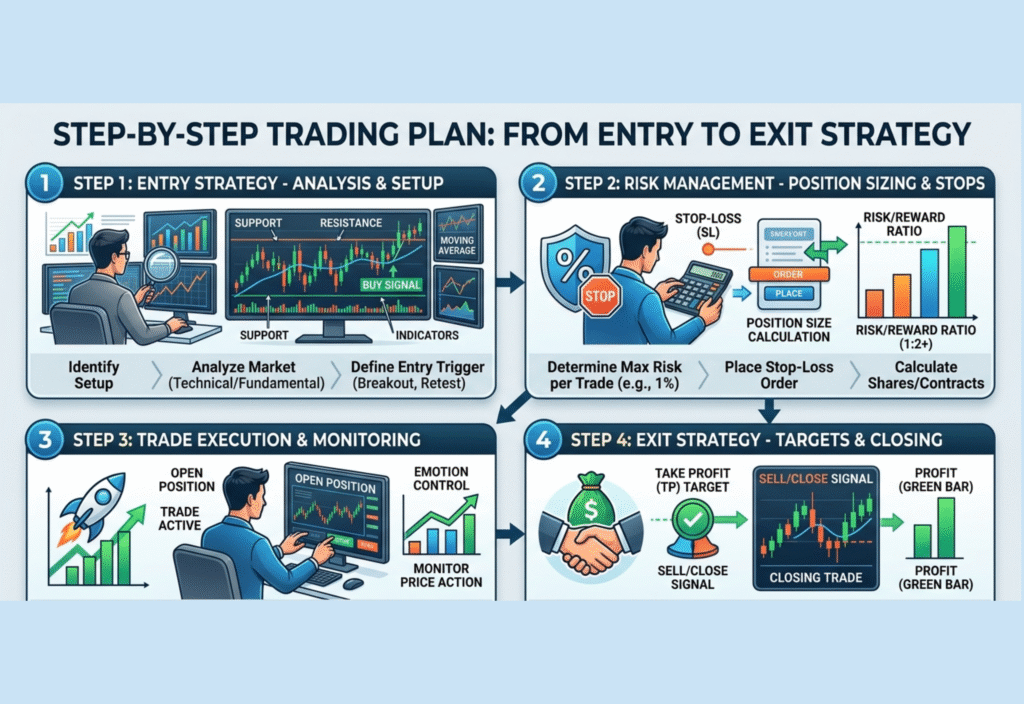
Trading plan step by step is essential for successful trading. A step-by-step trading plan helps traders manage risk, plan entries, and define exit strategies for consistent results.
A well-designed trading plan does not guarantee profit, but it significantly increases your chances of consistency and reduces emotional decision-making. In this guide, we will explore a complete step-by-step trading plan, focusing on entry and exit strategies, risk control, and long-term success.
What is a Trading Plan and Why is it Important
A trading plan is a written set of rules that defines how you trade in the market.
It includes:
-
Entry rules
-
Exit rules
-
Risk management
-
Position sizing
-
Trading psychology guidelines
Without a plan, traders often rely on emotions such as fear and greed, which leads to inconsistent results. A plan ensures that every trade is based on logic and analysis rather than impulse.
Step 1: Define Your Trading Goals
Before entering any trade, you must clearly define your objectives.
Ask yourself:
-
Am I trading for income or long-term growth?
-
How much capital can I risk?
-
What is my expected return?
Setting realistic goals helps you stay focused and avoid unrealistic expectations. Trading should be seen as a skill-building process, not a shortcut to quick wealth.
Step 2: Choose a Trading Style That Fits You
Different trading styles require different levels of time and risk.
Types of Trading:
-
Scalping – Very short-term trades, high speed, high risk
-
Day trading – Positions opened and closed within a day
-
Swing trading – Holding trades for several days or weeks
-
Position trading – Long-term trading based on major trends
For beginners, swing trading is often recommended because it allows more time for analysis and reduces stress.
Step 3: Select the Right Market
Choosing the correct market is important for success.
Common Markets:
-
Stock market
-
Forex (currency trading)
-
Cryptocurrency
-
Commodities
Each market behaves differently. For example, crypto markets are more volatile, while stock markets are relatively more stable. Beginners should start with markets that are easier to understand.
Step 4: Develop a Clear Entry Strategy
Your entry strategy determines when you enter a trade.
Common Entry Methods:
-
Trend following
-
Breakout strategy
-
Support and resistance levels
-
Moving averages
A strong entry strategy ensures that you enter trades with a higher probability of success. Avoid entering trades randomly or based on emotions.
Step 5: Use Technical and Fundamental Analysis
Before entering a trade, confirm your decision using analysis.
Technical Analysis:
-
Charts
-
Indicators
-
Patterns
Fundamental Analysis:
-
News events
-
Economic data
-
Company performance
Using both methods together can improve accuracy and reduce risk.
Step 6: Risk Management Before Entry
Risk management is the foundation of successful trading.
Golden Rules:
-
Risk only 1–2% of your capital per trade
-
Always use stop-loss
-
Never overleverage
-
Avoid revenge trading
If you focus on risk control, profits will follow over time. Protecting capital is more important than making profits.
Step 7: Position Sizing and Capital Allocation
Position sizing determines how much you invest in each trade.
Best Practices:
-
Divide your capital into smaller portions
-
Avoid putting all money in one trade
-
Adjust trade size based on risk
Proper position sizing helps protect your account from large losses.
Step 8: Execute the Trade with Discipline
Once your plan is ready, execute the trade confidently.
-
Enter at your defined price level
-
Set stop-loss immediately
-
Set take-profit target
Avoid hesitation or second-guessing. Once the trade is placed, trust your strategy.
Step 9: Define Your Exit Strategy
Your exit strategy is just as important as your entry strategy.
Types of Exit:
Stop-Loss Exit
Automatically closes the trade if the market goes against you, limiting losses.
Take-Profit Exit
Closes the trade when your target is reached, securing profits.
Manual Exit
You may exit manually if market conditions change.
A good exit plan ensures that you protect gains and limit losses.
Step 10: Monitor and Manage the Trade
After entering a trade, monitor it carefully.
-
Observe price movements
-
Avoid emotional reactions
-
Stick to your plan
Do not change your strategy based on short-term market fluctuations.
Step 11: Adjust Stop-Loss (Risk-Free Strategy)
When a trade moves in your favor:
-
Move stop-loss to break-even
-
Lock in partial profits
-
Reduce risk exposure
This allows you to protect your capital while still benefiting from market movements.
Step 12: Close the Trade Properly
Close your trade when:
-
Your target is achieved
-
Stop-loss is hit
-
Market conditions change
Do not hold onto trades longer than planned. Discipline is key.
Step 13: Maintain a Trading Journal
Keeping a trading journal is essential for improvement.
Record:
-
Entry and exit points
-
Reason for the trade
-
Profit or loss
-
Mistakes and lessons
This helps you identify patterns and improve over time.
Step 14: Develop Trading Psychology
Trading is not just technical—it is psychological.
Challenges:
-
Fear of loss
-
Greed for more profit
-
Overconfidence
-
Emotional stress
Solutions:
-
Follow your plan strictly
-
Accept losses as part of trading
-
Stay patient and disciplined
A strong mindset separates successful traders from unsuccessful ones.
Step 15: Avoid Common Trading Mistakes
Beginners often make similar mistakes.
Common Mistakes:
-
Trading without a plan
-
Ignoring risk management
-
Overtrading
-
Using too much leverage
-
Chasing losses
Avoiding these mistakes is crucial for long-term survival.
Step 16: Build Consistency in Trading
Consistency is more important than big profits.
-
Focus on steady growth
-
Follow your rules
-
Avoid emotional decisions
-
Keep learning and improving
Consistency builds confidence and long-term success.
Step 17: Continuous Learning and Improvement
Markets are always changing.
-
Keep learning new strategies
-
Study market trends
-
Analyze your trades regularly
-
Improve your skills
Successful traders never stop learning.
Conclusion
A step-by-step trading plan is essential for achieving consistent and sustainable results in trading. By following a structured approach—from entry to exit—you can reduce risk and make better decisions.
Trading is not about luck or quick profits. It is about discipline, patience, and proper risk management. Start with a simple plan, follow it consistently, and improve over time. With dedication and the right mindset, you can build strong trading skills and grow steadily in the financial markets.