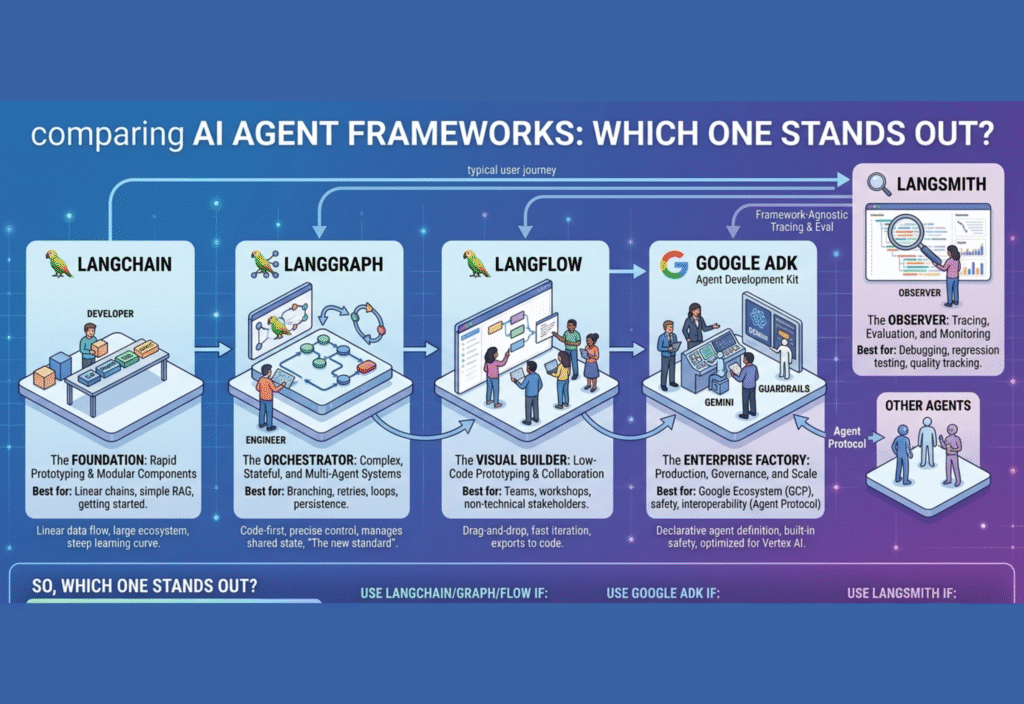
The world of artificial intelligence is evolving rapidly, and choosing the right tools has become critical for developers and businesses. This AI Platforms Comparison explores five leading solutions—Google ADK, LangChain, LangGraph, LangFlow, and LangSmith—highlighting their features, strengths, and ideal use cases to help you make informed decisions.
However, choosing the right platform is not straightforward. The decision depends on your technical expertise, project requirements, scalability needs, and long-term goals. This article provides a comprehensive comparison of these five platforms, detailing their features, advantages, limitations, and the scenarios where they shine the most.
1. Google ADK
Google ADK (AI Developer Kit) is a comprehensive toolkit from Google that aims to streamline AI development, particularly for large-scale enterprise applications. It provides pre-trained models, APIs, and ready-to-use integration options, making it easier to deploy AI solutions without building models from scratch.
Key Features
-
Wide AI Model Support: Includes models for NLP, vision, speech recognition, and recommendation systems.
-
Cloud Integration: Seamlessly integrates with Google Cloud services for storage, compute, and analytics.
-
Pre-built APIs: Offers ready-to-use APIs that simplify tasks like text summarization, translation, and image recognition.
-
Scalability: Designed for enterprise applications, supporting millions of users or data points.
Advantages
-
Backed by Google’s robust infrastructure, ensuring reliability and uptime.
-
Extensive documentation and tutorials for developers at all levels.
-
Can handle multiple AI models simultaneously, simplifying multi-purpose applications.
Limitations
-
Requires familiarity with Google Cloud infrastructure.
-
Less flexible for small-scale or highly customized AI workflows outside Google’s ecosystem.
Best Use Case: Enterprises looking for a powerful AI toolkit with integrated cloud services and support for multiple AI domains.
2. LangChain
LangChain is a Python-based framework built to simplify the creation of complex AI workflows. Unlike traditional frameworks, LangChain focuses on chaining multiple AI model calls, APIs, and external data sources to produce intelligent outputs.
Key Features
-
Support for Multiple LLMs: Can integrate with various large language models such as OpenAI GPT, Cohere, or Hugging Face models.
-
Prompt and Function Chaining: Allows developers to connect multiple AI prompts and functions to build complex applications.
-
Database and API Integration: Can query structured or unstructured data and integrate external APIs for enriched responses.
-
Modular Architecture: Developers can build highly customizable workflows depending on project needs.
Advantages
-
Highly flexible for developers who want fine-grained control over AI operations.
-
Large community with many tutorials, templates, and example projects.
-
Well-suited for building conversational AI, question-answering systems, and other LLM-based applications.
Limitations
-
Requires solid programming knowledge, making it less beginner-friendly.
-
Steeper learning curve for those unfamiliar with Python or AI model workflows.
Best Use Case: Developers building custom AI workflows that require control over multiple model interactions and integrations.
3. LangGraph
LangGraph is a visual, node-based framework that allows users to design AI workflows graphically. It prioritizes simplicity and speed in prototyping, making it accessible even to non-programmers.
Key Features
-
Drag-and-Drop Interface: Build AI workflows without writing complex code.
-
Node-Based Workflow: Each node represents a function, API call, or AI model, which can be connected visually.
-
Real-Time Testing: Evaluate workflows immediately to detect errors and optimize outputs.
-
Supports Multiple Models: Can integrate with various LLMs and APIs.
Advantages
-
Extremely intuitive for beginners or teams without deep programming expertise.
-
Speeds up prototyping of AI pipelines.
-
Visual debugging simplifies workflow adjustments and troubleshooting.
Limitations
-
Less flexible for highly complex projects that require custom coding.
-
May not scale efficiently for enterprise-level applications.
Best Use Case: Teams looking to quickly prototype AI workflows and experiment with different AI integrations without extensive coding knowledge.
4. LangFlow
LangFlow merges the visual simplicity of platforms like LangGraph with the flexibility of code-driven frameworks like LangChain. It provides a hybrid environment where developers can use both visual nodes and code to design AI workflows.
Key Features
-
Hybrid Interface: Combines drag-and-drop visual workflows with direct code editing for complex tasks.
-
Integration with Major LLMs and AI Tools: Supports multiple models, APIs, and external services.
-
Versioning and Exporting: Save workflow versions, export pipelines, and maintain collaboration across teams.
-
Community Contributions: Active community continuously adds new nodes, templates, and functionality.
Advantages
-
Balances ease of use with advanced functionality.
-
Facilitates collaboration between programmers and non-programmers.
-
Fast iteration cycles, allowing teams to test and deploy AI workflows efficiently.
Limitations
-
Some advanced features require programming knowledge.
-
May have a learning curve for users new to hybrid workflow design.
Best Use Case: Teams or organizations that need both visual simplicity and coding flexibility for collaborative AI development.
5. LangSmith
LangSmith focuses on monitoring, evaluating, and debugging AI agents after deployment. Unlike the previous platforms, its primary goal is not building AI workflows but ensuring AI systems remain reliable and effective in production environments.
Key Features
-
Real-Time Logging and Metrics: Tracks AI agent performance across multiple metrics.
-
Error Detection and Troubleshooting: Helps identify issues quickly and reduces downtime.
-
Performance Evaluation: Measures outputs, accuracy, and efficiency of AI models.
-
Supports Multiple Frameworks: Works with various AI frameworks to monitor heterogeneous environments.
Advantages
-
Essential for businesses running AI systems in production.
-
Helps optimize AI workflows by providing insights into performance bottlenecks.
-
Improves reliability, reducing risks associated with automated AI decisions.
Limitations
-
Not designed for initial AI development.
-
Primarily serves as a monitoring and evaluation tool rather than a workflow creation platform.
Best Use Case: Organizations with deployed AI agents that require monitoring, debugging, and performance optimization.
Side-by-Side Comparison
| Feature/Platform | Google ADK | LangChain | LangGraph | LangFlow | LangSmith |
|---|---|---|---|---|---|
| Primary Focus | Development Kit | Workflow Chaining | Visual Workflows | Hybrid Workflows | Monitoring & Debugging |
| Target Users | Developers, Enterprises | Developers | Non-programmers | Teams & Developers | Production Teams |
| Flexibility | Medium | High | Medium | High | Medium |
| Ease of Use | Medium | Medium | High | Medium-High | High |
| Integration | Google Cloud | APIs & Databases | APIs & LLMs | APIs & LLMs | Multiple AI frameworks |
| Ideal Use Case | Enterprise AI apps | Custom AI workflows | Prototype AI pipelines | Collaborative AI workflows | AI agent monitoring |
Choosing the Right Platform
Each platform has distinct strengths:
-
Google ADK excels in enterprise-grade projects needing cloud integration and scalability.
-
LangChain is ideal for developers who want full control over AI workflows and integration.
-
LangGraph is perfect for rapid prototyping and visual workflow experimentation.
-
LangFlow combines visual design with coding flexibility, making it suitable for collaborative projects.
-
LangSmith ensures production reliability and helps optimize AI agents once deployed.
Recommendation: For most developers, LangFlow provides a balanced solution combining ease of use, flexibility, and team collaboration. Enterprises focused on scalability may prefer Google ADK, while those monitoring deployed systems will find LangSmith indispensable.
Real-World Examples
-
Enterprise AI: A multinational company uses Google ADK to deploy NLP and vision models integrated into cloud services.
-
Custom AI Workflow: A startup uses LangChain to build a question-answering system by chaining multiple LLMs with real-time data sources.
-
Rapid Prototyping: A design team leverages LangGraph to quickly test AI workflows visually before coding them.
-
Team Collaboration: A mid-sized tech team employs LangFlow to combine visual workflows and code, enabling developers and non-developers to work together.
-
Production Monitoring: A healthcare AI system relies on LangSmith to track agent performance, ensuring patient safety and model reliability.
Conclusion
Choosing the right AI platform depends on your goals, expertise, and project requirements. While no single platform is universally perfect, understanding their unique features helps make informed decisions.
-
LangChain and LangFlow are excellent for developers seeking flexibility.
-
Google ADK suits enterprises needing scalable solutions.
-
LangGraph is ideal for visual prototyping.
-
LangSmith is critical for monitoring AI agents in production.
By selecting the appropriate platform, developers and businesses can accelerate AI development, improve operational efficiency, and deploy reliable intelligent systems, shaping the future of AI applications across industries.