
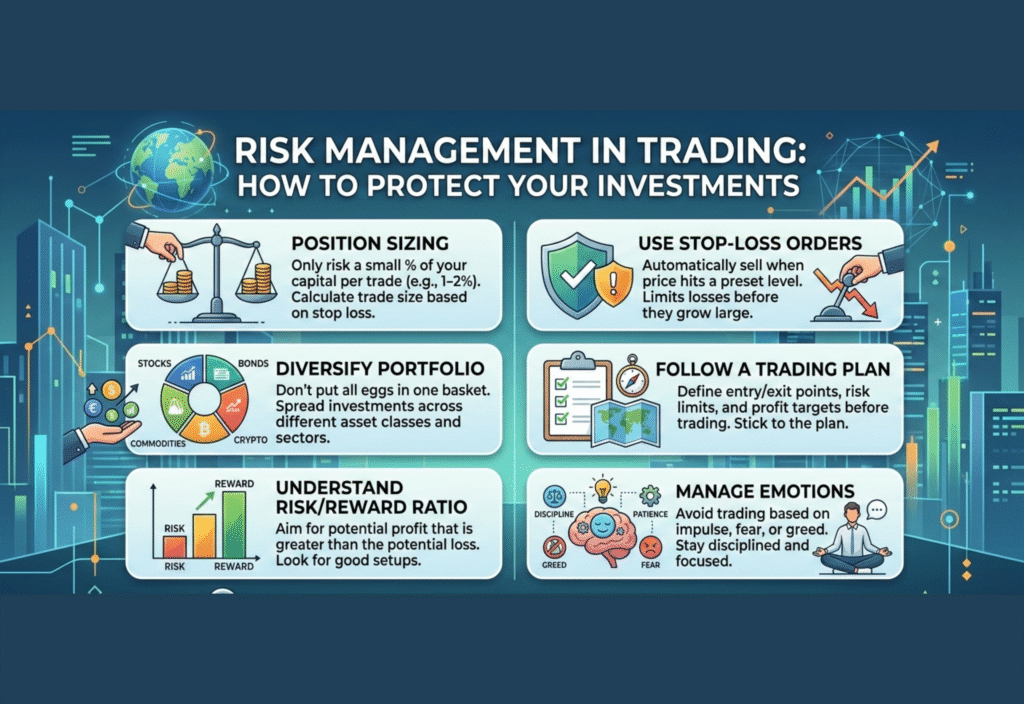
Trading in financial markets can be highly rewarding, but it also comes with risks. Many beginners focus only on profits without understanding the importance of managing risk. Without proper risk management, even experienced traders can suffer significant losses. Risk management is not just about avoiding losses; it is about protecting your capital, maintaining discipline, and making informed decisions. In this article, we will explore practical strategies and principles for effective risk management in trading, helping traders of all levels preserve their investments and trade more confidently.
Understanding Risk Management in Trading
Risk management is the process of identifying, evaluating, and controlling potential losses in trading. It ensures that no single trade can severely impact your overall portfolio. Simply put, it is a systematic approach to protect your investments while still allowing opportunities for profit.
Good risk management is built on four main pillars:
-
Limiting losses – Controlling the amount you can lose on each trade.
-
Protecting capital – Ensuring that your trading account remains safe for future trades.
-
Maintaining discipline – Sticking to a strategy even in volatile markets.
-
Sustainable trading – Trading in a way that allows you to stay in the market long-term.
Without risk management, even a few bad trades can wipe out months or years of profits.
Why Risk Management is Essential
Many traders focus solely on making profits, but risk management is equally important. Here’s why:
-
Preserves Capital: Protecting your investment ensures you can continue trading and learning from the market.
-
Reduces Emotional Stress: Risk management helps prevent panic, fear, or greed from influencing decisions.
-
Promotes Consistency: A disciplined approach ensures steady results rather than large wins followed by heavy losses.
-
Handles Market Volatility: Markets can change quickly due to economic or political news. Proper risk management reduces vulnerability.
-
Prepares for Unexpected Events: Even with strong analysis, sudden market shocks can occur. Risk control safeguards your account.
Key Strategies for Effective Risk Management
1. Set a Maximum Risk per Trade
Decide how much of your total capital you are willing to risk on a single trade. Most professional traders risk 1–3% of their account per trade.
Example:
If your account has $10,000, risk $100–$300 per trade. Even multiple losses won’t significantly impact your overall portfolio.
This approach protects your capital and gives you confidence to trade without fear.
2. Use Stop-Loss Orders
A stop-loss order automatically closes a trade at a pre-set price if the market moves against you.
Benefits:
-
Limits potential losses
-
Reduces emotional decision-making
-
Maintains a consistent risk/reward ratio
Example:
You buy a stock at $50 and set a stop-loss at $48. If the price drops to $48, the trade closes automatically, limiting your loss to $2 per share.
Stop-loss is the most basic and effective tool for every trader.
3. Diversify Your Investments
Diversification reduces the impact of a single loss and balances risk across multiple trades.
-
Spread capital across different assets (stocks, commodities, ETFs)
-
Avoid putting all money in one sector or stock
Example:
Instead of investing all $10,000 in one stock, divide it among 5–6 different instruments. Even if one loses, the others may perform well, protecting your overall capital.
4. Determine Position Size Carefully
Position size refers to how much you invest in a particular trade. Combine your maximum risk per trade with your stop-loss distance to calculate the proper position size.
Formula:
Position Size = Account Risk ÷ Stop-Loss Distance
This ensures losses stay within your acceptable limit, even if the trade fails.
5. Maintain a Risk/Reward Ratio
Always compare potential profit to potential loss before entering a trade.
-
Ideal ratio: 2:1 or higher
-
Ensures profitable trades outweigh losing trades
Example:
Risk $100 to potentially make $200. Even if some trades fail, the profitable trades compensate for the losses.
6. Avoid Overleveraging
Leverage allows traders to control large positions with a small amount of capital. While it can amplify gains, it also increases losses.
-
Use leverage cautiously
-
Never risk more than you can afford to lose
Overleveraging is a common cause of account wipeouts among beginners.
7. Keep Emotions Under Control
Trading is not just numbers; it is also about psychology. Fear, greed, and overconfidence can lead to:
-
Holding losing trades too long
-
Closing profitable trades too early
-
Overtrading or increasing position size impulsively
Solution:
Stick to your trading plan and rules. Emotional discipline is as important as technical knowledge.
8. Keep a Trading Journal
Maintain a record of all trades, including:
-
Entry and exit points
-
Profit and loss
-
Risk/reward ratio
-
Mistakes and lessons learned
A trading journal helps you analyze performance, identify weaknesses, and improve risk management strategies over time.
Practical Example of Risk Management
Suppose you have a trading account of $10,000:
-
Decide to risk 2% per trade → $200 maximum loss
-
Buy a stock at $50 with a stop-loss at $48 → $2 risk per share
-
Position size = $200 ÷ $2 = 100 shares
-
Set a target price with 2:1 reward ratio → $52
Even if the trade hits the stop-loss, your loss is limited to $200, preserving the rest of your capital.
Common Risk Management Mistakes
-
Ignoring stop-loss orders
-
Investing too much in a single trade
-
Letting emotions control trading decisions
-
Trading without a plan
-
Using excessive leverage
Avoiding these mistakes can protect your account and ensure long-term success.
Final Thoughts
Risk management is the backbone of successful trading. It is not about avoiding losses entirely; it is about controlling risk so that profits can grow while losses are limited. By applying stop-loss orders, position sizing, diversification, and disciplined trading, you can protect your investments, reduce stress, and increase the probability of consistent success.
Remember, trading is a marathon, not a sprint. Consistency, patience, and disciplined risk management are what separate successful traders from those who fail. Protect your capital first, and profits will follow naturally.