
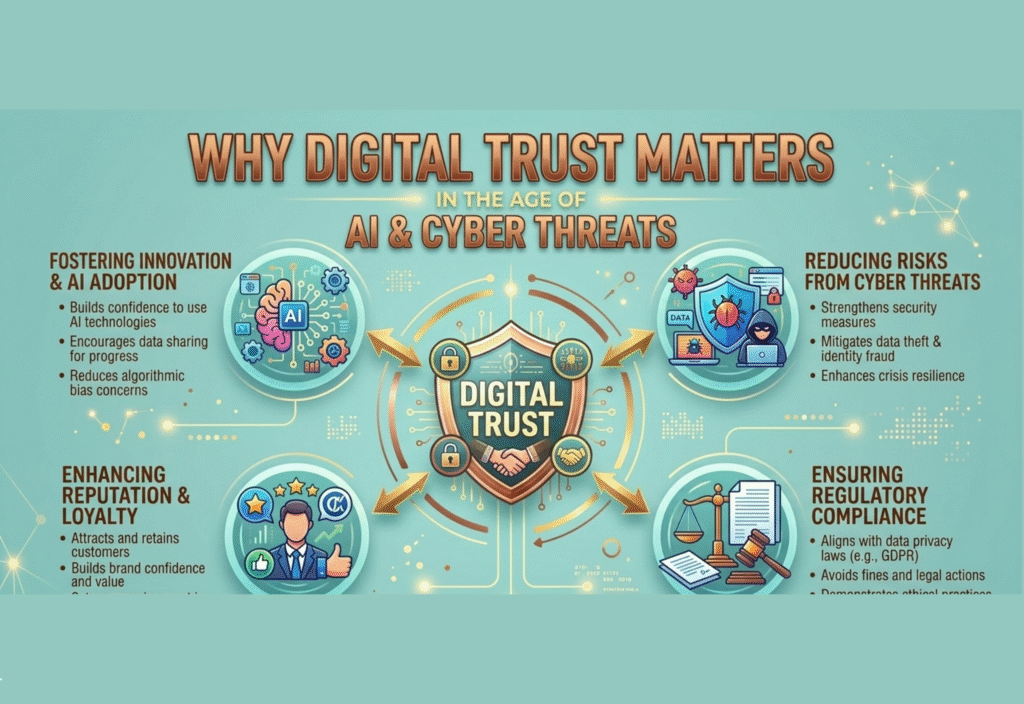
In the modern digital era, technology has become deeply integrated into almost every aspect of our lives. From the smartphones we use to the cloud platforms that host critical business applications, digital systems underpin our personal and professional activities. Alongside this rapid technological advancement, artificial intelligence (AI) has emerged as a transformative force, automating tasks, improving decision-making, and creating new opportunities across industries. However, as the adoption of AI accelerates, the importance of digital trust becomes more critical than ever.
Digital trust is the confidence users, organizations, and society have that digital systems are secure, reliable, transparent, and ethical. Without it, users may hesitate to adopt new technologies, businesses may face reputational damage, and cyber threats may exploit vulnerabilities, leading to widespread disruptions. In an age dominated by AI-driven systems and increasing cyber threats, understanding and building digital trust is essential for both organizations and individuals.
What is Digital Trust?
Digital trust can be defined as the degree of confidence users place in digital systems, services, and technologies. It ensures that information, applications, and interactions online are secure, transparent, and reliable. Digital trust encompasses several critical dimensions:
-
Security – Assurance that systems are protected from unauthorized access, breaches, and cyberattacks.
-
Privacy – Confidence that personal and sensitive data is collected, stored, and used ethically.
-
Reliability – Systems perform consistently and deliver accurate results.
-
Transparency – Users understand how technologies, especially AI systems, operate and make decisions.
-
Ethical Use of Technology – Technologies are designed and implemented to adhere to ethical standards, avoiding harm or bias.
In simple terms, digital trust is the belief that an organization’s technology systems are safe, effective, and trustworthy. As AI systems and automation become more prevalent, this trust is increasingly vital for adoption and long-term success.
How AI Influences Digital Trust
Artificial intelligence is no longer a futuristic concept—it is present in banking, healthcare, education, manufacturing, marketing, and more. AI systems analyze large datasets, identify patterns, and make decisions autonomously. While AI offers incredible benefits, it also introduces new challenges to digital trust:
1. Data Privacy Concerns
AI systems often require massive amounts of data to function effectively. This includes personal, financial, or medical information. Users must trust that their data is being handled securely and ethically. Failure to ensure data privacy can lead to breaches, identity theft, and loss of public trust. Organizations need to implement robust data protection frameworks, comply with regulations such as GDPR and CCPA, and maintain transparency about data usage.
2. Algorithmic Transparency
Many AI models, particularly deep learning networks, operate as “black boxes,” meaning their decision-making processes are not immediately understandable. Lack of transparency can lead to skepticism, reduced adoption, and ethical concerns. Users want assurances that AI systems are unbiased, explainable, and fair. Providing clear documentation, explainable AI models, and accessible reporting mechanisms helps in building trust.
3. Automation Risks
AI automation brings efficiency, speed, and scalability. However, it also increases risk. If AI systems malfunction or are exploited, the consequences can be severe, ranging from financial loss to operational failure. Demonstrating robust monitoring, fail-safes, and human oversight reassures users that automation is reliable and controlled.
4. Ethical Considerations
AI systems must operate ethically. Biased AI in hiring, healthcare, or finance can perpetuate inequality or harm individuals. Ethical AI practices, such as auditing models for bias, providing accountability, and aligning with societal values, are essential to maintaining trust in digital systems.
The Role of Cybersecurity in Digital Trust
While AI introduces new dynamics, traditional cybersecurity remains a foundational element of digital trust. Cyber threats are evolving rapidly, targeting businesses, government organizations, and individuals. In this environment, digital trust depends heavily on robust cybersecurity measures:
-
Encryption and Secure Communications – Protect sensitive data both in transit and at rest.
-
Authentication and Access Control – Ensure only authorized individuals or systems can access critical resources.
-
Threat Detection and Incident Response – Continuously monitor systems to detect breaches and respond promptly.
-
Security by Design – Integrate security measures from the initial stages of system development rather than as an afterthought.
-
Regular Updates and Patches – Protect systems from vulnerabilities and exploits through timely maintenance.
Organizations that neglect cybersecurity risk losing user confidence, facing regulatory penalties, and suffering operational disruption. Cybersecurity and digital trust are inseparable; strong cybersecurity practices form the foundation of trustworthy digital experiences.
Why Digital Trust Matters for Businesses
For businesses, digital trust is not merely a technical requirement—it is a strategic advantage. Companies that maintain high levels of trust enjoy benefits such as:
-
Customer Loyalty – Users prefer platforms and services they perceive as secure and ethical.
-
Brand Reputation – Companies that prioritize trust are more resilient to negative publicity, especially during data breaches or AI errors.
-
Regulatory Compliance – Trust ensures adherence to data protection laws and AI ethical standards.
-
Business Continuity – Secure and reliable systems reduce the likelihood of disruptions and enhance operational stability.
Conversely, organizations that fail to build trust may experience customer churn, revenue loss, and legal consequences. In a highly competitive digital landscape, trust is a differentiator.
Strategies to Build Digital Trust
Building digital trust requires a holistic approach that integrates technology, policy, and organizational culture:
-
Transparent AI Practices – Explain how AI models make decisions and provide mechanisms for accountability.
-
Robust Cybersecurity Measures – Implement multi-layered security protocols, encryption, firewalls, and continuous monitoring.
-
Clear Data Privacy Policies – Communicate to users how their data is collected, stored, and used.
-
Ethical AI Standards – Audit AI systems regularly for fairness, bias, and ethical compliance.
-
User Education – Educate users about cybersecurity, AI systems, and best practices for safe digital interactions.
-
Regular System Audits – Conduct security and compliance audits to maintain accountability and transparency.
These strategies not only protect organizations but also reinforce user confidence, fostering long-term relationships.
Real-World Applications
Healthcare
Hospitals using AI for diagnostics or treatment planning must protect patient data and ensure algorithms provide accurate, unbiased recommendations. Digital trust here directly affects patient outcomes and institutional credibility.
Financial Services
Banks using AI for fraud detection, loan approvals, or investment recommendations must maintain security and transparency. Any misuse of data or biased decision-making can result in financial loss and legal issues.
Consumer Technology
IoT devices, smart home systems, and wearable technology collect personal data. Companies that prioritize security and user consent build stronger digital trust and customer loyalty.
Enterprise Solutions
Businesses adopting AI-driven enterprise platforms require trust that automation, analytics, and cloud services will function securely and ethically. Trust in these systems drives adoption and productivity.
The Future of Digital Trust
As AI continues to evolve and cyber threats become more sophisticated, digital trust will only grow in importance. Organizations that proactively invest in security, privacy, ethical AI, and transparency will gain a competitive advantage. Users will increasingly evaluate technology based not only on functionality but also on trustworthiness.
In the coming years, digital trust may become a core metric for business performance, influencing adoption, user satisfaction, and market success.
Conclusion
Digital trust is no longer optional—it is essential in a world driven by AI and exposed to constant cyber threats. Trust ensures that users feel safe using digital systems, organizations can maintain their reputation, and technology can be deployed responsibly. By focusing on security, transparency, ethical AI, and data privacy, businesses can build a foundation of trust that supports innovation and long-term success.
In an era where AI is shaping industries and cyber threats are growing more complex, prioritizing digital trust is the key to creating a secure, reliable, and ethical digital future.