
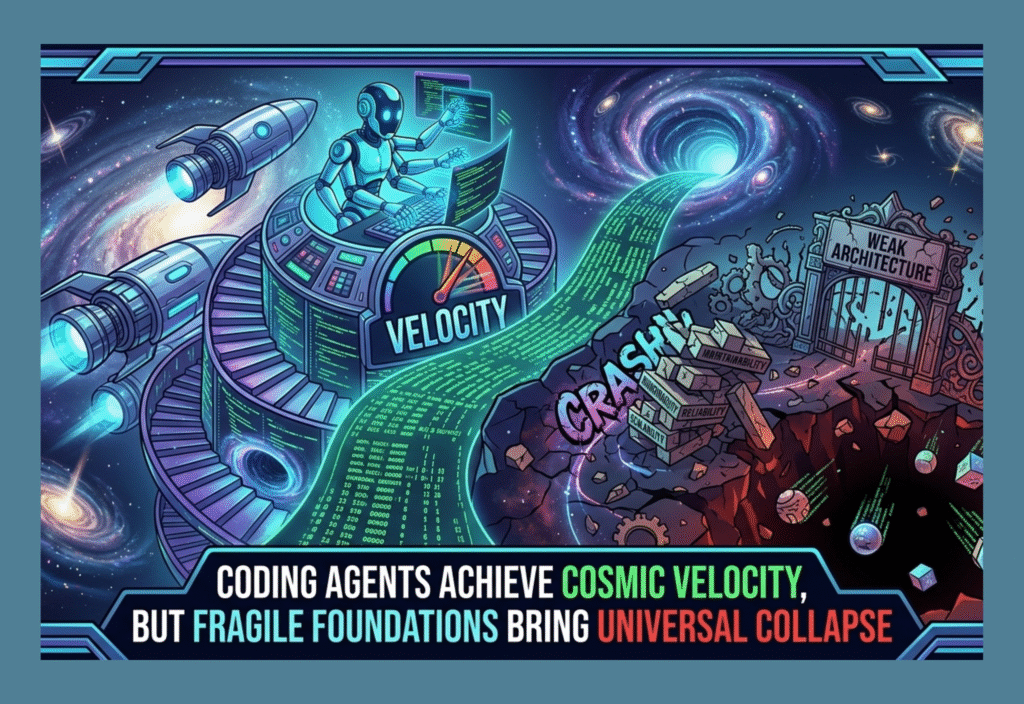
In recent years, the software development landscape has been transformed by AI-powered coding agents. These tools can generate code, optimize algorithms, and even debug programs at speeds far exceeding that of human developers. Companies are increasingly adopting them to accelerate development cycles, reduce costs, and improve productivity. However, this surge in speed brings a critical warning: coding agents cannot compensate for weak software architectures. In fact, poorly designed architectures can lead to catastrophic failures that even the fastest coding agent cannot fix. Understanding this balance between speed and stability is essential for anyone involved in modern software development.
The Rise of Coding Agents
AI-driven coding agents have evolved from simple autocomplete tools to sophisticated systems capable of writing functional code from natural language instructions. Tools like these are not limited to generating boilerplate code; they can handle complex logic, interface with APIs, and suggest improvements for existing codebases.
For example, a coding agent can:
-
Write unit tests automatically for new functions
-
Generate database queries optimized for performance
-
Refactor legacy code to align with current standards
-
Detect syntax errors and suggest fixes before code execution
These capabilities save enormous amounts of time. Tasks that would take developers hours or days to complete can now be executed in minutes. For startups trying to launch products quickly, or enterprises trying to maintain continuous delivery pipelines, coding agents offer a tempting shortcut.
But here lies the problem: while coding agents excel at speed, they are only as effective as the architecture that supports the code. A weak or poorly planned architecture can turn a small error into a system-wide failure.
Why Architecture Matters More Than Speed
Software architecture is the backbone of any application. It defines how components interact, how data flows, and how scalable, secure, and maintainable the system is. A strong architecture provides resilience, enabling software to evolve and handle increasing loads without collapsing.
Weak architectures, however, introduce significant risks:
-
Brittle Systems: When components are tightly coupled, a minor change in one module can break others unexpectedly. Coding agents may produce code quickly, but they cannot anticipate cascading failures in fragile architectures.
-
Poor Scalability: Fast code generation cannot solve underlying performance bottlenecks. Applications built on a weak architecture may perform well under small loads but fail dramatically under high traffic.
-
Security Vulnerabilities: Speed often comes at the cost of thorough validation. Without proper architectural design, even the most secure code snippets generated by AI can leave critical backdoors open.
-
Maintenance Challenges: Future updates and feature additions become increasingly risky and time-consuming when the architecture lacks clarity and modularity.
In short, no matter how advanced coding agents become, they cannot replace solid architectural planning.
Case Studies in Architectural Failure
Several high-profile software failures demonstrate the dangers of prioritizing speed over architecture:
1. Web Application Outages
During major online events, some rapidly deployed web applications crashed due to inadequate load balancing and weak backend structures. Even though the code itself was functional, the system could not handle the traffic surge, leading to downtime and customer dissatisfaction.
2. Startups Scaling Too Fast
Some startups leveraged coding agents to accelerate product development but neglected architectural planning. When user numbers grew, the systems could not scale. Modules that worked fine in small tests suddenly failed under real-world conditions. This mismatch between fast development and weak infrastructure caused project delays and financial losses.
3. Security Breaches
Applications developed under tight deadlines without robust architecture oversight often became targets for cyberattacks. AI-generated code may include secure algorithms, but without proper authentication, encryption, and error handling integrated into the architecture, the system remains vulnerable.
4. Technical Debt Accumulation
Rapid coding often leads to technical debt. When coding agents are used without architectural discipline, teams accumulate poorly structured code that becomes increasingly difficult to maintain. Over time, fixing or extending these systems consumes more resources than the initial development saved.
Balancing Speed and Strength
To harness the benefits of coding agents without risking system stability, organizations must prioritize architecture alongside automation. Here are some best practices:
1. Adopt Proven Design Patterns
Design patterns provide tested solutions to common architectural problems. Using patterns like MVC (Model-View-Controller), Singleton, or Observer ensures modularity, reusability, and maintainability. Coding agents can generate code faster, but design patterns provide the structural blueprint that prevents system-wide failures.
2. Emphasize Modular Architecture
Breaking applications into independent, loosely coupled modules allows coding agents to work effectively without creating fragile dependencies. This approach simplifies debugging, testing, and future development while reducing the risk of cascading failures.
3. Implement Continuous Testing and Monitoring
Automated code generation must be paired with rigorous testing and monitoring pipelines. Unit tests, integration tests, and load tests catch errors early, ensuring that the speed of coding does not compromise reliability. Monitoring in production environments helps identify bottlenecks before they escalate into system-wide failures.
4. Document Standards and Conventions
Even AI-generated code must adhere to coding standards and architectural guidelines. Clear documentation ensures that future developers understand the system, reducing the risk of errors and inefficiencies.
5. Plan for Scalability and Security
Coding agents can help implement individual features quickly, but teams must anticipate future growth and security needs. Architectural planning should include database optimization, caching strategies, encryption, and user authentication mechanisms to build robust systems.
The Role of Human Oversight
While AI coding agents are powerful, human judgment remains critical. Architects and senior developers provide the foresight to anticipate scalability issues, design weaknesses, and security risks. Their role is not to replace coding agents but to guide them. By combining human expertise with AI-driven speed, teams can achieve a balance between rapid development and resilient systems.
The Future of AI-Driven Development
As AI evolves, coding agents may become more capable of understanding and optimizing architecture themselves. Advanced models could detect bottlenecks, recommend better data structures, and even refactor code to align with best architectural practices. However, until such capabilities are fully realized, human-led architectural oversight remains indispensable.
The takeaway is clear: speed is not a substitute for stability. Coding agents can accelerate development, but weak architectures amplify failure. Organizations that succeed in the next decade will be those that combine the efficiency of AI with the rigor of sound architectural design.
Conclusion
In software development, coding agents represent a leap forward in speed, efficiency, and productivity. They reduce repetitive work, enhance consistency, and enable rapid iteration. Yet, the value of fast code is limited if it is built upon weak foundations. A poorly designed architecture can turn even the most sophisticated AI-generated code into a liability.
The key to success lies in balance: leverage coding agents for speed, but never compromise on architecture. Invest in modular design, adopt proven patterns, enforce standards, and integrate thorough testing. With this approach, organizations can enjoy the best of both worlds: the power of AI-driven coding and the resilience of a strong, scalable architecture.