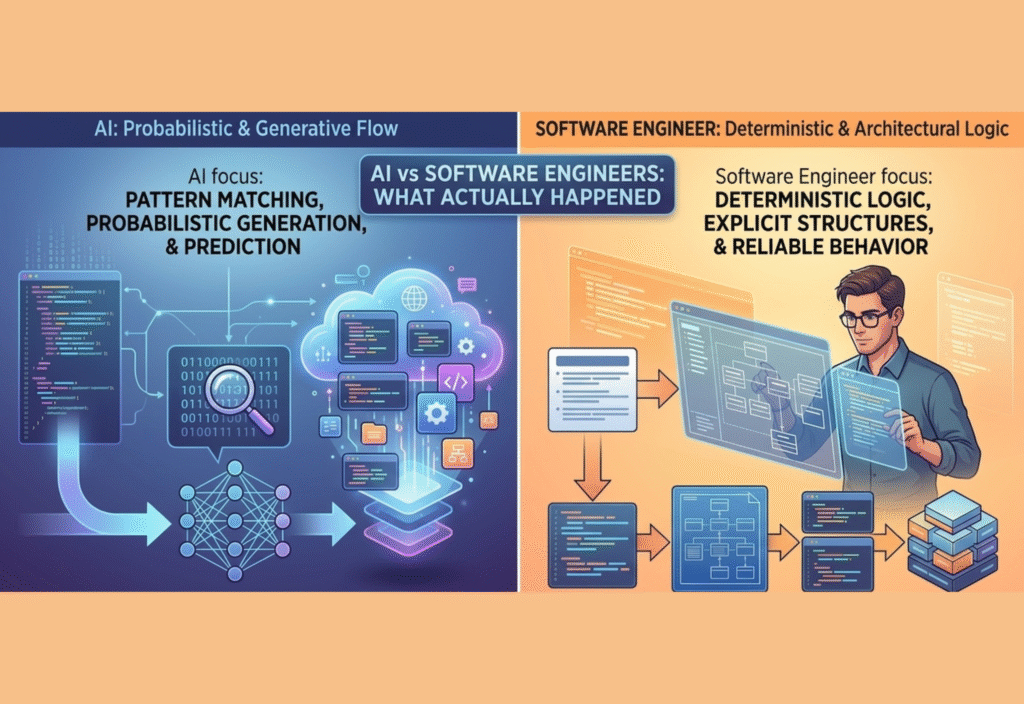
The conversation around AI vs Software Engineers has dominated technology discussions in recent years. With AI tools now capable of generating code, debugging programs, suggesting optimizations, and even designing software architectures, many have asked whether human engineers are at risk. Headlines often dramatize the idea that AI might replace programmers entirely. The reality, however, is more nuanced. In practice, AI is augmenting human engineers, allowing them to focus on complex problem-solving, creativity, and innovation rather than repetitive coding tasks.
This article explores the evolution of AI in software development, how it has impacted the roles of engineers, real-world examples of AI integration, the skills modern engineers need, and what the future of software development looks like.
The Evolution of AI in Software Development
Automation in software development is not new. Early tools like code auto-completion, syntax highlighting, and macros allowed developers to work faster but did not fundamentally change their role. These tools reduced errors and improved productivity, but creativity and design still depended entirely on human engineers.
The real shift came with machine learning (ML) and natural language processing (NLP). Modern AI tools like OpenAI’s ChatGPT, GitHub Copilot, and DeepMind’s AlphaCode can generate code, debug problems, and even design solutions from high-level descriptions.
AI can now:
-
Generate multi-line code from natural language instructions
-
Suggest optimizations and performance improvements
-
Detect logical errors and potential security vulnerabilities
-
Assist in algorithm and system design
Despite these capabilities, AI still struggles with context-specific requirements, project-specific constraints, and creative solutions. Human engineers remain indispensable. This demonstrates that AI vs Software Engineers is not a competition but a collaborative evolution.
How AI vs Software Engineers Roles Are Changing
The integration of AI into software engineering has transformed the roles engineers play. Instead of replacing humans, AI is augmenting their abilities, allowing them to focus on high-value tasks.
1. Rapid Prototyping
AI tools can quickly generate functional prototypes, allowing engineers to experiment with ideas faster than ever. Developers no longer need to spend hours writing repetitive boilerplate code.
Example: A startup developing a fintech application can use AI to generate authentication, payment gateway integration, or dashboard templates. Engineers refine these outputs, saving time and reducing errors.
2. Debugging and Error Detection
Debugging is one of the most tedious aspects of software development. AI now helps identify syntax errors, logical issues, and security vulnerabilities. Advanced AI tools even provide explanations and suggested fixes, reducing time spent on repetitive tasks and allowing engineers to focus on critical optimization and architecture design.
3. Documentation and Knowledge Sharing
Documentation is essential for collaboration and maintainability, but it is often a time-consuming task. AI can generate comments, API documentation, and summaries of large codebases, allowing engineers to focus on core development and problem-solving.
4. Collaborative Problem-Solving
AI tools act as “co-pilots” for engineers, suggesting algorithms, approaches, and potential solutions. Engineers review these suggestions, apply context-specific logic, and integrate them into projects. This demonstrates that AI vs Software Engineers is a collaboration, not a rivalry.
Debunking the Myth: AI vs Software Engineers Replacement
Despite fears in the media, AI is not replacing engineers. Software development requires human expertise for:
-
Strategic planning and system design
-
Collaboration with cross-functional teams
-
Ethical oversight and compliance
-
Creative problem-solving and innovation
Human engineers remain essential for evaluating AI outputs, ensuring quality, and guiding projects toward business goals. In other words, engineers are AI-augmented problem solvers, not obsolete coders.
Real-World Examples of AI in Development
GitHub Copilot
GitHub Copilot integrates into IDEs and provides real-time coding suggestions. Developers report that Copilot reduces repetitive coding tasks by 30–40%, allowing more time for architecture, testing, and creative solutions.
DeepMind AlphaCode
AlphaCode focuses on competitive programming, generating multiple solutions to algorithmic challenges. Engineers still evaluate, refine, and integrate the best approaches, showing the collaborative nature of AI vs Software Engineers.
Microsoft and AI Integration
Microsoft integrates AI into platforms like Visual Studio and Azure, helping engineers automate repetitive tasks, analyze large datasets, and optimize cloud-based applications. Teams report faster development cycles and more efficient collaboration.
Startups and Small Businesses
AI allows smaller teams to develop products faster without extensive resources. While AI generates boilerplate code or prototypes, human engineers handle customization, integration, and quality assurance, demonstrating that AI enhances rather than replaces engineers.
The Skills Engineers Need in the AI Era
AI has shifted the skills required for modern software engineering. Traditional coding skills are still essential, but engineers now need additional competencies:
-
AI literacy – Understanding AI capabilities, limitations, and integration methods
-
Problem decomposition – Breaking complex projects into manageable parts that AI can assist with
-
Critical evaluation – Reviewing AI-generated code for correctness, security, and efficiency
-
Ethical and secure coding – Ensuring AI outputs are safe, unbiased, and compliant
-
Collaboration – Working effectively with AI tools and multidisciplinary teams
Engineers who adopt these skills thrive in an AI-driven development environment, while those who rely solely on traditional coding may face challenges.
Challenges of AI in Software Development
While AI has many benefits, it also introduces risks:
-
Over-reliance on AI: Blindly accepting AI outputs can introduce errors
-
Bias and security risks: AI trained on historical code may perpetuate vulnerabilities or biased solutions
-
Job shifts: Engineers now need AI collaboration skills in addition to coding
-
Ethical concerns: AI-generated code must follow privacy, ethical, and legal standards
Companies must adopt AI responsibly, pairing automation with human oversight to maximize benefits and minimize risks.
Industry Adoption and Trends
AI is now a staple in large corporations and startups alike. Key trends include:
-
Cloud-based AI coding assistants: Platforms like GitHub Copilot and Microsoft IntelliCode are widely used in enterprise environments
-
Algorithmic optimization: AI helps engineers test multiple solutions quickly and select the most efficient
-
Integration with DevOps: AI automates testing, deployment, and monitoring processes
-
Data-driven development: AI analyzes code usage patterns, predicting bottlenecks and performance issues
These trends show that AI vs Software Engineers is increasingly about teamwork, not replacement.
The Future: Collaboration Over Competition
The future of software development will revolve around collaboration between AI and human engineers. AI accelerates repetitive tasks and provides suggestions, while humans ensure creativity, ethics, and business alignment.
New roles are emerging, such as:
-
AI-integrated software architect
-
AI-assisted QA engineer
-
AI ethics and governance specialist
-
Human-AI interaction designer
These roles highlight that engineers who embrace AI will lead the next wave of innovation.
Conclusion
The story of AI vs Software Engineers is not one of competition but evolution. AI augments human capabilities by automating routine work, accelerating development, and assisting in problem-solving. Engineers remain vital for creativity, decision-making, and ethical oversight.
The software industry’s future will feature a collaborative ecosystem, where humans and AI work together to produce better, faster, and more innovative software. Engineers who embrace this partnership will not only survive but thrive in the AI-augmented era.