Artificial intelligence is rapidly transforming industries across the world. From healthcare and finance to transportation and digital services, AI-driven technologies are enabling smarter decision-making and more efficient systems. However, as AI applications grow in complexity and scale, traditional single-model architectures often struggle to meet performance demands. To overcome these challenges, researchers and developers are increasingly adopting multi-agent systems (MAS).
A multi-agent system consists of multiple intelligent agents working together to perform tasks, make decisions, and solve complex problems. Instead of relying on a single centralized AI model, tasks are distributed among specialized agents that collaborate and communicate with each other. This architecture offers improved scalability, flexibility, and reliability, making it an ideal approach for building large-scale AI solutions.
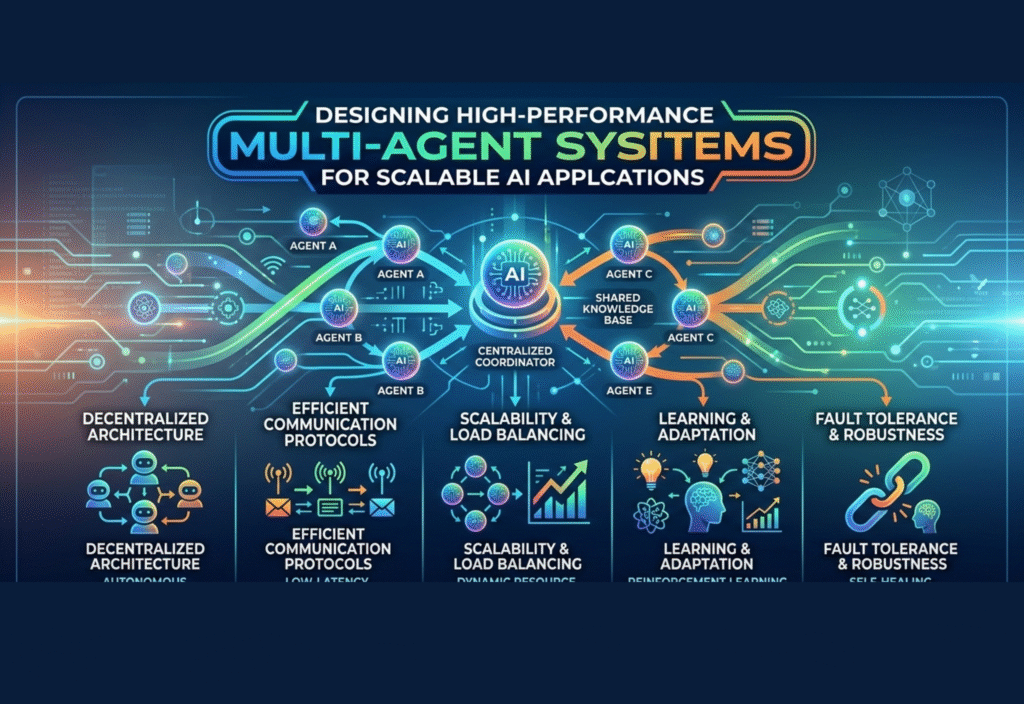
Designing high-performance multi-agent systems for scalable AI applications requires thoughtful architecture, efficient communication protocols, and robust coordination mechanisms. This article explores the principles, architecture strategies, challenges, and best practices for developing efficient multi-agent systems that can operate effectively at scale.
Understanding the Concept of Multi-Agent Systems
A multi-agent system is a network of autonomous agents that interact with each other and with their environment. Each agent is capable of perceiving information, processing data, making decisions, and performing actions to achieve specific objectives.
Agents in a multi-agent system can operate independently but often collaborate to accomplish shared goals. They can also compete, negotiate, or coordinate depending on the design of the system. The distributed nature of these agents allows complex problems to be broken into smaller tasks that can be handled more efficiently.
Unlike traditional centralized AI systems, multi-agent architectures allow decision-making to occur at multiple levels. This distributed intelligence improves system resilience and allows applications to adapt to changing conditions in real time.
The Importance of Scalability in AI Systems
As AI applications expand, scalability becomes one of the most critical design requirements. Large-scale AI systems must be capable of handling growing volumes of data, increasing numbers of users, and complex operational workflows.
Scalability challenges often include:
-
Increased computational demand
-
Large data processing requirements
-
Real-time decision-making needs
-
High system availability requirements
Multi-agent systems address these challenges by distributing tasks among multiple agents. Instead of overloading a single processing unit, workloads are divided and handled simultaneously by specialized agents.
This approach allows systems to scale horizontally by adding new agents without redesigning the entire architecture. As a result, multi-agent systems provide a practical foundation for building large-scale AI infrastructures.
Key Characteristics of High-Performance Multi-Agent Systems
To achieve optimal performance, multi-agent systems must exhibit several important characteristics.
Autonomy
Agents should be able to operate independently and make decisions without constant supervision. Autonomous agents can react quickly to environmental changes and maintain system efficiency.
Collaboration
Agents must work together to achieve common objectives. Collaboration requires well-defined communication protocols and coordination mechanisms.
Adaptability
High-performance systems must be able to adapt to new situations, changing workloads, and evolving requirements. Adaptive agents can learn from data and modify their behavior accordingly.
Robustness
Distributed systems must remain operational even if individual agents fail. Robust architectures include fault tolerance and redundancy to maintain stability.
Efficiency
Agents should perform tasks efficiently without consuming excessive computational resources. Efficient algorithms and optimized communication are essential for maintaining performance at scale.
Architectural Approaches for Multi-Agent Systems
The architecture of a multi-agent system plays a crucial role in determining its scalability and performance. Several architectural models are commonly used in AI applications.
Centralized Architecture
In centralized architectures, a central controller manages all agents and coordinates their activities. The controller assigns tasks, collects data, and makes key decisions.
While this model simplifies management and coordination, it introduces a single point of failure. If the central controller fails, the entire system may stop functioning. Additionally, centralized architectures often struggle to scale as the number of agents increases.
Decentralized Architecture
Decentralized systems eliminate the need for a central controller. Each agent operates independently and communicates directly with other agents when necessary.
This approach offers several advantages, including improved scalability and increased resilience. If one agent fails, other agents can continue functioning without interruption.
However, decentralized architectures require sophisticated coordination mechanisms to prevent conflicts and ensure efficient collaboration.
Hybrid Architecture
Hybrid architectures combine elements of both centralized and decentralized models. A central coordinator may provide guidance or high-level task allocation, while individual agents retain autonomy for decision-making and execution.
This architecture balances control and flexibility, making it suitable for many real-world AI applications.
Communication Strategies in Multi-Agent Systems
Communication is the backbone of multi-agent collaboration. Agents must exchange information efficiently to coordinate tasks and maintain system stability.
Common communication methods include:
Message Passing
Agents communicate by sending structured messages containing relevant information. Message passing allows agents to share data, request assistance, or report results.
Event-Driven Communication
In event-driven systems, agents respond to specific events or triggers within the environment. This approach reduces unnecessary communication and improves efficiency.
Shared Knowledge Bases
Agents may access shared databases or knowledge repositories to retrieve information and update system state.
Efficient communication protocols are essential to prevent network congestion and maintain system performance.
Task Allocation and Coordination
One of the most important aspects of designing multi-agent systems is determining how tasks are distributed among agents.
Static Task Allocation
In static allocation, tasks are assigned to agents based on predefined roles. While this approach is simple, it may not adapt well to changing workloads.
Dynamic Task Allocation
Dynamic allocation allows tasks to be assigned based on real-time conditions. Agents can request tasks, negotiate responsibilities, or redistribute workloads when necessary.
Market-Based Coordination
Some multi-agent systems use economic models where agents bid for tasks based on their capabilities and available resources. This approach encourages efficient task distribution.
Effective coordination mechanisms ensure that agents collaborate efficiently without duplicating work or creating bottlenecks.
Performance Optimization Techniques
Designing high-performance multi-agent systems requires continuous optimization.
Load Balancing
Workloads should be distributed evenly across agents to prevent performance bottlenecks.
Parallel Processing
Agents should perform tasks simultaneously whenever possible. Parallel processing significantly improves system efficiency.
Resource Management
Efficient management of memory, processing power, and network bandwidth is essential for maintaining scalability.
Monitoring and Feedback
Continuous monitoring allows developers to detect performance issues and optimize system behavior. Feedback loops enable agents to learn from previous actions and improve decision-making.
Security and Trust in Multi-Agent Systems
Security is a critical concern in distributed AI systems. Agents must be able to trust the information they receive and verify the integrity of communication channels.
Security measures may include:
-
Authentication protocols
-
Secure communication channels
-
Data encryption
-
Trust management systems
Ensuring security helps prevent malicious behavior and protects sensitive information within the system.
Real-World Applications of Multi-Agent Systems
Multi-agent systems are widely used across various industries due to their scalability and flexibility.
Autonomous Transportation
Self-driving vehicles rely on multiple AI agents responsible for perception, navigation, safety monitoring, and route planning.
Smart Cities
Urban management systems use multi-agent networks to optimize traffic flow, energy consumption, and public services.
Robotics and Manufacturing
Collaborative robots in manufacturing environments coordinate tasks using multi-agent communication frameworks.
Healthcare Systems
AI agents can assist in patient monitoring, diagnosis support, and hospital resource management.
Financial Services
In financial markets, multi-agent systems analyze market trends, detect fraud, and optimize trading strategies.
These applications demonstrate how distributed intelligence can improve efficiency and decision-making across complex environments.
Challenges in Building Scalable Multi-Agent Systems
Despite their advantages, multi-agent systems present several technical challenges.
Complexity of Coordination
Managing interactions between large numbers of agents can become complex. Poor coordination may lead to conflicts or inefficient task distribution.
Communication Overhead
Excessive communication between agents can slow down the system and increase resource consumption.
System Stability
Maintaining stability in highly dynamic environments requires robust algorithms and continuous monitoring.
Debugging and Testing
Identifying errors in distributed systems can be difficult because issues may arise from interactions between multiple agents.
Addressing these challenges requires careful system design and thorough testing.
The Future of Multi-Agent AI Systems
The future of artificial intelligence is likely to rely heavily on multi-agent architectures. Advances in machine learning, distributed computing, and cloud technologies are making it easier to build sophisticated multi-agent systems.
Emerging trends include:
-
Autonomous collaborative AI networks
-
Self-learning agent ecosystems
-
Edge computing integration
-
AI-driven resource optimization
As these technologies continue to evolve, multi-agent systems will become increasingly powerful and capable of solving complex global challenges.
Conclusion
Designing high-performance multi-agent systems for scalable AI applications is a crucial step toward building the next generation of intelligent technologies. By distributing tasks across specialized agents, developers can create systems that are more flexible, resilient, and capable of handling large-scale workloads.
Successful multi-agent systems require well-designed architectures, efficient communication protocols, intelligent task allocation strategies, and robust security mechanisms. When these elements are implemented effectively, multi-agent systems can unlock powerful capabilities and drive innovation across industries.
As artificial intelligence continues to advance, multi-agent architectures will play an essential role in shaping the future of scalable and intelligent AI solutions.