
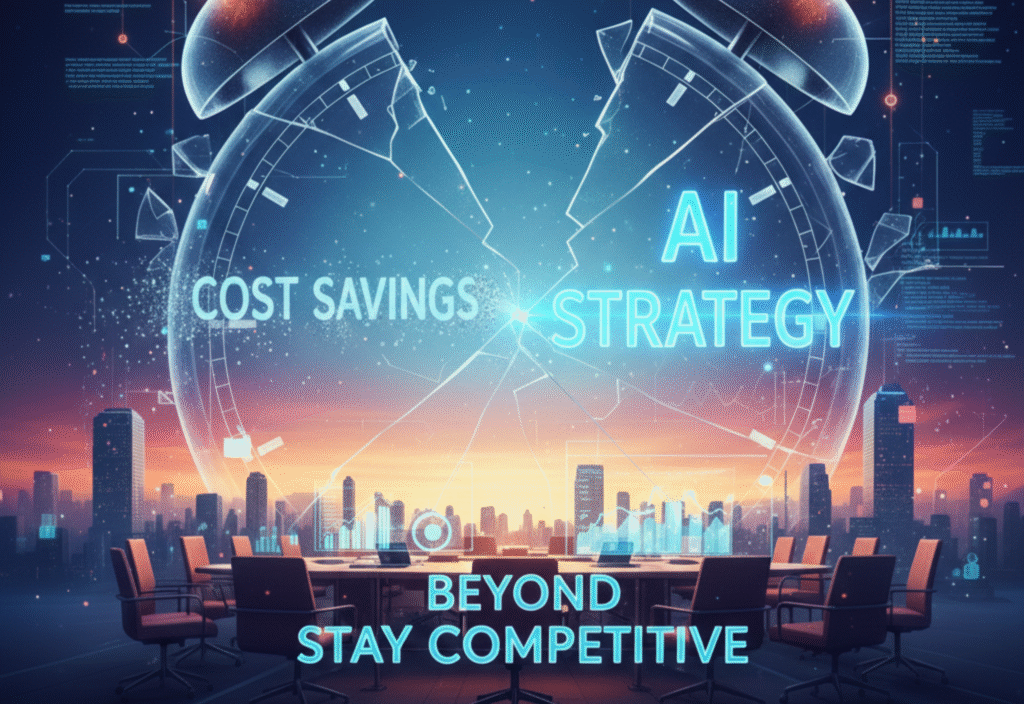
Artificial Intelligence (AI) has quickly become central to modern business strategy. However, many organizations still focus on cost savings alone. In contrast, Andrew Ng emphasizes that an AI strategy beyond cost savings is crucial. It helps companies stay competitive, foster innovation, and unlock new growth opportunities.
The Danger of a Cost-Centric AI Strategy
Many organizations initially implement AI to automate repetitive tasks, optimize operational efficiency, and reduce workforce costs. While these benefits are tangible, an exclusive focus on cost reduction can lead to several problems:
Short-term thinking – Companies may prioritize quick wins over long-term strategic benefits.
Missed innovation opportunities – AI has the potential to create new products, services, and business models, which are often overlooked if the primary goal is expense reduction.
Competitive stagnation – Competitors leveraging AI for growth, customer experience, or innovation will surpass those using it only for savings.
Andrew Ng warns that an AI strategy centered on cost-saving is “already dead” in the sense that it does not provide a sustainable competitive advantage.
AI as a Growth Engine
Instead of viewing AI merely as a tool to cut costs, companies should treat it as a strategic growth engine. This involves exploring areas where AI can:
Enhance customer experiences – AI-powered personalization, chatbots, and predictive analytics can improve engagement and satisfaction.
Drive new revenue streams – Companies can develop AI-driven products or services that generate additional income.
Support strategic decision-making – AI analytics can provide insights that guide business strategy, helping leaders make more informed choices.
For example, retail companies are using AI not just to optimize inventory but also to predict trends, personalize marketing campaigns, and recommend products in real time. Similarly, healthcare organizations employ AI not only to streamline administrative tasks but also to improve patient outcomes through predictive diagnostics and treatment recommendations.
Building an Effective AI Strategy
A forward-thinking AI strategy should integrate the following principles:
Focus on Impact, Not Just Efficiency – Evaluate AI initiatives based on their ability to create measurable business impact rather than solely on cost reduction.
Adopt a Product Mindset – Treat AI solutions as products that provide ongoing value, requiring continuous improvement, monitoring, and iteration.
Invest in Talent and Culture – Develop AI expertise in-house and foster a culture that encourages experimentation, learning, and adoption of AI insights.
Ethical and Responsible AI – Ensure that AI systems operate transparently, fairly, and securely, maintaining trust with customers and stakeholders.
Andrew Ng frequently emphasizes the importance of “AI as a lever for transformation” — using AI to fundamentally reshape how businesses operate and deliver value.
Case Studies of AI-Driven Success
Amazon – Beyond automating warehouses, Amazon uses AI to optimize pricing, predict consumer demand, and personalize shopping experiences, significantly increasing revenue and customer loyalty.
Netflix – AI algorithms recommend content to viewers, enhancing engagement and retention, which is central to the company’s growth strategy.
Healthcare Startups – Many startups leverage AI for drug discovery and diagnostics, creating entirely new avenues for revenue and innovation.
These examples demonstrate that when AI is applied strategically, it becomes a source of competitive advantage, rather than merely a tool to reduce expenses.
The Future of AI in Business Strategy
As AI continues to evolve, the distinction between companies that succeed and those that fall behind will hinge on how they integrate AI into their core strategy. Cost savings alone will not ensure relevance in a market where AI can redefine products, services, and customer expectations. Companies must embrace AI as a means of innovation, differentiation, and value creation.
Andrew Ng’s warning serves as a wake-up call: organizations must elevate their AI strategies from efficiency-focused initiatives to transformative efforts that fuel growth, customer satisfaction, and competitive advantage.
Conclusion
Focusing solely on cost savings through AI is a narrow approach that limits potential and risks falling behind more innovative competitors. As Andrew Ng highlights, companies must think bigger, using AI to enhance decision-making, improve customer experiences, and generate new business opportunities. By adopting a strategic, impact-oriented AI mindset, organizations can unlock the full potential of this transformative technology and secure a sustainable competitive advantage in the rapidly evolving digital landscape.