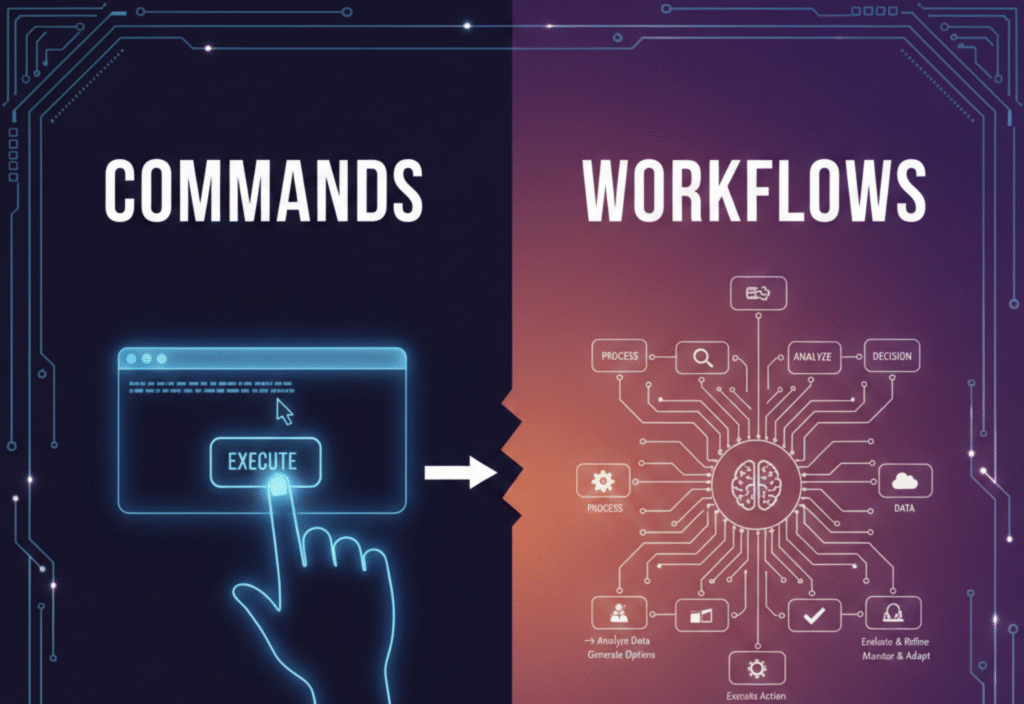
Artificial Intelligence (AI) has evolved rapidly over the past decade. Early AI systems were designed to execute specific commands—simple instructions given by humans to perform tasks. These systems were effective for structured, predictable problems but struggled with complexity, scalability, and real-world variability.
Today, a new paradigm is emerging: AI systems thinking in workflows rather than individual commands. This approach allows AI to coordinate multiple tasks, adapt to changing conditions, and integrate seamlessly with human and digital processes. It represents a significant shift in how AI operates and impacts modern technology and business.
From Command-Based AI to Workflow-Oriented AI
Command-Based AI
Traditional AI systems rely heavily on human instructions. For example:
“Identify all spam emails”
“Predict the next product a customer will buy”
While useful, these systems are linear and limited. They perform well for well-defined tasks but struggle when tasks require multiple steps, context, or integration with other systems.
Workflow-Oriented AI
In contrast, workflow-oriented AI is designed to understand processes rather than isolated commands. Instead of executing a single instruction, it can:
Sequence tasks automatically
Handle dependencies between steps
Adapt when conditions change
Coordinate with other AI or human agents
This shift allows AI to operate more autonomously and intelligently, handling complex processes without continuous human intervention.
Key Benefits of Workflow-Oriented AI
Scalability
Workflow-based AI can manage multiple tasks simultaneously, making it ideal for enterprise applications. Businesses can automate entire processes rather than individual actions.Flexibility and Adaptability
Workflows can adjust in real-time. If one step fails, the AI can reroute the process or alert humans, ensuring continuity.Improved Collaboration with Humans
Workflow-oriented AI complements human teams. It can take care of repetitive or complex sequences while humans focus on strategic decisions.Enhanced Decision-Making
By understanding entire processes, AI can make context-aware decisions, rather than isolated, command-specific outputs.Integration with Multiple Systems
Workflow AI can coordinate between software, databases, sensors, and IoT devices. This integration is crucial for industries like logistics, healthcare, and finance.
Real-World Applications
1. Supply Chain Management
AI can manage the end-to-end supply chain by monitoring inventory, predicting demand, and coordinating shipping without constant human commands.
2. Healthcare
Workflow-oriented AI can schedule appointments, triage patient data, and provide treatment recommendations while integrating lab results and hospital databases.
3. Customer Service
Instead of just responding to individual inquiries, AI can manage the full workflow of a customer issue—from ticket creation to resolution—while learning from patterns to improve responses.
4. IT Operations
AI-driven orchestration tools can manage infrastructure tasks like server scaling, patch deployment, and network monitoring as a single coordinated workflow rather than separate commands.
How Workflow-Oriented AI Works
Workflow AI relies on several components:
Task Sequencing: Defines the order of steps and dependencies
Decision Nodes: Allows branching based on conditions and context
Integration APIs: Connects multiple systems, databases, and tools
Monitoring & Feedback: Tracks workflow progress and adapts to changes
These components allow AI to operate like a digital process manager, capable of handling complex, multi-step operations efficiently.
The Future of AI in Workflows
The shift to workflow-oriented AI is still in its early stages but growing rapidly. As businesses demand more intelligent, autonomous systems, AI will increasingly coordinate processes across departments, systems, and even industries.
Key trends include:
Agentic AI: AI agents that manage workflows autonomously
AI Orchestration Platforms: Tools that let AI coordinate multiple tasks and systems
Hybrid Human-AI Teams: Workflow AI enhances human capabilities rather than replacing them
By focusing on workflows instead of commands, AI moves closer to real-world problem-solving and enterprise-grade efficiency.
Conclusion
The evolution from command-based AI to workflow-oriented AI marks a major milestone in the development of intelligent systems. This approach allows AI to handle complex tasks, adapt to changing conditions, and collaborate effectively with humans and other systems.