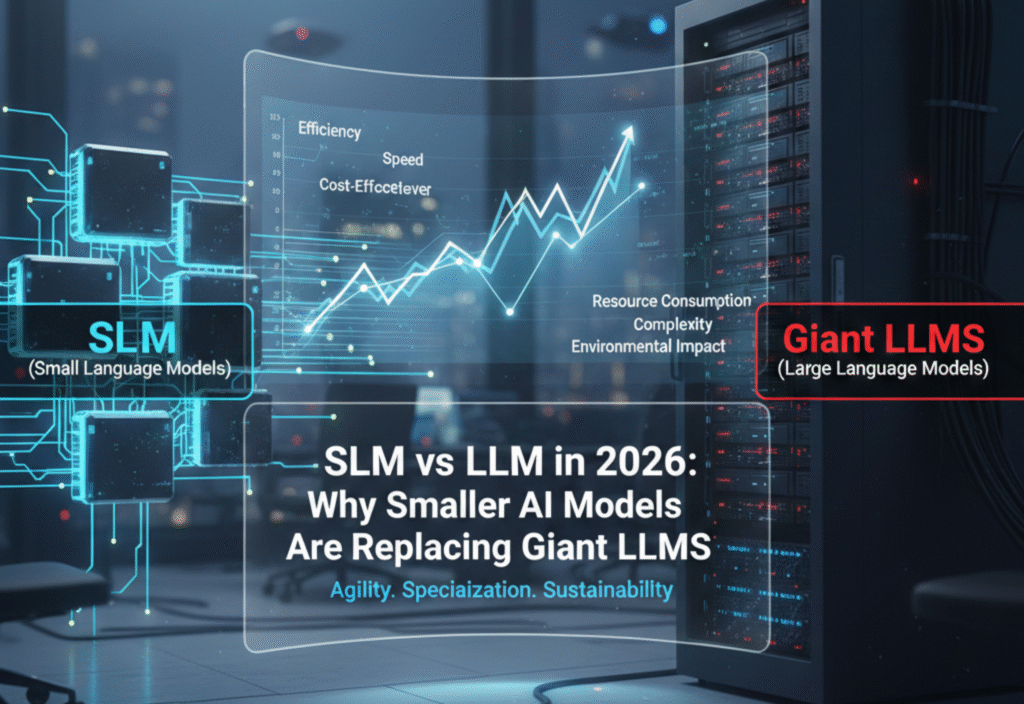
SLM vs LLM in 2026 has become one of the most important debates in artificial intelligence as organizations rethink how AI models are built and deployed. While large language models once dominated the industry with massive scale and general intelligence, smaller AI models are now gaining traction due to lower costs, faster performance, and better real-world efficiency. This shift marks a new phase in AI adoption where practicality matters more than size.
Enterprises, startups, and even governments are increasingly choosing smaller, more efficient AI models over giant LLMs—and for good reason. Cost efficiency, speed, privacy, and task specialization are redefining what “better AI” truly means.
This shift does not signal the end of LLMs, but it does represent a strategic evolution in how AI is built, deployed, and monetized.
SLM vs LLM in 2026: Understanding LLMs and Their Power at a Price
Large Language Models (LLMs), such as GPT-style architectures, were designed to be general-purpose intelligence engines. Trained on trillions of tokens and hundreds of billions of parameters, LLMs excel at:
Open-ended reasoning
Creative writing and natural conversation
Cross-domain knowledge
Complex problem-solving
However, this power comes with significant trade-offs.
Key Limitations of LLMs in 2026
High Operational Costs
Running LLMs requires expensive GPUs, high energy consumption, and continuous infrastructure scaling, making them costly for long-term use.
Latency Issues
Real-time applications often struggle with response delays, especially in edge computing and mobile environments.
Privacy and Compliance Risks
Sending sensitive data to cloud-based LLMs introduces regulatory, security, and compliance challenges.
Overkill for Narrow Tasks
Most business use cases do not require general intelligence—only precise, domain-specific outputs.
As AI adoption has matured, organizations are asking a critical question:
Do we really need giant models for every task?
What Are Small Language Models (SLMs)?
Small Language Models (SLMs) are compact, task-focused AI systems trained on curated datasets rather than the entire internet. They typically range from one million to a few billion parameters and are optimized for specific domains such as healthcare, finance, customer support, and IoT systems.
SLMs are not weaker by default—they are smarter by design.
SLM vs LLM in 2026: Why Smaller AI Models Are Replacing LLMs
1. Cost Efficiency at Scale
SLMs require fewer computational resources, lower cloud costs, and minimal energy consumption. For enterprises deploying AI across thousands of workflows, SLMs can reduce operational expenses by 60–90% compared to LLM-based systems.
2. Faster Inference and Real-Time Performance
In industries such as autonomous systems, financial trading, smart manufacturing, and customer support automation, milliseconds matter. SLMs deliver near-instant responses, making them ideal for real-time decision-making.
3. On-Device and Edge AI Deployment
Unlike LLMs, SLMs can run on smartphones, embedded devices, local servers, and private enterprise infrastructure. This enables offline AI, reduced latency, and stronger data sovereignty.
4. Better Data Privacy and Compliance
With stricter regulations like GDPR, the EU AI Act, and data localization laws, organizations prefer AI models that keep data local. SLMs eliminate the need to transmit sensitive data to third-party cloud providers.
5. Task Specialization Beats General Intelligence
In SLM vs LLM in 2026, success is measured by accuracy, reliability, and relevance—not parameter count.
Examples include:
A legal SLM trained on case law outperforming general LLMs in legal analysis
A medical SLM delivering safer diagnostic support than generic chatbots
A fintech SLM providing more accurate fraud detection with fewer false positives
SLM vs LLM in 2026: A Practical Comparison
| Feature | LLMs | SLMs |
|---|---|---|
| Model Size | Extremely large | Compact and efficient |
| Cost | Very high | Low to moderate |
| Speed | Slower inference | Ultra-fast |
| Privacy | Cloud-dependent | Local-friendly |
| Customization | Complex | Easy |
| Best Use Case | General-purpose AI | Specialized AI |
Real-World Applications Driving the Shift
Enterprise Automation
Organizations use SLMs for HR screening, CRM automation, and internal knowledge assistants.
Healthcare
SLMs enable secure patient data analysis, clinical decision support, and accurate medical transcription.
Web 3.0 and Edge Computing
Decentralized applications prefer SLMs due to lower compute requirements, on-chain and off-chain AI compatibility, and reduced dependence on centralized servers.
Are LLMs Becoming Obsolete?
Absolutely not.
LLMs continue to dominate research, experimentation, creative content generation, multimodal AI systems, and advanced reasoning tasks. However, in production environments, SLMs are becoming the default choice, while LLMs act as foundational or supervisory models.
The future is not SLM or LLM—it is SLMs powered by LLM intelligence, distilled and fine-tuned for specific roles.
The Future of AI: Smaller, Smarter, and Strategic
By 2026, the AI industry has learned a crucial lesson:
bigger models are not always better models.
Efficiency, specialization, and responsible deployment now define AI success. Small Language Models represent a practical, scalable, and sustainable future—one where AI is accessible, affordable, and aligned with real-world needs.