
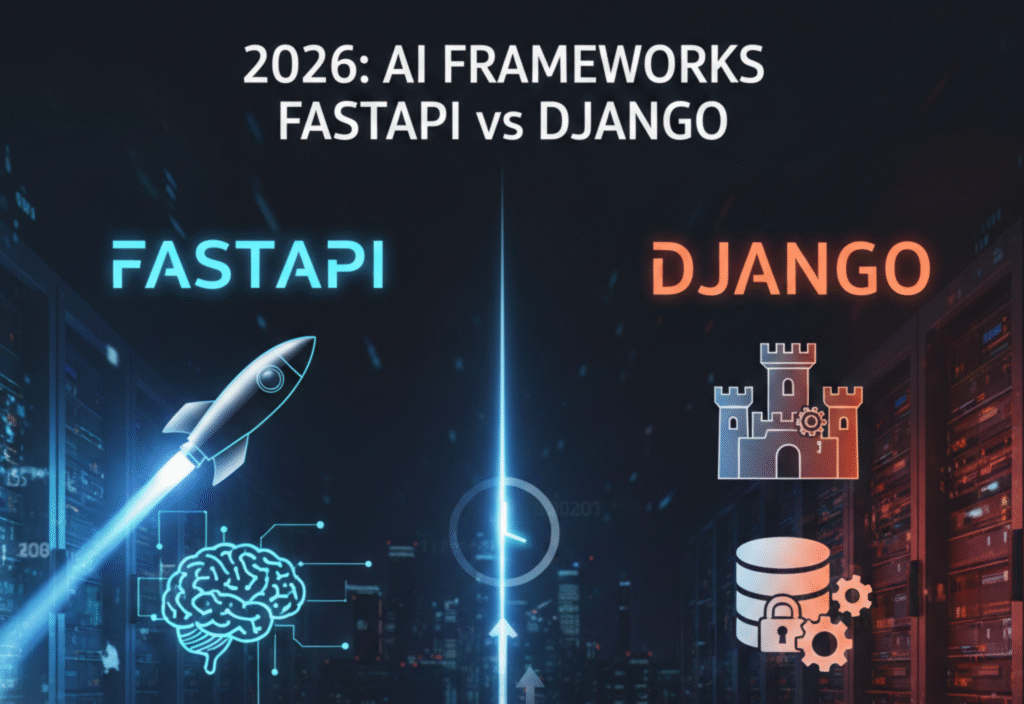
FastAPI vs Django 2026 is a common question among developers who build AI applications. In 2026, success in AI development depends on more than just accurate models. Developers must also deploy models quickly, handle real-time requests, and scale systems without problems. Therefore, choosing the right framework plays a major role in AI performance and reliability.
Today, AI-powered systems like chatbots, recommendation engines, fraud detection tools, and LLM-based APIs need fast responses and stable infrastructure. Because of this, developers often compare FastAPI and Django before starting an AI project.
FastAPI vs Django 2026: Overview of Both Frameworks
FastAPI
FastAPI is a modern Python framework that helps developers build fast APIs. It uses Python type hints, which makes code easier to read and maintain. Moreover, FastAPI is built on Starlette and Pydantic, which improves speed and data validation.
Most importantly, FastAPI supports asynchronous programming by default. As a result, it handles many AI inference requests at the same time. For this reason, AI startups and ML engineers widely use FastAPI.
Key Features of FastAPI (2026):
-
Async Support: Developers use
asyncandawaitto process multiple requests efficiently. -
Automatic Validation: Pydantic checks request and response data automatically.
-
Auto API Documentation: FastAPI creates Swagger and OpenAPI docs without extra setup.
-
High Speed: Its lightweight design helps reduce response time.
Django
Django is a powerful full-stack framework known for stability and security. Instead of focusing only on APIs, Django provides complete tools for web development. These tools include authentication, database management, and an admin dashboard.
Even in 2026, Django remains popular for large AI platforms. Especially when projects require complex databases and user roles, Django offers strong long-term support.
Key Features of Django (2026):
-
Full Web Framework: Django manages backend logic, templates, and databases together.
-
Strong ORM: Developers handle database queries easily and safely.
-
Built-in Security: Django protects applications from common attacks.
-
Large Community: Thousands of plugins help speed up development.
Performance Comparison: FastAPI vs Django 2026 for AI Applications
Performance matters a lot in AI applications. Therefore, let’s compare FastAPI vs Django 2026 from a practical AI point of view.
| Feature | FastAPI | Django |
|---|---|---|
| Async Handling | Built-in | Limited |
| Response Speed | Very fast | Moderate |
| Resource Usage | Lightweight | Heavier |
| Real-Time AI | Excellent | Average |
Verdict:
FastAPI performs better for real-time AI predictions. However, Django works well for AI systems that focus on dashboards and data management.
Integration with AI and Machine Learning Tools
FastAPI
FastAPI integrates easily with popular AI libraries. For example, developers use it with TensorFlow, PyTorch, scikit-learn, and ONNX. In addition, FastAPI allows teams to serve AI models through REST or gRPC APIs.
Because FastAPI handles async tasks smoothly, it works well for microservice-based AI systems. As a result, many companies choose FastAPI for production AI APIs.
Django
Django also supports AI integration, but developers often add extra tools. Usually, they use Django REST Framework to expose APIs. For heavy tasks, teams rely on Celery or background workers.
Therefore, Django fits better in AI platforms that need admin panels, reports, and user control instead of real-time inference.
Use Case Scenarios: FastAPI vs Django 2026
When to Choose FastAPI
-
Real-time AI prediction systems
-
AI chatbots and LLM APIs
-
High-traffic microservices
-
Recommendation engines
When to Choose Django
-
Full web applications with AI features
-
Admin dashboards for AI teams
-
AI systems with complex databases
-
Enterprise AI platforms
Community and Ecosystem in 2026
Both frameworks continue to grow in 2026. On one side, FastAPI attracts AI startups because of speed and simplicity. On the other side, enterprises trust Django for stability and security.