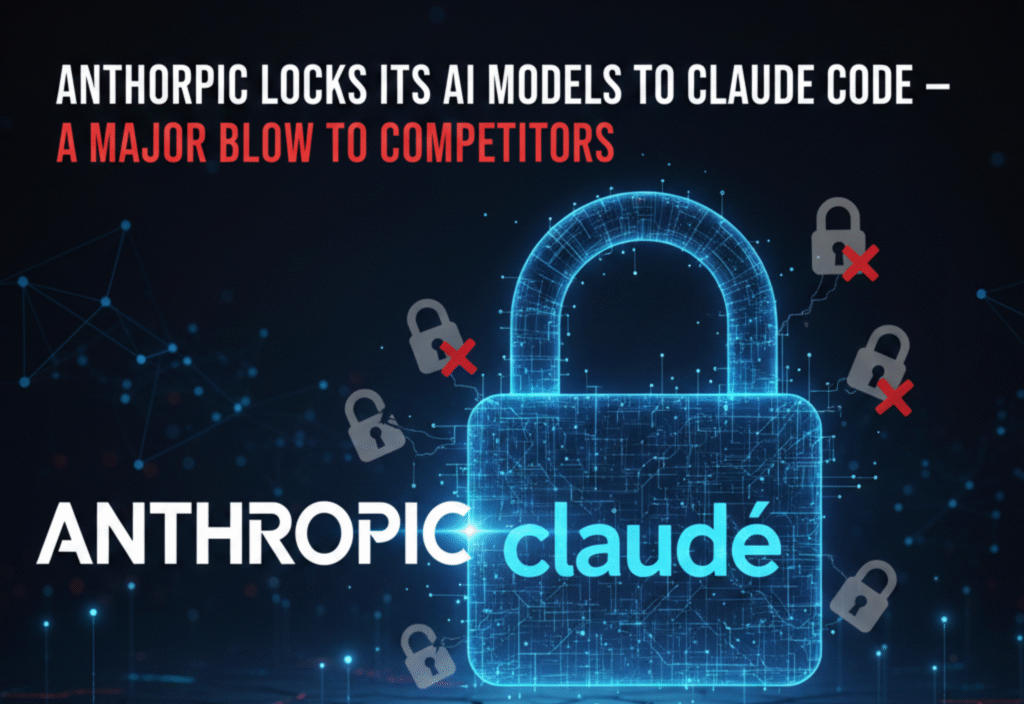
The AI industry is changing fast, and Anthropic has just made a bold move. The company has started restricting access to its most advanced AI models by tying them closely to Claude Code, its own developer environment. As a result, competitors and third-party developers are feeling the impact.
Instead of competing only on model quality, Anthropic is now focusing on platform control. This shift signals a new phase in the AI race—one where ecosystems matter more than standalone APIs.
What Is Claude Code?
Claude Code is Anthropic’s dedicated AI coding platform. It is designed to help developers write, understand, and improve code using Claude models in a tightly controlled environment.
In particular, Claude Code focuses on:
-
Writing and refactoring code
-
Understanding large codebases
-
Debugging and testing software
-
Supporting secure enterprise workflows
Because the platform is built around Claude from the ground up, Anthropic can fine-tune how the model behaves at every step.
What Does Locking the Models Mean?
Although Anthropic has not used the word “lock,” the effect is clear. Many advanced features are now available mainly inside Claude Code, not through general API access.
For example:
-
New model capabilities may arrive first—or only—inside Claude Code
-
API users may receive fewer features or slower updates
-
Certain tools work best when used within the platform
As a consequence, developers who rely on external tools may no longer get the same level of access.
Why Anthropic Chose This Strategy
1. Better Control Over Results
First of all, AI models depend heavily on how they are used. By controlling the full environment, Anthropic can reduce errors and improve consistency.
In addition, this approach helps:
-
Lower hallucination rates
-
Improve safety and reliability
-
Deliver predictable outputs for businesses
For enterprise customers, this level of control is especially valuable.
2. Strong Protection Against Competition
At the same time, AI models are becoming easier to replace. Many competitors now offer similar performance at lower costs.
Therefore, Anthropic is building a defensive moat. Once developers depend on Claude Code workflows, switching to another provider becomes harder.
3. Clear Business Advantages
From a business perspective, platforms generate more revenue than raw APIs. Because of this, Claude Code allows Anthropic to:
-
Offer premium subscriptions
-
Sell enterprise licenses
-
Bundle security and compliance features
As a result, Anthropic gains long-term customers rather than short-term API users.
Why Competitors Are Under Pressure
Big AI Players Must Respond
This move increases pressure on major AI companies:
-
OpenAI may push deeper GPT integrations into developer tools
-
Google could expand Gemini inside cloud and IDE products
-
Meta, despite open-source strength, may struggle with platform control
Clearly, the “API-only” strategy is losing ground.
Smaller Startups Face Bigger Risks
Meanwhile, startups that depend on Claude APIs are in a tougher position. They must now ask important questions:
-
Will they get access to the same model features?
-
Will pricing change over time?
-
Will Claude Code become a direct competitor?
Because of this uncertainty, many startups may rethink their dependencies.
Developer Reactions Are Mixed
Not surprisingly, the developer community is divided.
On one hand, supporters argue that:
-
Integrated tools produce better results
-
Safety improves in controlled environments
-
Innovation moves faster inside platforms
On the other hand, critics worry about:
-
Vendor lock-in
-
Reduced openness
-
Less experimentation across tools
In short, convenience is winning—but flexibility is shrinking.
A Growing Industry Pattern
Anthropic’s move fits a larger trend in tech. Over time, industries often shift from open tools to closed platforms.
For example:
-
Cloud providers moved from servers to ecosystems
-
Mobile apps shifted into app stores
-
Social media platforms locked users into networks
Likewise, AI is now following the same path.
What This Means Going Forward
For Developers
Developers should expect more AI-first platforms in the future. Because switching costs may rise, choosing tools carefully will matter more than ever.
At the same time, open-source alternatives may grow as a counterbalance.
For Businesses
Enterprises will focus less on raw model benchmarks and more on long-term vendor stability. In addition, contract negotiations may become harder as platforms gain power.
For the AI Market
Overall, competition is shifting. Instead of asking “Which model is smarter?” the real question becomes “Which platform controls the workflow?”
Final Thoughts
Anthropic’s decision to tie its strongest AI models to Claude Code marks a major turning point. This is not just a technical update—it is a strategic statement.