
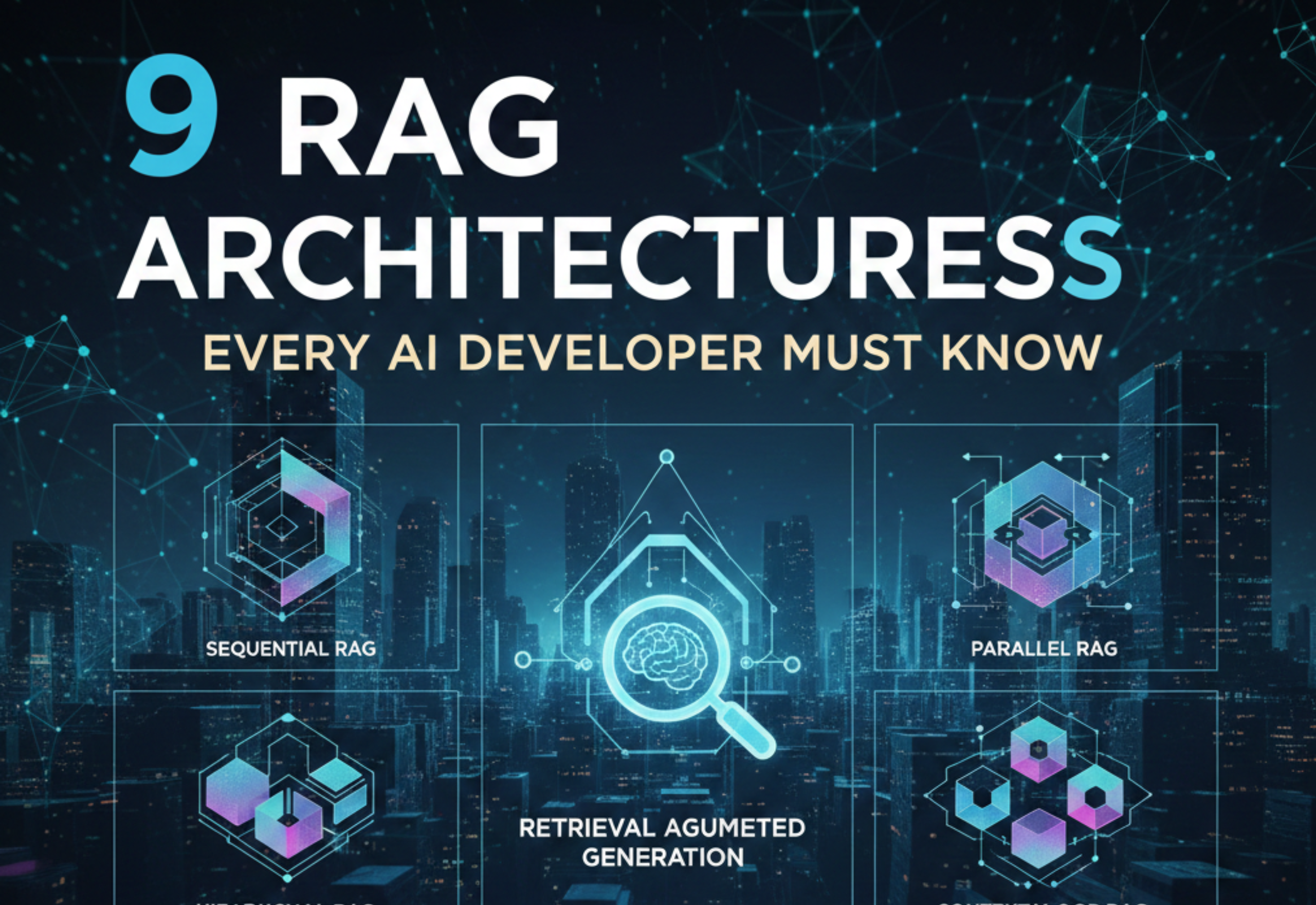
Retrieval-Augmented Generation (RAG) is rapidly transforming the way AI systems handle knowledge and generate responses. Unlike traditional generative AI models that rely solely on training data, RAG architectures combine retrieval mechanisms with generation models, enabling more accurate, context-aware, and up-to-date responses. This guide explores 9 RAG architectures every AI developer should understand, complete with practical examples and insights on implementation.
What is Retrieval-Augmented Generation (RAG)?
Before diving into architectures, let’s clarify the concept:
-
Retrieval: The system searches a database or document store for relevant information based on a query.
-
Generation: A generative AI model (like GPT) produces a response using the retrieved information as context.
The combination allows AI models to answer questions with real-world, up-to-date knowledge, even beyond their training data. This is essential for applications like chatbots, knowledge management, research assistants, and more.
Why RAG Architectures Matter in 2026
RAG architectures are crucial because:
-
Improved accuracy: Retrieval ensures that generated content is grounded in verified sources.
-
Scalability: They allow AI models to work with massive datasets without retraining.
-
Up-to-date information: Retrieval can pull real-time data from external sources.
-
Explainability: Some RAG models provide source references, improving trust.
Understanding the various architectures will help you design robust AI systems for multiple domains.
1. Basic RAG (Single-Stage Retrieval + Generation)
Structure:
-
Input query → Retrieve top-k documents → Feed retrieved documents + query to a generator.
Example:
-
Query: “Latest AI tools for 2026.”
-
Retriever fetches the top 5 documents from a knowledge base.
-
Generator (e.g., GPT-4) produces a concise summary with insights from all 5 sources.
Use Case: FAQ bots, customer support, and basic knowledge assistants.
2. RAG with Contextual Embeddings
Key Concept: Instead of keyword matching, embeddings allow semantic search, finding documents that match the meaning of the query.
Architecture:
-
Encode documents and query into vectors.
-
Compute similarity in vector space.
-
Retrieve top-n semantically similar documents for generation.
Example:
-
Query: “Impact of AI in healthcare.”
-
Embedding search finds articles about AI diagnostics, patient monitoring, and predictive analytics.
-
Generator summarizes the findings.
Use Case: Research assistants, medical AI systems, legal AI platforms.
3. RAG with Multi-Document Fusion
Concept: Aggregates multiple retrieved documents before feeding them to the generator.
How It Works:
-
Retrieve multiple documents.
-
Fuse content (e.g., concatenation or embedding-level fusion).
-
Feed fused content into generator.
Example:
-
Researching “Sustainable AI practices.”
-
Fuse articles from OpenAI, academic papers, and industry reports.
-
Generate a single coherent summary.
Use Case: Report generation, knowledge synthesis tools.
4. Chain-of-Thought RAG
Concept: Integrates reasoning steps within RAG pipelines.
Architecture:
-
Retrieve relevant documents.
-
Generator produces intermediate reasoning steps.
-
Final output is generated based on both retrieval and reasoning steps.
Example:
-
Query: “How to reduce carbon emissions in AI operations?”
-
Step 1: Retrieve technical methods.
-
Step 2: Evaluate trade-offs.
-
Step 3: Generate actionable recommendations.
Use Case: Complex problem-solving, engineering solutions, consulting AI.
5. Iterative RAG (Re-Retrieval Loops)
Concept: Uses multiple retrieval steps to refine answers.
Architecture:
-
Initial retrieval.
-
Generation produces preliminary answer.
-
Use answer to retrieve more targeted documents.
-
Final generation incorporates all retrieved info.
Example:
-
Query: “Best AI coding assistants in 2026.”
-
Iterative retrieval fetches the latest tools, compares features, and generates a ranked list.
Use Case: Market research, competitive intelligence, scientific literature analysis.
6. Hybrid RAG (Sparse + Dense Retrieval)
Concept: Combines traditional sparse retrieval (keyword-based) and dense retrieval (embedding-based).
Architecture:
-
Query goes to sparse retriever (fast, broad search).
-
Query also goes to dense retriever (semantic search).
-
Merge results and feed to generator.
Example:
-
Query: “Top AI security threats.”
-
Sparse retrieval finds news articles.
-
Dense retrieval finds research papers.
-
Generator creates a complete report combining both perspectives.
Use Case: Enterprise knowledge management, threat intelligence systems.
7. RAG with External APIs
Concept: Uses external APIs to fetch real-time information during generation.
Architecture:
-
Generator formulates queries for APIs (like stock prices, weather, or latest news).
-
Retrieve API results → integrate into response.
Example:
-
Query: “Current AI funding rounds in 2026.”
-
API fetches live investment data.
-
Generator creates a summary of top deals.
Use Case: Financial AI assistants, news aggregation platforms, real-time analytics.
8. RAG with Feedback Loops (Self-Improving RAG)
Concept: Uses user feedback to continuously improve retrieval and generation.
Architecture:
-
User interacts with RAG system.
-
Feedback collected (correct/incorrect, useful/not useful).
-
Retriever and generator are updated to reflect feedback.
Example:
-
Chatbot answers medical questions.
-
Users flag inaccurate info.
-
System retrains or reweights retrieval to reduce future errors.
Use Case: Personalized AI assistants, learning platforms, adaptive customer service.
9. RAG with Multi-Modal Retrieval
Concept: Retrieves not only text but also images, audio, video, or other modalities.
Architecture:
-
Query processed to search across multiple modalities.
-
Retrieved content converted into embeddings suitable for generator.
-
Generator produces a response referencing all modalities.
Example:
-
Query: “Explain climate change effects with images.”
-
Retrieve scientific images, charts, and text summaries.
-
Generator produces an explanation with references to images.
Use Case: Educational tools, multimedia AI assistants, content generation platforms.
Implementation Tips for Developers
-
Choose the right retriever: Dense for semantic tasks, sparse for large-scale keyword searches.
-
Optimize retrieval size: Too few documents → incomplete answers; too many → noisy output.
-
Cache frequently used queries: Improves performance for repeated queries.
-
Monitor hallucinations: Ensure generator grounding with reliable sources.
-
Experiment with fusion strategies: Concatenation, weighted averaging, or attention-based fusion.
Conclusion
RAG architectures are redefining AI capabilities, combining the best of retrieval and generation. By mastering these 9 RAG architectures, developers can build AI systems that are accurate, scalable, and adaptable for real-world applications. From single-stage RAG to multi-modal and iterative pipelines, understanding the nuances of each approach is key to staying ahead in AI development in 2026.