
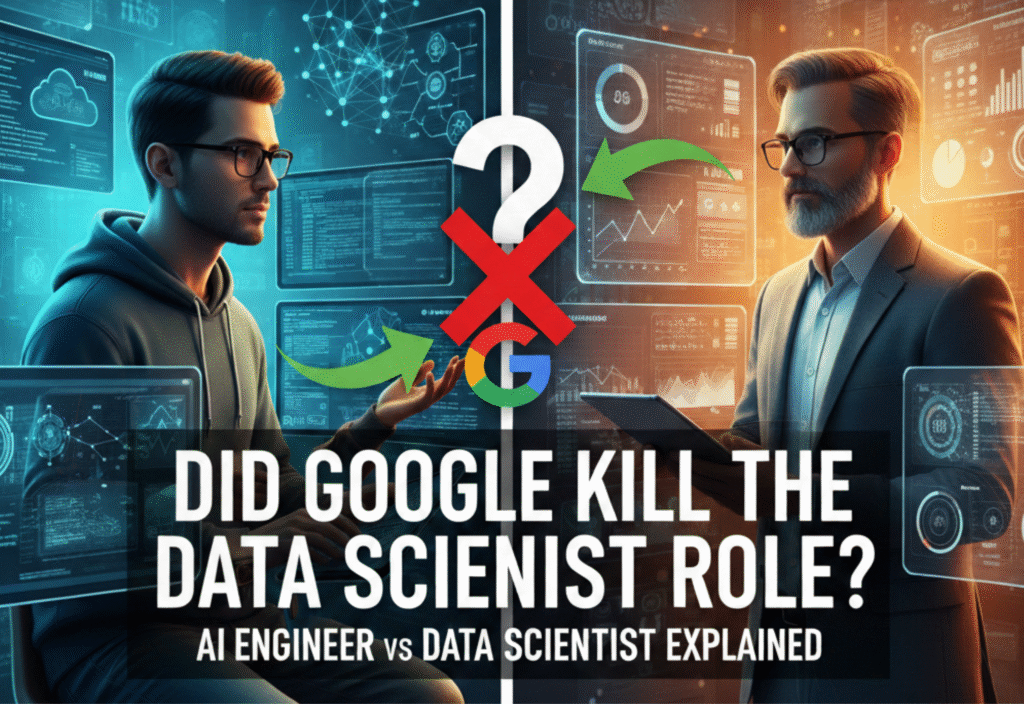
AI Engineer vs Data Scientist is a hot topic in 2026 as Google and other tech giants redefine the roles in AI and data-driven decision-making. Understanding the differences between these roles is essential for anyone looking to stay competitive in the evolving tech landscape.
The Evolution of the Data Scientist Role
Data science has been a coveted career path since the early 2010s. Data scientists are experts in extracting insights from large datasets, building predictive models, and helping companies make data-driven decisions. Their skill set typically includes:
-
Statistical analysis and mathematics
-
Data cleaning and preprocessing
-
Machine learning modeling
-
Data visualization
-
Domain knowledge to solve business problems
However, in recent years, major tech companies like Google, Microsoft, and Amazon have started shifting their hiring focus. Platforms such as Google Cloud AI, AutoML, and TensorFlow have made it easier for non-experts to build models, while AI engineers and ML operations (MLOps) specialists are now taking the lead in production-level AI deployments.
Google and the AI-First Approach
Google, as a leader in AI research and innovation, has been instrumental in reshaping the tech talent landscape. Through initiatives like Vertex AI, Google emphasizes automation and scalable AI solutions. This reduces the dependency on traditional data scientist roles for building models from scratch. Instead, the focus is on engineers who can:
-
Integrate AI solutions into production systems
-
Manage data pipelines and cloud infrastructure
-
Optimize models for scalability and performance
-
Ensure AI solutions comply with ethical and regulatory standards
While this does not literally “kill” the data scientist role, it does redefine it. Data scientists are now often expected to have coding skills and cloud computing knowledge comparable to AI engineers.
Data Scientist vs AI Engineer: Key Differences
While the lines are blurring, the core responsibilities of data scientists and AI engineers still differ:
| Aspect | Data Scientist | AI Engineer |
|---|---|---|
| Primary Focus | Discover insights from data | Deploy AI/ML models into production |
| Skills Required | Statistics, ML algorithms, data visualization | Software engineering, cloud computing, AI frameworks |
| Tools | Python, R, SQL, Tableau | TensorFlow, PyTorch, Vertex AI, Docker, Kubernetes |
| End Goal | Guide business decisions through data | Build scalable AI systems for real-world applications |
| Work Environment | Research-heavy, experimental | Engineering-heavy, production-focused |
In short, data scientists analyze the “what” and “why”, while AI engineers implement the “how” at scale.
The Rise of AI Automation Tools
AI-powered tools are further accelerating this shift. Platforms like AutoML, DataRobot, and H2O.ai allow businesses to build sophisticated models without deep expertise in machine learning. This automation reduces the demand for traditional data science tasks, especially for routine model building, but it increases the value of engineers who can operationalize AI.
Career Implications
For tech professionals, the evolution offers both challenges and opportunities:
-
Upskilling Matters: Data scientists need AI engineering skills, including coding, cloud deployment, and MLOps knowledge.
-
Hybrid Roles Emerging: Companies now look for “AI scientists” or “ML engineers,” blending analytics and engineering expertise.
-
Focus on Business Impact: Understanding business context, ethics, and AI explainability is becoming as important as technical skill.
Are Data Scientists Becoming Obsolete?
Not exactly. While Google and other tech giants are shifting emphasis, the data scientist role is not dead. It’s evolving. Companies still need experts who can:
-
Interpret complex datasets
-
Design experiments
-
Ensure AI outputs are unbiased and ethical
The difference is that the modern data scientist must think like an engineer, and the modern AI engineer must understand data science principles.
Conclusion
So, did Google kill the data scientist role? No—but it certainly redefined it. Traditional roles focused solely on analytics are giving way to hybrid positions that require both data literacy and engineering skills. AI engineers are taking center stage in deploying scalable solutions, while data scientists must adapt to remain relevant.