
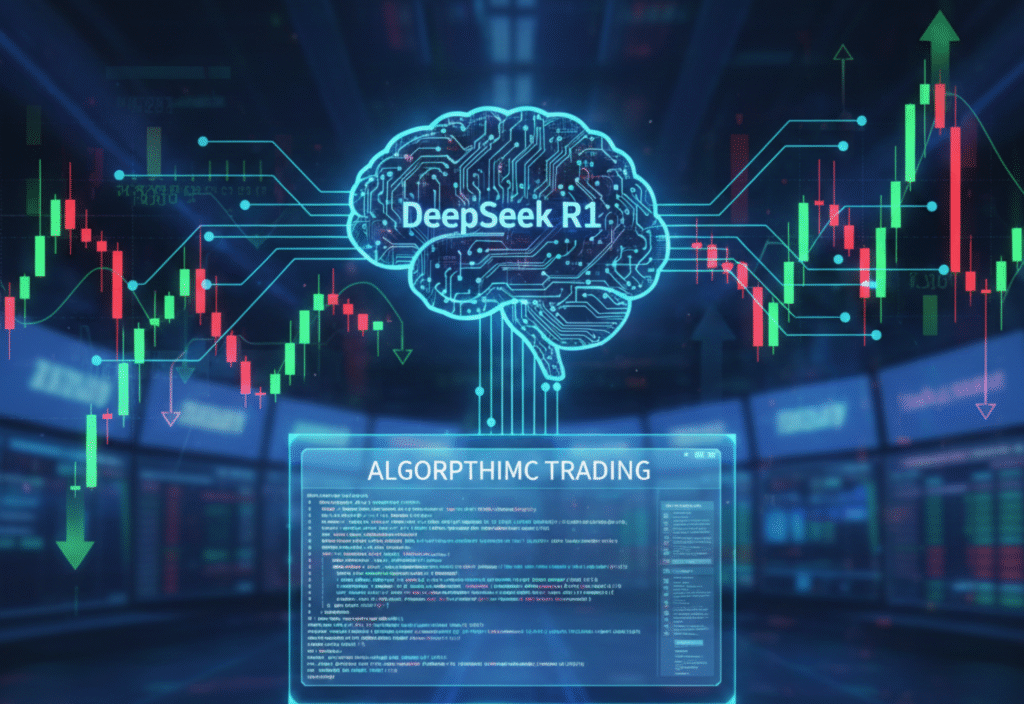
Financial markets have always been driven by a complex mix of data, psychology, and uncertainty. Traders constantly search for an edge—patterns that signal when a trend is about to reverse. In recent years, artificial intelligence (AI) has emerged as a powerful tool in this pursuit. Among the new-generation AI models gaining attention is DeepSeek R1, a reasoning-focused model designed to analyze complex patterns and decision pathways.
But a critical question remains: Can AI models like DeepSeek R1 truly predict market reversals, or are they just sophisticated pattern recognizers? This article explores the role of DeepSeek R1 in algorithmic trading, its strengths, limitations, and whether AI can realistically anticipate market turning points.
Understanding Algorithmic Trading
Algorithmic trading refers to the use of computer programs and mathematical models to execute trades automatically based on predefined rules. These rules may involve:
Price action
Technical indicators
Volume and order flow
News and sentiment data
Statistical arbitrage strategies
Traditional algorithmic trading relies heavily on human-designed logic. AI-driven trading, however, shifts this paradigm by allowing models to learn patterns directly from data.
What Is DeepSeek R1?
DeepSeek R1 is a reasoning-oriented AI model optimized for tasks that require step-by-step logic, contextual understanding, and pattern inference. Unlike basic predictive models that focus purely on numerical forecasting, DeepSeek R1 emphasizes:
Multi-step reasoning
Feature relationship analysis
Scenario evaluation
Probabilistic decision-making
In trading, this makes DeepSeek R1 particularly interesting for market structure analysis, trend exhaustion detection, and potential reversal zones.
Market Reversals: Why Are They So Hard to Predict?
Market reversals occur when a prevailing trend changes direction. While they appear obvious in hindsight, predicting them in real time is extremely difficult due to:
Noise vs. signal – Markets generate massive amounts of random price movement.
Human behavior – Fear, greed, and herd psychology distort rational patterns.
Macro events – News, interest rate decisions, and geopolitical events can invalidate technical setups instantly.
Regime shifts – Strategies that work in trending markets fail in ranging or volatile conditions.
This is where AI promises an advantage: processing far more variables simultaneously than a human trader can.
How DeepSeek R1 Can Be Used in Algorithmic Trading
1. Pattern Recognition Beyond Indicators
Instead of relying only on RSI, MACD, or moving averages, DeepSeek R1 can analyze raw price sequences, volatility clusters, and candle structures to detect subtle shifts in momentum.
2. Contextual Market Reasoning
DeepSeek R1 can evaluate:
Whether a trend is weakening
If volume confirms or contradicts price
How current price action compares to historical reversal scenarios
This contextual reasoning helps avoid false reversal signals that plague simple indicator-based systems.
3. Multi-Timeframe Analysis
AI models can simultaneously process:
Higher-timeframe trend direction
Lower-timeframe entry signals
Structural support and resistance levels
This layered view is crucial for identifying high-probability reversal zones.
4. Sentiment and News Interpretation
When combined with sentiment data (social media, news headlines, macro releases), DeepSeek R1 can factor in market psychology, a key driver behind sharp reversals.
Can DeepSeek R1 Actually Predict Reversals?
The Honest Answer: Partially, Not Perfectly
DeepSeek R1 does not “predict” reversals in a crystal-ball sense. Instead, it:
Assigns probabilities to potential outcomes
Identifies conditions under which reversals are more likely
Flags early warning signals of trend exhaustion
This distinction is critical. AI improves decision quality, not certainty.
Strengths of Using DeepSeek R1 in Trading
Data Processing at Scale
AI can analyze years of historical data across multiple assets in seconds.
Reduced Emotional Bias
AI systems do not suffer from fear, greed, or overconfidence.
Adaptive Learning
Models can be retrained to adapt to changing market conditions.
Strategy Optimization
DeepSeek R1 can help refine entry, exit, and risk management rules through simulation and backtesting.
Limitations and Risks
Overfitting
AI models may learn patterns that only exist in historical data but fail in live markets.
Black Swan Events
Unexpected events (wars, crashes, policy shocks) can invalidate AI assumptions instantly.
Data Quality Dependence
Poor or biased data leads to poor predictions—AI does not fix bad inputs.
False Confidence
Traders may blindly trust AI signals without understanding underlying risk.
Best Practices for Using DeepSeek R1 in Algorithmic Trading
Use AI as a decision-support tool, not a replacement
Combine AI signals with:
Risk management rules
Stop-loss and position sizing
Human oversight
Regularly retrain models to avoid performance decay
Test strategies across multiple market regimes
Never deploy untested AI strategies with real capital
AI vs Human Traders: Who Wins?
The future is not AI vs humans, but AI + humans.
Humans excel at intuition, macro judgment, and ethical responsibility.
AI excels at data analysis, consistency, and speed.
DeepSeek R1 can enhance a trader’s ability to spot potential reversals earlier, but final decisions should still consider broader market context.
The Future of AI-Driven Market Prediction
As AI models evolve, we can expect:
Better regime detection
More explainable AI decisions
Hybrid systems combining rules-based logic with deep learning
Stronger focus on risk-adjusted returns rather than raw prediction accuracy
DeepSeek R1 represents a step toward reasoning-based trading systems, moving beyond simple prediction toward structured decision-making.
Final Verdict: Can AI Predict Market Reversals?
AI models like DeepSeek R1 cannot predict market reversals with certainty—but they can significantly improve the odds.
When used responsibly, DeepSeek R1 can:
Detect early signs of trend exhaustion
Reduce emotional trading mistakes
Enhance systematic trading strategies
However, markets remain inherently uncertain. The most successful traders will be those who combine AI intelligence with human judgment, discipline, and risk control.