
Artificial intelligence is transforming rapidly, and the success of AI systems depends not only on model size but also on how effectively context is managed. Context engineering, the practice of designing and controlling what an AI model knows at any given time, plays a crucial role in ensuring accurate, relevant, and consistent outputs. From simple prompts to autonomous AI agents, context determines whether responses are superficial or deeply intelligent.
What Is Context Engineering?
Context engineering refers to the process of structuring, selecting, and delivering information to an AI model so it can generate reliable and goal-aligned responses. Unlike simple prompts, this approach is dynamic and often involves multiple layers of context, including:
-
User instructions and goals
-
Conversation history or session memory
-
External data such as documents or databases
-
Tool outputs and system states
Effectively managing context ensures AI systems produce accurate, relevant, and coherent results while reducing errors and hallucinations.
Why Context Engineering Matters
Even the most advanced AI models can fail if context is poorly handled. Without clear, structured, and relevant information:
-
Responses may be inaccurate or inconsistent
-
Repetition or irrelevant information can occur
-
AI may fail in multi-step reasoning tasks
Proper context management enhances productivity, improves reliability, and enables AI systems to perform complex workflows with minimal human intervention.
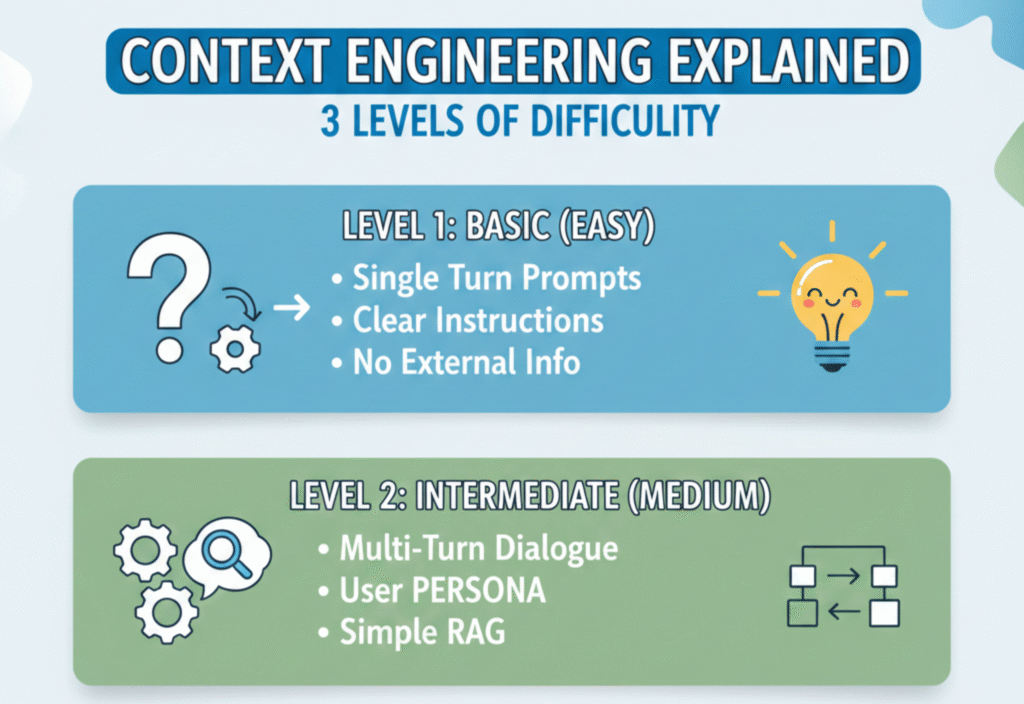
Level 1: Basic Context Engineering (Beginner)
At the beginner level, context engineering is manual and straightforward. Users craft prompts directly and provide only the information necessary for a single task.
Characteristics
-
Short prompts with minimal instructions
-
Human-managed context
-
No memory or automated retrieval
Example Use Cases
-
Writing a blog post or article
-
Summarizing short paragraphs
-
Simple Q&A with AI
Example Prompt:
“Explain context engineering in simple terms with examples for beginners.”
Advantages
-
Easy and fast to implement
-
Requires no technical setup
Limitations
-
Limited reasoning depth
-
Cannot handle complex or multi-step tasks
-
Requires repeated prompts for similar tasks
Level 2: Intermediate Context Engineering (Structured & Dynamic)
Intermediate context management introduces structured prompts and dynamic retrieval. At this level, AI systems can use stored information, session memory, and external sources to provide more accurate responses.
Characteristics
-
System, user, and memory layers
-
Retrieval-Augmented Generation (RAG) from documents
-
Dynamic session-based context
Example Use Cases
-
AI chatbots answering company FAQs
-
Knowledge assistants for research
-
Automated content summarization
Advantages
-
Improved accuracy and relevance
-
Reduced hallucinations
-
Scalable for business or research applications
Limitations
-
Requires setup and programming effort
-
Context windows may still limit long conversations
Level 3: Advanced Context Engineering (Agentic & Autonomous)
The advanced level involves autonomous AI agents that continuously manage and update their own context. These systems can plan, reason, and adapt to user goals without constant input.
Characteristics
-
Long-term and short-term memory
-
Prioritization and compression of context
-
Integration with external tools and APIs
-
Multi-agent coordination and self-reflection
Example Use Cases
-
Autonomous AI agents for research or workflows
-
AI copilots for enterprise automation
-
Complex decision-making systems
Advantages
-
Handles multi-step tasks efficiently
-
Learns and adapts over time
-
Minimal human intervention
Limitations
-
High complexity and maintenance
-
Requires robust safety and monitoring
-
Resource-intensive
Comparing the 3 Levels
| Level | Complexity | Automation | Memory | Typical Use Case |
|---|---|---|---|---|
| Basic | Low | None | No | Content writing, learning |
| Intermediate | Medium | Partial | Short-term | Chatbots, knowledge assistants |
| Advanced | High | Full | Long-term | AI agents, autonomous workflows |
Common Mistakes in Context Management
-
Overloading prompts with irrelevant data
-
Ignoring memory and session history
-
Repeating instructions unnecessarily
-
Confusing prompts with context
-
Failing to prioritize information
Avoiding these errors ensures more reliable AI behavior and better outcomes.
The Future of Context Engineering
As AI systems evolve, context management will become increasingly sophisticated. Innovations such as:
-
Automatic context pruning
-
Semantic memory hierarchies
-
Personalized AI context graphs
-
Multi-agent context sharing
…will make context engineering a critical skill for AI practitioners and developers, often more impactful than simply upgrading the AI model itself.
Conclusion
Context engineering is the foundation of effective AI interactions. Understanding its three levels of difficulty—basic, intermediate, and advanced—enables users to select the right approach for their goals, whether it’s writing a simple prompt or building autonomous AI agents. Mastering this discipline transforms AI from a reactive tool into a proactive, intelligent partner capable of reasoning, learning, and performing complex tasks.