
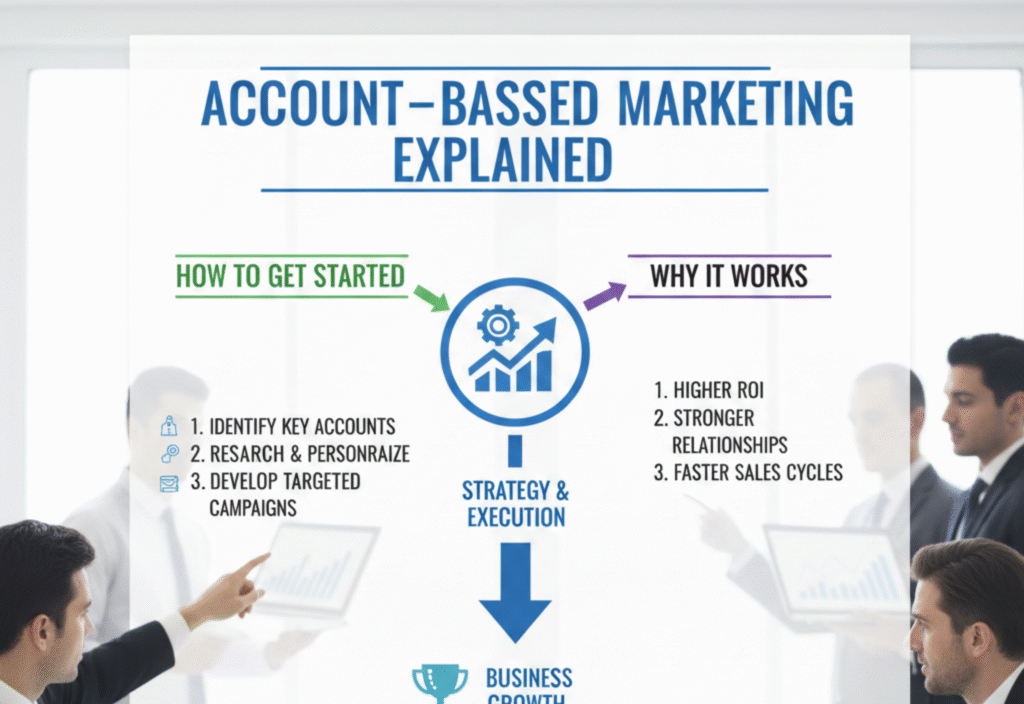
In today’s competitive B2B marketing landscape, generic marketing strategies no longer deliver the results businesses expect. Decision-makers are overwhelmed with ads, emails, and content that fail to address their specific needs. This is where Account-Based Marketing (ABM) comes in—a highly focused strategy that aligns marketing and sales efforts to target high-value accounts with personalized campaigns.
What Is Account-Based Marketing?
Account-Based Marketing is a strategic B2B marketing approach where companies identify high-value target accounts and create customized marketing and sales efforts tailored specifically to those accounts.
Unlike traditional lead-based marketing, which focuses on generating a large number of leads, ABM prioritizes quality over quantity. Marketing teams work closely with sales teams to engage decision-makers within target companies using personalized content, messaging, and experiences.
How Account-Based Marketing Works
ABM works by flipping the traditional marketing funnel upside down. Instead of attracting a broad audience and nurturing leads, ABM starts by identifying ideal accounts and then creating targeted campaigns for them.
Key Components of ABM:
-
Identification of high-value accounts
-
Deep research into account needs and challenges
-
Personalized messaging and content
-
Multi-channel engagement
-
Close alignment between sales and marketing
This approach ensures that every marketing effort is intentional and focused on accounts most likely to convert.
Types of Account-Based Marketing
1. One-to-One ABM
This is the most personalized form of ABM, where campaigns are created for a single high-value account. It’s ideal for enterprise-level clients with long sales cycles.
2. One-to-Few ABM
In this approach, businesses target a small group of similar accounts with tailored messaging. It balances personalization and scalability.
3. One-to-Many ABM
This type uses automation and technology to target hundreds of accounts with semi-personalized campaigns. It’s best for companies looking to scale ABM efficiently.
Why Account-Based Marketing Works
1. Higher ROI
ABM focuses resources on accounts that matter most, leading to better conversion rates and higher revenue returns.
2. Strong Sales and Marketing Alignment
ABM requires collaboration between sales and marketing teams, eliminating silos and improving overall performance.
3. Shorter Sales Cycles
Personalized messaging addresses pain points directly, helping prospects move faster through the buyer’s journey.
4. Better Customer Experience
Tailored content makes prospects feel understood, increasing trust and engagement.
5. Improved Customer Retention
ABM doesn’t stop after conversion—it helps build long-term relationships that lead to upselling and cross-selling opportunities.
How to Get Started with Account-Based Marketing
Step 1: Identify Your Ideal Customer Profile (ICP)
Define the characteristics of your most valuable customers, including:
-
Industry
-
Company size
-
Revenue
-
Location
-
Pain points
This will help you select accounts with the highest potential value.
Step 2: Select Target Accounts
Using your ICP, create a list of high-priority accounts. Sales and marketing teams should collaborate to finalize this list.
Step 3: Research Decision-Makers
Identify key stakeholders within each account, such as:
-
CEOs
-
Marketing Directors
-
IT Managers
-
Procurement Officers
Understand their roles, challenges, and goals.
Step 4: Create Personalized Content
Develop content tailored to each account, including:
-
Personalized emails
-
Custom landing pages
-
Case studies
-
Whitepapers
-
Product demos
The more relevant the content, the higher the engagement.
Step 5: Choose the Right Channels
ABM campaigns often use multiple channels, such as:
-
Email marketing
-
LinkedIn advertising
-
Website personalization
-
Webinars
-
Direct mail
Consistency across channels is key to success.
Step 6: Align Sales and Marketing Teams
Ensure both teams share goals, metrics, and communication. Regular meetings and shared dashboards can help maintain alignment.
Step 7: Measure and Optimize
Track key ABM metrics, including:
-
Account engagement
-
Pipeline value
-
Deal size
-
Conversion rates
-
ROI
Use insights to refine your strategy and improve performance.
Best Tools for Account-Based Marketing
Some popular ABM tools include:
-
HubSpot
-
Demandbase
-
Terminus
-
6sense
-
LinkedIn Sales Navigator
These tools help with account targeting, personalization, analytics, and automation.
Common ABM Mistakes to Avoid
-
Targeting too many accounts at once
-
Lack of personalization
-
Poor sales and marketing alignment
-
Ignoring data and analytics
-
Expecting instant results
ABM is a long-term strategy that requires patience and consistency.
Account-Based Marketing vs Traditional Marketing
| Traditional Marketing | Account-Based Marketing |
|---|---|
| Broad audience | Targeted accounts |
| Lead-focused | Account-focused |
| Generic messaging | Personalized messaging |
| Marketing-led | Sales and marketing aligned |
Final Thoughts
Account-Based Marketing is one of the most effective strategies for B2B companies looking to drive high-quality leads, improve sales efficiency, and build long-term customer relationships. By focusing on the right accounts and delivering personalized experiences, businesses can achieve sustainable growth in an increasingly competitive market.