
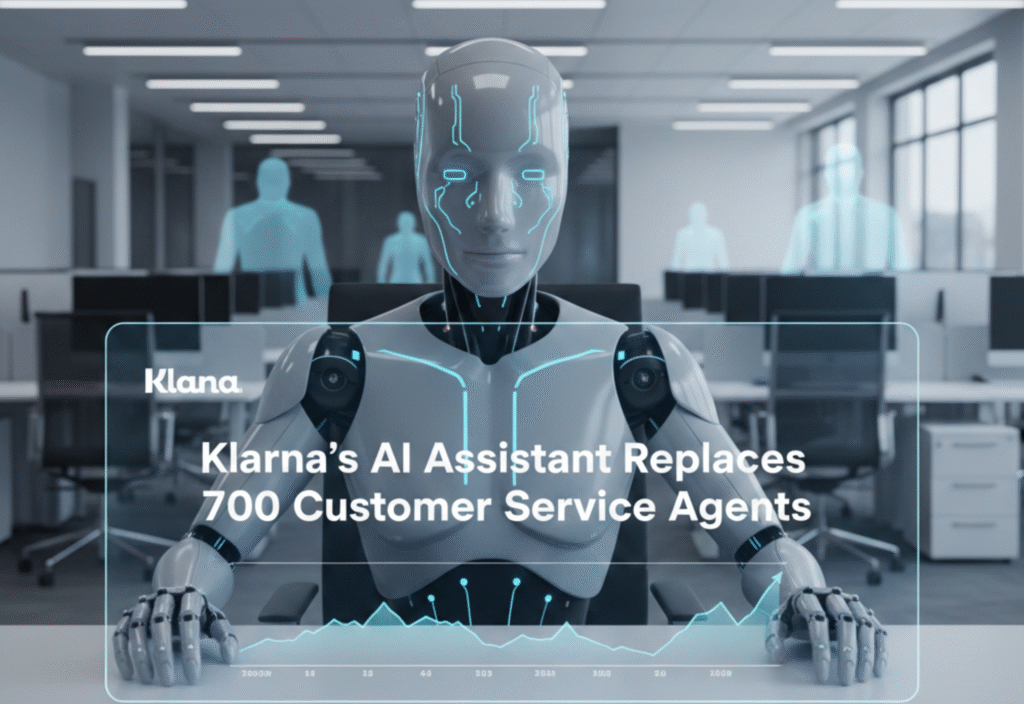
Artificial Intelligence is rapidly changing how companies manage customer support. Today, many global businesses are turning to AI to improve efficiency and reduce costs. A strong example of this shift is Klarna, the fintech company that introduced an AI assistant capable of handling the workload of 700 customer service agents.
This move clearly shows how AI is becoming a core part of modern customer experience strategies.
The Growing Pressure on Customer Support Teams
As Klarna’s customer base expanded, the number of daily support requests also increased. Customers frequently contacted support about payments, refunds, account issues, and order updates. Managing this volume using only human agents was becoming slow and expensive.
As a result, Klarna needed a solution that could scale quickly without lowering service quality.
Why Klarna Introduced an AI Assistant
To solve this challenge, Klarna launched an AI-powered customer service assistant. This assistant uses natural language processing (NLP) and machine learning to understand customer questions and respond in a human-like way.
In addition, the AI was trained on Klarna’s:
-
product information
-
support policies
-
FAQs
-
past customer conversations
Because of this training, the assistant can accurately resolve most common issues without human involvement.
How the AI Matches the Work of 700 Agents
Unlike human agents, the AI assistant can manage thousands of chats at the same time. It works continuously, without breaks, and delivers instant responses. For example, it can quickly handle questions about payment status or refund timelines.
As a result, tasks that once required hundreds of agents are now completed in seconds. Therefore, Klarna confirmed that the AI assistant performs work equal to 700 customer service agents.
Faster Responses Lead to Better Customer Experience
Speed plays a major role in customer satisfaction. Previously, customers often waited minutes or even hours for support. Now, they receive answers almost immediately.
Moreover, faster responses reduce frustration and increase trust. Consequently, Klarna benefits from higher customer satisfaction and stronger brand loyalty.
Lower Costs and Better Efficiency
Hiring and training large support teams is costly. Salaries, onboarding, and infrastructure add up quickly. By using AI, Klarna significantly reduces these expenses.
At the same time, the company can easily scale support during busy periods. As a result, Klarna saves money while maintaining high service standards.
Humans and AI Working Together
Importantly, Klarna has not removed human agents entirely. Instead, the company follows a hybrid model. The AI assistant handles routine and repetitive questions, while human agents focus on complex or sensitive cases.
This approach improves efficiency and allows employees to work on tasks that require empathy and deeper problem-solving.
What This Means for the Future of Customer Service
Klarna’s success highlights a clear trend. More companies are moving toward AI-first customer support. In the future, businesses are likely to rely on AI for instant help, personalized responses, and predictive support.
Therefore, organizations that adopt AI early will gain a strong competitive advantage.
Conclusion
Klarna’s AI assistant replacing the workload of 700 customer service agents is a powerful example of AI in action. It proves that AI can improve speed, reduce costs, and enhance customer satisfaction at the same time.