AI expenses comparison has become a critical topic as businesses increasingly rely on artificial intelligence for automation, analytics, and decision-making. While AI promises efficiency and innovation, the real cost depends heavily on how models are deployed—whether through cloud-based services, local infrastructure, or quantized alternatives. Understanding these cost differences early helps teams avoid unexpected expenses and build more sustainable AI systems.
Understanding AI Cost Beyond Just Price”
When people think about AI costs, they usually focus on API pricing or GPU hardware. In reality, AI expenses include multiple hidden factors:
Infrastructure and compute
Scalability and latency
Maintenance and updates
Data privacy and compliance
Energy consumption
Long-term operational costs
Each deployment approach handles these costs very differently.
Cloud AI Models: Convenience at a Premium
Cloud-based AI models (such as API-hosted LLMs or vision models) are the most popular choice today—and for good reason.
Advantages of Cloud AI Models
Zero setup required: No hardware or ML expertise needed
Instant scalability: Handle spikes in usage easily
Continuous improvements: Providers update models automatically
High accuracy: Access to state-of-the-art models
The Real Cost of Cloud AI
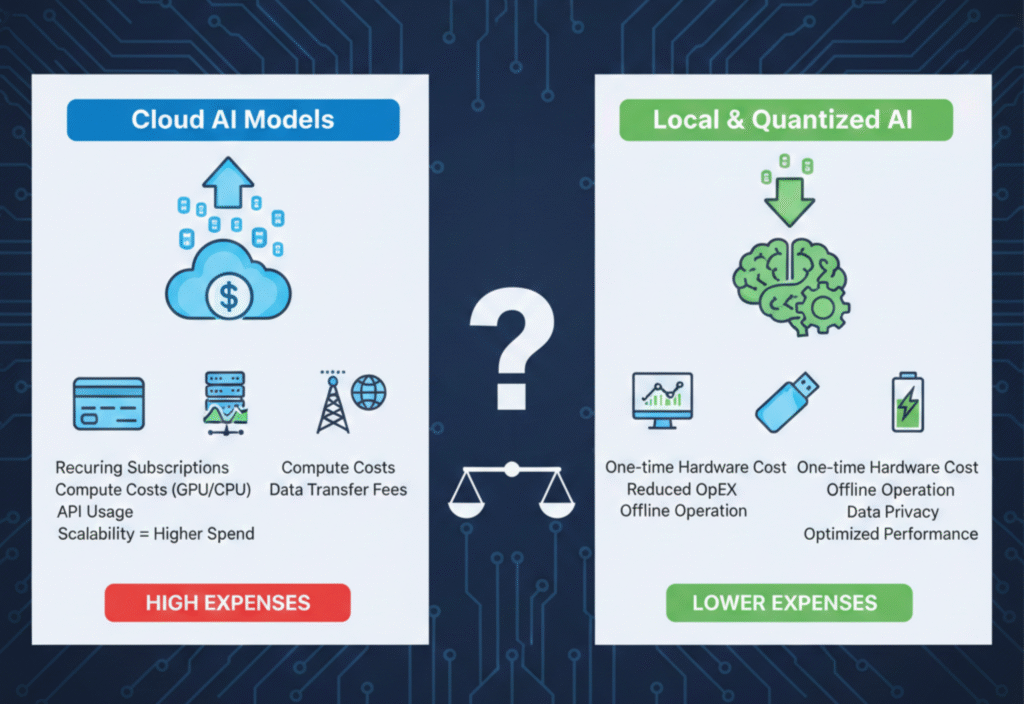
Despite the convenience, cloud models come with ongoing and often underestimated expenses:
Pay-per-token or request pricing quickly adds up at scale
High inference costs for real-time or high-volume applications
Vendor lock-in, making migration difficult later
Data privacy concerns, especially for sensitive or regulated data
Latency issues due to network dependency
Best for: Prototypes, early-stage startups, low-volume usage, and teams without ML infrastructure.
Local AI Models: Control with Responsibility
Local models run on your own servers, GPUs, or even high-end consumer hardware. This approach is gaining popularity as open-source AI models improve rapidly.
Advantages of Local AI Models
No per-request cost once infrastructure is set up
Full control over data and privacy
Lower latency for on-device or internal systems
Freedom to customize and fine-tune models
Hidden Costs of Local AI
While local deployment avoids API fees, it introduces new expenses:
Upfront hardware investment (GPUs, servers, cooling)
Ongoing electricity and maintenance costs
Engineering expertise required for deployment and optimization
Scaling limitations during traffic spikes
Manual model updates and monitoring
Best for: Companies with steady workloads, privacy-sensitive data, and in-house technical expertise.
Quantized Models: The Cost-Efficiency Sweet Spot
Quantization reduces model precision (for example, from 16-bit to 8-bit, 4-bit, or even 2-bit), dramatically lowering resource usage while preserving most performance.
Why Quantized Models Are Game-Changers
Up to 50–80% lower memory usage
Faster inference on CPUs and smaller GPUs
Lower energy consumption
Enables AI on edge devices and low-cost hardware
Significantly reduced infrastructure costs
Trade-Offs of Quantized Models
Slight accuracy degradation (often negligible)
More testing required to find optimal precision
Not all models support extreme quantization well
Despite these challenges, modern quantization techniques have made this approach surprisingly robust and production-ready.
Best for: Cost-sensitive applications, edge AI, startups scaling up, and teams replacing expensive cloud inference.
Cost Comparison Overview
| Factor | Cloud Models | Local Models | Quantized Models |
|---|---|---|---|
| Upfront Cost | Low | High | Low–Medium |
| Ongoing Cost | High | Medium | Very Low |
| Scalability | Excellent | Limited | Moderate |
| Data Privacy | Low | High | High |
| Performance per Dollar | Medium | High | Very High |
| Vendor Lock-In | High | None | None |
Which Option Is Right for You?
There is no universal “best” choice—only the best fit for your use case.
Choose cloud models if speed, simplicity, and cutting-edge performance matter most.
Choose local models if you need control, privacy, and predictable workloads.
Choose quantized models if you want maximum efficiency, lower costs, and scalable AI without massive infrastructure.
Many successful teams now use a hybrid approach, combining cloud models for complex tasks and quantized local models for routine inference.
Final Thoughts: The Future Is Cost-Aware AI
As AI adoption grows, cost efficiency will become just as important as model accuracy. Quantized and local models are no longer “inferior alternatives”—they are strategic tools for building sustainable AI systems.