
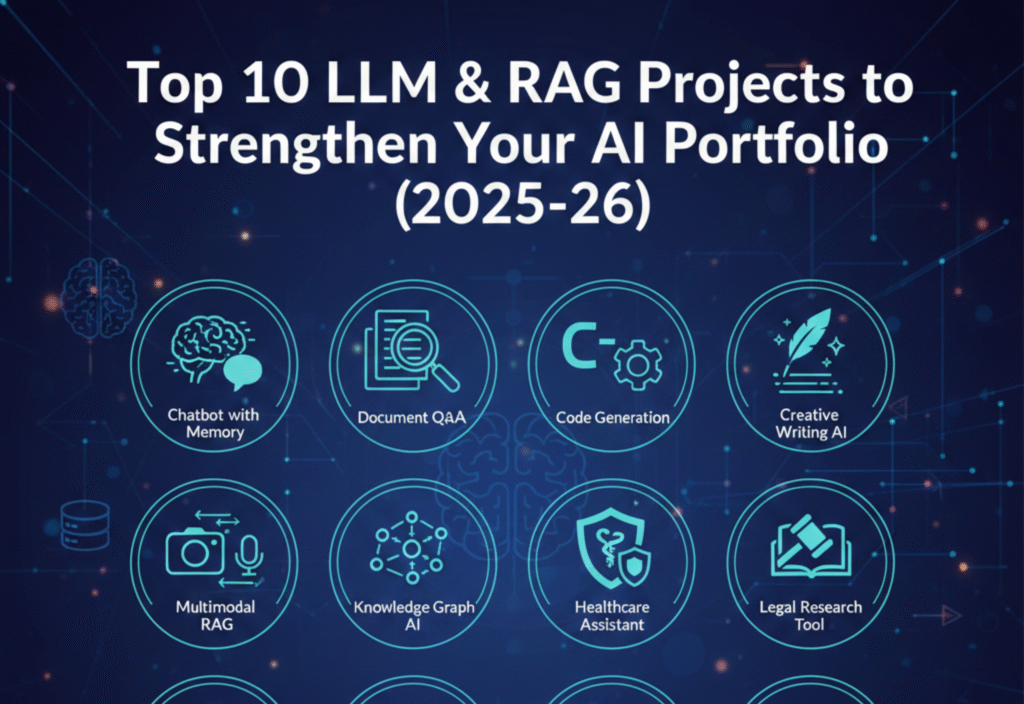
LLM RAG projects are becoming essential for anyone building a competitive AI portfolio in 2025–26. These projects combine large language models with retrieval-augmented generation to solve real-world problems such as document search, knowledge assistants, and intelligent automation. In this article, we explore the top 10 LLM RAG projects that can significantly strengthen your AI portfolio and improve your industry readiness.
1. Intelligent Document Question-Answering System (RAG-Based)
One of the most in-demand applications of RAG is document intelligence. This project focuses on building a system that allows users to upload PDFs, Word files, or knowledge bases and ask natural language questions.
Key Features:
-
Document ingestion and chunking
-
Vector embeddings with semantic search
-
Context-aware answer generation using an LLM
-
Source citation for transparency
Why It Matters:
Businesses rely heavily on internal documentation. A RAG-powered document assistant demonstrates your ability to build enterprise-ready AI solutions that reduce manual search and improve productivity.
2. AI Research Assistant for Web & Knowledge Retrieval
This project involves creating an AI assistant that can research topics by retrieving information from multiple sources and synthesizing it into structured outputs.
Key Features:
-
Query decomposition and intelligent search
-
RAG pipeline with ranking and filtering
-
Summarized answers with references
-
Follow-up question handling
Why It Matters:
This shows your understanding of multi-step reasoning, retrieval accuracy, and hallucination reduction—critical challenges in modern LLM systems.
3. Customer Support Chatbot with RAG Memory
A customer support chatbot powered by RAG can answer queries based on FAQs, manuals, tickets, and historical interactions.
Key Features:
-
Knowledge base indexing
-
Contextual conversation memory
-
Intent detection and fallback handling
-
Escalation to human agents
Why It Matters:
Customer support automation is a top commercial use case for AI. This project proves your ability to deliver real business value with LLMs.
4. Codebase-Aware AI Developer Assistant
This project focuses on building an AI assistant that understands an entire codebase and helps developers navigate, debug, and refactor code.
Key Features:
-
Code parsing and embedding
-
File-level and function-level retrieval
-
Context-aware code explanations
-
Bug detection and improvement suggestions
Why It Matters:
Developer tools powered by LLMs are growing rapidly. This project demonstrates your ability to work with structured data, long contexts, and technical reasoning.
5. Personalized Learning Tutor Using RAG
Create an AI tutor that adapts to a learner’s progress and retrieves relevant content based on skill gaps and goals.
Key Features:
-
Student profile and progress tracking
-
Adaptive question generation
-
RAG-based lesson explanations
-
Performance feedback loops
Why It Matters:
Education technology is a major growth area. This project highlights personalization, user modeling, and ethical AI use.
6. Legal or Compliance Document Analyzer
Build a system that analyzes contracts, policies, or regulations and answers compliance-related questions.
Key Features:
-
Clause extraction and categorization
-
Semantic similarity search
-
Risk and compliance flagging
-
Explainable responses with citations
Why It Matters:
Legal and compliance AI requires precision and trust. This project demonstrates advanced RAG design and responsible AI implementation.
7. Multi-Modal RAG System (Text + Images)
Go beyond text by building a RAG system that understands both images and documents.
Key Features:
-
Image embeddings and OCR integration
-
Cross-modal retrieval
-
Visual question answering
-
Combined text-image reasoning
Why It Matters:
Multi-modal AI is the future. This project shows you can handle complex data pipelines and emerging AI capabilities.
8. Enterprise Knowledge Search Engine
This project focuses on building a scalable search system for internal company knowledge.
Key Features:
-
Role-based access control
-
Large-scale vector indexing
-
Query expansion and re-ranking
-
Analytics on user queries
Why It Matters:
Enterprises need secure, scalable AI systems. This project shows architectural thinking and production readiness.
9. AI Content Auditor & Fact-Checker
Build a system that verifies AI-generated or human-written content using external sources.
Key Features:
-
Claim extraction
-
Evidence retrieval using RAG
-
Confidence scoring
-
Explanation of verification results
Why It Matters:
With misinformation concerns rising, fact-checking AI is highly valuable. This project demonstrates ethical AI design and evaluation skills.
10. Autonomous AI Agent with RAG Tooling
Create an AI agent capable of planning tasks, retrieving knowledge, and executing multi-step workflows.
Key Features:
-
Goal decomposition
-
Tool selection and execution
-
RAG-based memory
-
Self-evaluation and correction
Why It Matters:
AI agents represent the next generation of LLM applications. This project shows mastery of advanced reasoning, orchestration, and autonomy.
How to Present These Projects in Your Portfolio
To maximize impact:
-
Include architecture diagrams
-
Explain your RAG pipeline decisions
-
Highlight challenges like hallucination control
-
Provide demos or GitHub repositories
-
Mention evaluation metrics and improvements
Employers care more about how you think than the tools you use.
Final Thoughts
In 2025–26, simply knowing how to call an LLM API is not enough. What sets strong candidates apart is the ability to build robust, scalable, and trustworthy LLM & RAG systems.
Lorem ipsum dolor sit amet, consectetur adipiscing elit. Ut elit tellus, luctus nec ullamcorper mattis, pulvinar dapibus leo.