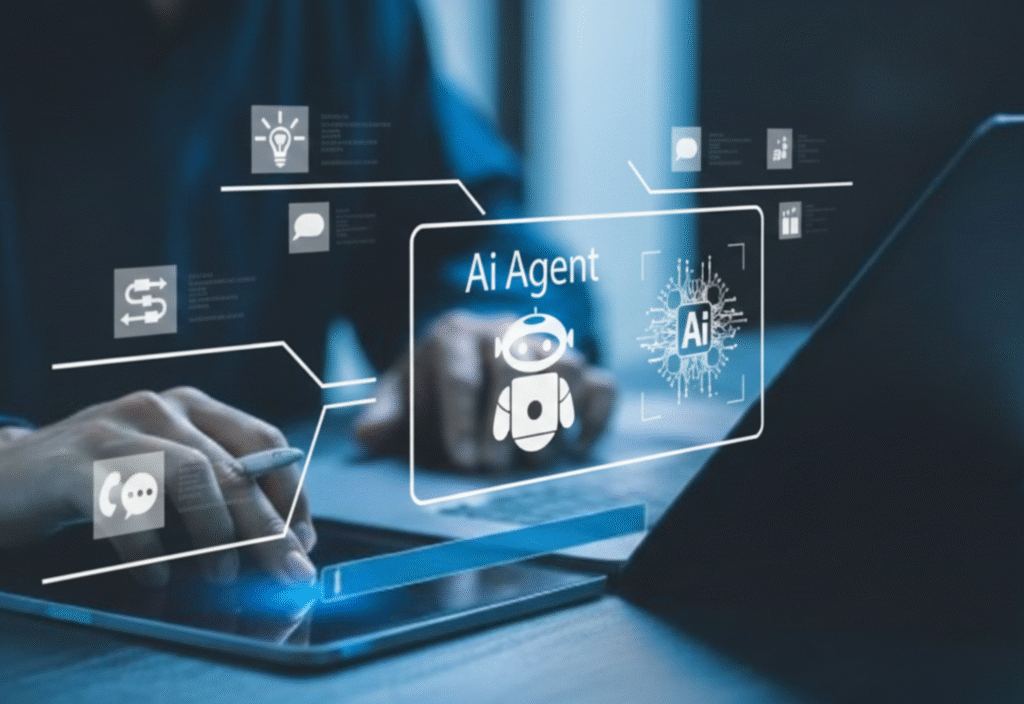
Artificial Intelligence (AI) is rapidly transforming industries and daily life. Among its innovations, intelligent systems capable of autonomous tasks have become essential. These autonomous agents can perceive environments, analyze data, make decisions, and act independently. They play a crucial role in improving efficiency, automating routine tasks, and providing smarter solutions in healthcare, finance, robotics, gaming, and customer service.
This guide provides a complete overview of these systems and explains how you can develop your own intelligent agents for practical applications.
What Are AI Agents?
An AI agent is a system designed to operate independently and achieve specific goals. Unlike traditional software, these digital agents can adapt to changing circumstances, learn from experience, and make decisions intelligently.
Key Features:
Autonomy: Operates without constant supervision
Reactivity: Responds to environmental changes
Pro-activeness: Initiates actions to reach objectives
Learning: Improves performance over time
Collaboration: Can interact with humans or other agents
Types of AI Agents
AI agents vary based on their complexity and decision-making abilities:
1. Simple Reflex Agents
Act according to predefined rules based on current conditions
Do not consider past experiences
Example: Thermostat that adjusts temperature automatically
2. Model-Based Reflex Agents
Maintain an internal model of the environment
Can use past actions to make better decisions
Example: Autonomous vacuum cleaner remembering cleaned areas
3. Goal-Based Agents
Choose actions to achieve specific objectives
Example: Chess AI planning moves ahead to win a game
4. Utility-Based Agents
Make decisions to maximize a defined utility function
Example: AI trading bots optimizing profits
5. Learning Agents
Learn from past experiences to improve future actions
Example: Recommendation systems like Netflix or Spotify that adapt to user preferences
How They Work
These intelligent systems operate in a continuous cycle of perception, reasoning, action, and learning:
Perception: Gather environmental data
Reasoning: Analyze the data and decide the best action
Action: Perform tasks to achieve goals
Learning: Adjust behavior based on outcomes
Example: A delivery robot senses obstacles, chooses an optimal route, navigates, and learns from blocked paths to improve future navigation.
Applications
Virtual Assistants
Systems like Siri, Alexa, and Google Assistant automate tasks and respond to commands
Autonomous Vehicles
Self-driving cars analyze sensors, predict traffic, and navigate safely
Robotics
Industrial robots perform assembly, packaging, and quality control efficiently
Finance
AI-powered systems detect fraud, optimize investments, and provide insights
Healthcare
Diagnostic tools and monitoring systems help detect diseases early and assist in treatment planning
Gaming
Adaptive NPCs provide immersive and dynamic gameplay experiences
Customer Service
Chatbots handle queries 24/7, reducing human workload
Tools and Frameworks
Python: Programming language for AI
TensorFlow & PyTorch: Deep learning frameworks
OpenAI Gym: Reinforcement learning platform
Rasa: Chatbot development
Unity ML-Agents: AI agents in games and simulations
Microsoft Bot Framework: Virtual agents and chatbots
Learning Path
Understand AI basics: machine learning, deep learning, NLP
Learn programming: Python, NumPy, Pandas
Study AI algorithms: search, planning, reinforcement learning
Build projects: chatbots, game agents, robotics
Work on advanced systems: autonomous vehicles, trading bots, recommendation engines
Specialize: focus on a domain and stay updated with latest research
Challenges
Large data requirements for learning agents
Complexity in designing intelligent behavior
Ethical and safety concerns
High computational resources needed
Adapting to unpredictable environments
Future
Smarter automation for complex tasks
Human-AI collaboration in workplaces
Personalized solutions in healthcare, finance, and education
Advanced autonomous systems like drones and delivery robots
Transparent and explainable AI for safe decisions
Conclusion
AI agents, ranging from simple reflex systems to advanced learning agents, are transforming technology. They enable automation, improve decision-making, and adapt to changing conditions. Understanding their types, applications, tools, and learning methods equips you to build efficient, adaptive, and intelligent systems for the future of AI.