Artificial Intelligence (AI) is one of the fastest-growing fields in technology today. Becoming a skilled AI engineer requires more than just coding knowledge; it demands consistent learning, problem-solving skills, and a mindset tuned to innovation. By building the right habits, you can accelerate your growth and stand out in this competitive field.
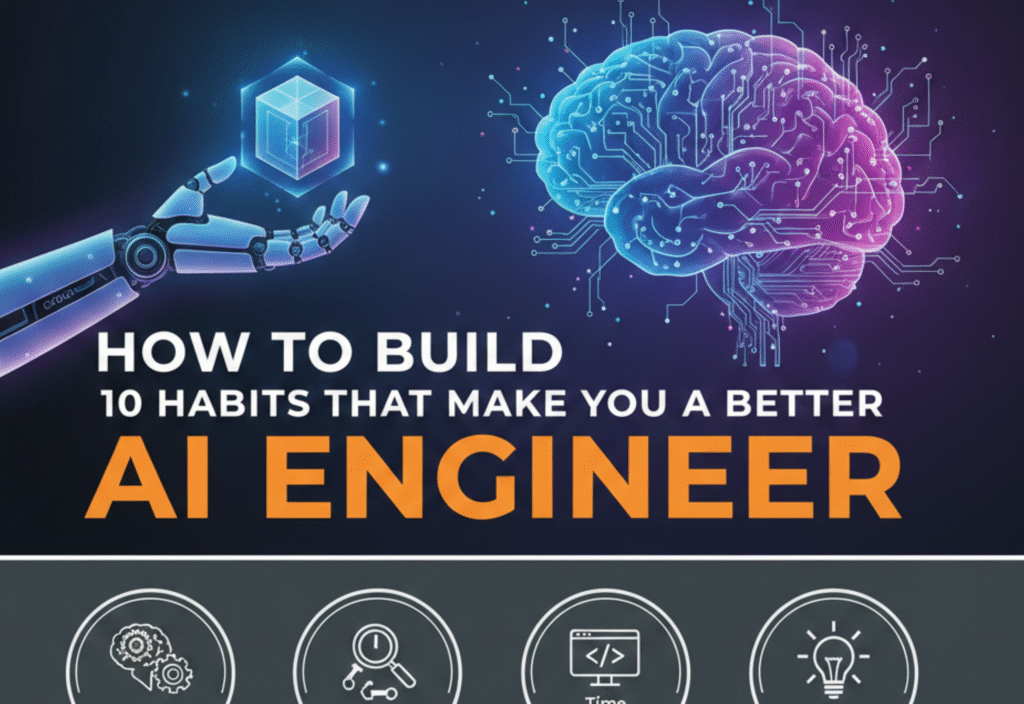
Here’s a guide on how to build 10 habits that make you a better AI engineer.
1. Dedicate Time for Daily Learning
AI is constantly evolving. To stay ahead:
-
Spend at least 30–60 minutes daily reading research papers, blogs, or tutorials.
-
Follow AI thought leaders and research groups on social media.
-
Use platforms like arXiv, Medium, or Towards Data Science to discover trends.
Habit tip: Keep a dedicated notebook or digital log of new concepts learned daily.
2. Practice Coding Consistently
AI engineering relies heavily on programming skills, especially in Python, R, or Java:
-
Solve coding problems regularly on platforms like LeetCode, HackerRank, or Kaggle.
-
Work on small AI projects to apply what you learn.
-
Refactor code to improve efficiency and readability.
Habit tip: Commit to writing at least 50–100 lines of AI-focused code daily.
3. Master Math and Statistics Fundamentals
A strong foundation in linear algebra, calculus, probability, and statistics is critical:
-
Understand how algorithms work under the hood.
-
Practice solving real problems using mathematical tools.
-
Review concepts periodically to retain understanding.
Habit tip: Dedicate 15–30 minutes daily to solving math problems relevant to AI.
4. Experiment With AI Models
Practical experimentation builds intuition:
-
Implement models from scratch and compare with pre-built frameworks.
-
Tweak parameters and observe outcomes.
-
Learn from failures and optimize iteratively.
Habit tip: Keep a personal log of experiments, successes, and lessons learned.
5. Document Your Work Thoroughly
Clear documentation helps future reference and collaboration:
-
Write detailed READMEs for projects.
-
Comment code effectively.
-
Maintain a personal knowledge base of key algorithms and techniques.
Habit tip: Update documentation immediately after completing tasks to avoid forgetting details.
6. Stay Updated With AI Research
AI research moves fast. Staying current ensures you’re not left behind:
-
Subscribe to AI journals and newsletters.
-
Attend webinars, conferences, or virtual meetups.
-
Summarize important research in your own words.
Habit tip: Allocate at least 2–3 hours weekly to read and analyze recent papers.
7. Collaborate and Seek Feedback
Learning in isolation slows growth. Collaboration enhances skills:
-
Contribute to open-source AI projects.
-
Share your work with peers or mentors for feedback.
-
Participate in hackathons or competitions.
Habit tip: Schedule regular code reviews or pair-programming sessions.
8. Focus on Problem-Solving
AI engineers are problem solvers, not just coders:
-
Practice breaking down complex problems into smaller components.
-
Apply AI to real-world scenarios.
-
Explore multiple solutions before settling on one.
Habit tip: Keep a “problem-solving journal” to track challenges and solutions.
9. Learn Data Handling and Preprocessing
Data is the backbone of AI. Effective data management is essential:
-
Clean and preprocess datasets carefully.
-
Explore and visualize data for insights.
-
Understand feature engineering and selection techniques.
Habit tip: Dedicate part of your workflow to data exploration before model building.
10. Cultivate a Growth Mindset
AI engineering requires perseverance:
-
Embrace failures as learning opportunities.
-
Continuously refine your skills.
-
Stay curious and open to new approaches.
Habit tip: Reflect weekly on challenges overcome and skills improved.
Conclusion
Building these 10 habits creates a strong foundation for excelling as an AI engineer. Daily learning, coding practice, experimentation, documentation, and a growth mindset together ensure continuous improvement. By following these habits consistently, you’ll not only enhance your technical skills but also become a more effective problem solver in the AI space.
Success in AI isn’t just about knowing algorithms—it’s about how you approach learning, problem-solving, and innovation every single day.