Python is one of the most flexible programming languages in the world, and its power becomes even more impressive when used through the command line. Whether you’re a beginner or an experienced developer, Python offers a wide range of CLI (Command Line Interface) tools that can save you time, automate repetitive tasks, and simplify complex workflows.
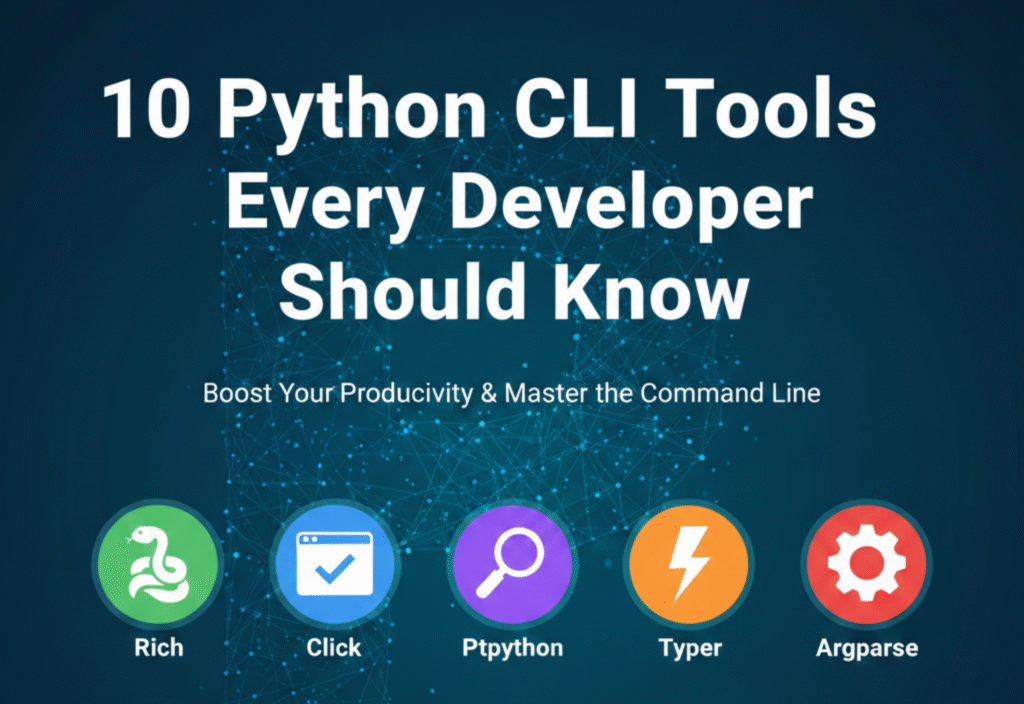
In this article, we’ll explore 10 essential Python CLI tools that every developer should have in their toolbox.
1. Click
Click is a highly popular Python package for building command-line interfaces with clean, readable syntax.
It supports nested commands, automatic help generation, and powerful customization options.
If you’re building automation scripts or CLI utilities, Click makes the process incredibly smooth.
Why developers love it:
-
Easy to write
-
Automatically creates help pages
-
Supports complex CLI structures
2. Rich
Rich is a beautiful library for making your terminal output visually stunning. It supports colored text, tables, markdown, progress bars, and more.
Use cases:
-
Debugging
-
Pretty logging
-
CLI dashboards
If you want your CLI tool to stand out, Rich is a must-have.
3. Typer
Typer is built on top of Click but designed to feel like FastAPI. It uses type hints, making your code clean, predictable, and easy to maintain.
Best for:
-
Modern CLI apps
-
Scripts requiring strong typing
-
Automatic documentation generation
4. HTTPie
HTTPie is a user-friendly command-line HTTP client. It’s like cURL but much easier to read and use.
You can:
-
Test APIs
-
Send requests
-
Format JSON output
Developers working with APIs absolutely love HTTPie.
5. Poetry
Poetry is one of the best tools for dependency management and packaging in Python.
It simplifies virtual environments, versioning, and publishing packages.
Key features:
-
Handles package installation
-
Creates isolated environments
-
Manages project metadata with ease
6. Pipenv
Pipenv is another powerful dependency manager combining the strengths of pip and virtualenv.
It improves workflow consistency and makes Python environments more predictable.
Why it’s useful:
-
Reliable environment creation
-
Easy package locking
-
Clean project structure
7. Pytest
Pytest is the go-to testing framework for Python developers. It offers simple test writing and powerful features like fixtures, plugins, and auto-discovery.
Great for:
-
Unit testing
-
Automation testing
-
Large test suites
8. Black
Black is an opinionated code formatter that ensures your code is clean and consistent.
You run it once, and it reformats your entire project automatically.
Benefits:
-
Saves time
-
Enforces style consistency
-
Eliminates style arguments
9. Commitizen
Commitizen helps developers write clean, standardized commit messages.
If you’re following semantic versioning or working in teams, this tool keeps everything organized.
Why use it:
-
Automates versioning
-
Ensures clean Changelogs
-
Improves team collaboration
10. Cookiecutter
Cookiecutter is a template generator for creating new projects quickly.
Whether you’re launching a web app, ML project, or API, Cookiecutter provides structured templates for immediate productivity.
Perfect for:
-
Starting new projects
-
Maintaining standard folder structures
-
Faster development cycles
Final Thoughts
These 10 Python CLI tools can drastically improve your productivity, automate routine tasks, and help you build cleaner, more powerful Python applications.
Whether you’re managing dependencies, formatting code, sending API requests, or generating project templates, these tools make development smoother and faster.