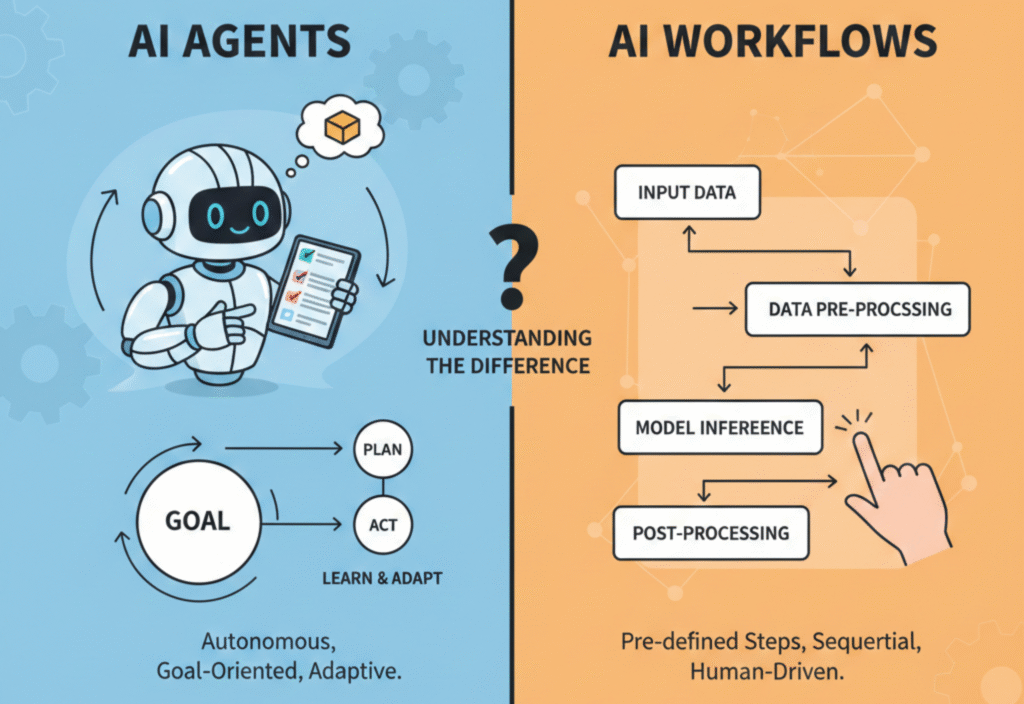
Understanding the difference between AI agents vs workflows is crucial for anyone implementing AI in business or technology. While both use artificial intelligence, they work in very different ways. AI agents act independently and make decisions, whereas workflows follow a fixed set of steps to complete tasks. Therefore, knowing the difference helps businesses use AI more effectively and avoid confusion.
What Are AI Agents?
AI agents are advanced systems that can operate on their own with very little human supervision. They don’t just follow instructions—they understand goals, analyze data, and decide what action to take next. In addition, they can improve their performance over time by learning from new information.
This makes AI agents very powerful in situations where flexibility and smart decision-making are required.
Key Features of AI Agents:
- They work independently without constant human control
- They analyze data and make decisions
- They learn from experience and improve over time
- They focus on completing goals rather than fixed steps
Real-World Examples of AI Agents:
For example:
- Chatbots that solve customer problems automatically
- Virtual assistants like Siri, Alexa, or Google Assistant
- Recommendation systems used by Netflix, Amazon, and YouTube
- AI tools that can write, code, or research independently
In short, AI agents behave like intelligent digital assistants that can think and act on their own.
What Are AI Workflows?
AI workflows are structured systems that follow a step-by-step process to complete tasks. Unlike AI agents, workflows do not make independent decisions. Instead, they follow predefined rules or sequences designed by humans.
Moreover, AI workflows often combine automation tools and AI models to improve efficiency and reduce manual work.
Key Features of AI Workflows:
- They follow a fixed order of steps
- They automate repetitive tasks
- They use AI tools within structured processes
- They produce consistent and predictable results
Real-World Examples of AI Workflows:
For example:
- Automatic invoice generation and approval systems
- Customer support ticket routing systems
- Data cleaning and analysis pipelines
- Email marketing automation sequences
As a result, workflows are widely used in businesses to save time and improve accuracy.
Key Differences Between AI Agents and Workflows
Although both use AI, their roles are very different.
1. Level of Autonomy
- AI agents operate independently
- AI workflows follow fixed instructions
2. Decision-Making Ability
- AI agents make real-time decisions
- AI workflows do not decide; they execute steps
3. Flexibility
- AI agents are flexible and adaptive
- AI workflows are structured and predictable
4. Learning Ability
- AI agents improve over time through learning
- AI workflows remain mostly static unless updated
5. Purpose
- AI agents are goal-driven systems
- AI workflows are process-driven systems
Therefore, each has its own unique role in AI systems.
When to Use AI Agents
AI agents are best used when tasks require intelligence, adaptability, and real-time decision-making.
For example:
- Customer support automation
- Personal AI assistants
- Smart recommendation engines
- Complex problem-solving systems
In these cases, AI agents can handle uncertainty and act independently.
When to Use AI Workflows
AI workflows are best suited for structured, repetitive, and predictable tasks.
For example:
- Invoice processing systems
- HR onboarding processes
- Data reporting pipelines
- Email automation systems
Because they follow fixed steps, workflows are reliable and efficient.
How AI Agents and Workflows Work Together
In modern AI systems, AI agents and workflows are often used together to get the best results.
For example:
- An AI agent decides what needs to be done
- A workflow executes the step-by-step process
In addition, this combination helps businesses achieve both intelligence and efficiency at the same time.
Real-World Impact of AI Agents vs Workflows
The difference between these two technologies is shaping the future of automation.
AI agents are changing how people interact with technology by making systems more intelligent and autonomous. On the other hand, AI workflows are improving business efficiency by automating repetitive tasks.
As a result, companies that understand both can build stronger and more scalable AI systems.
Why This Difference Matters in 2026 and Beyond
As AI continues to evolve, understanding this difference becomes even more important. Businesses that clearly separate agents and workflows can:
- Improve productivity
- Reduce operational errors
- Build smarter automation systems
- Scale AI solutions more efficiently
Therefore, this knowledge is essential for developers, businesses, and tech professionals.
Conclusion
In conclusion, understanding AI agents vs workflows is key to using artificial intelligence effectively. AI agents provide autonomy, intelligence, and adaptability, while AI workflows offer structure, reliability, and efficiency.
Instead of choosing one over the other, the best approach is to use both together. Therefore, organizations can build powerful AI systems that are both smart and highly efficient for the future.