Artificial intelligence is transforming industries, powering everything from virtual assistants and chatbots to complex enterprise automation systems. However, as AI adoption grows, developers face a recurring problem: AI token bloat.
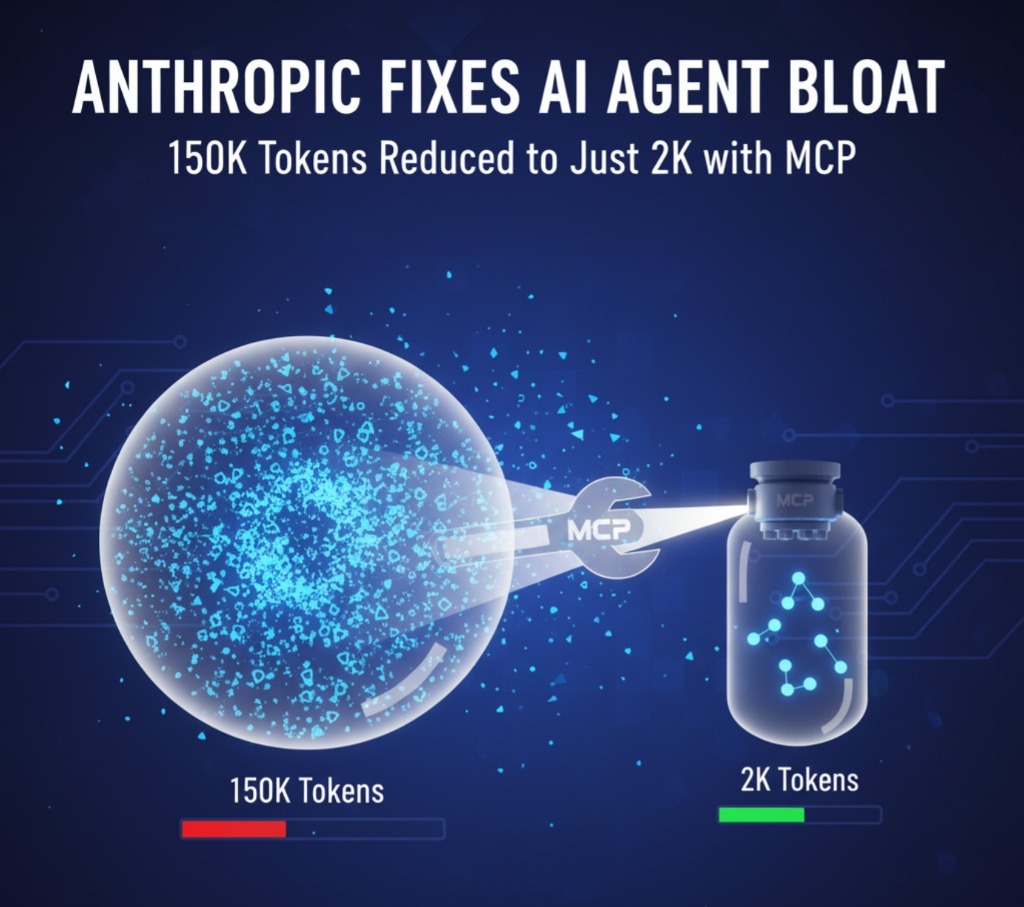
AI token bloat occurs when AI agents accumulate excessive tokens — units of information representing text, instructions, or memory — over time. This overload slows processing, increases computational costs, and makes AI less effective at executing tasks. Anthropic’s Model Context Protocol (MCP) addresses this challenge, reducing token usage from 150,000 to just 2,000 tokens. This innovation makes AI agents faster, cheaper, and smarter, allowing developers and businesses to deploy large-scale AI systems efficiently.
In this article, we will explore what AI token bloat is, why it is problematic, how MCP solves it, and the implications for the future of AI development.
What Is AI Token Bloat?
AI agents use tokens to process instructions, retain memory, and perform operations. Each token can represent a word, piece of data, or instruction for the AI model. Over time, AI agents accumulate unnecessary tokens — old context, repeated data, or irrelevant instructions. This accumulation is known as AI token bloat, and it has several negative consequences:
Slower Processing: The AI model must read and analyze large amounts of unnecessary data, delaying responses.
Higher Compute Costs: More tokens increase API calls and computing expenses.
Repeated or Irrelevant Outputs: Old or redundant information can confuse the model, leading to errors.
Inefficient Task Execution: Tasks that should take seconds may take minutes due to excessive context.
Context Overload: Models struggle to differentiate relevant information from noise, decreasing accuracy.
For developers managing multiple AI agents or handling enterprise-level workloads, token bloat can become a serious bottleneck, affecting performance, scalability, and cost-efficiency.
How Anthropic’s MCP Tackles AI Token Bloat
Anthropic’s Model Context Protocol (MCP) is designed to optimize how AI agents manage context and memory. By retrieving only the necessary information for a task, MCP dramatically reduces token usage while maintaining model intelligence.
Key features of MCP include:
1. Smarter Context Filtering
MCP analyzes past interactions and retains only relevant information for the current task. By filtering out unnecessary historical data, AI agents avoid loading large, irrelevant datasets that contribute to token bloat.
2. On-Demand Data Pulling
Instead of pre-loading entire documents or full interaction histories, MCP retrieves only the specific data required at the moment. This on-demand approach minimizes token usage and ensures the agent is working with precise information.
3. Code Execution Instead of Long Prompts
Many tasks previously required extensive instructions in natural language. MCP enables AI agents to execute short code snippets instead of long prompts, further reducing token consumption and improving efficiency.
4. Modular Memory Access
Memory is divided into modular blocks that are retrieved only when needed, rather than loading all stored data at once. This keeps AI agents lightweight, reduces context clutter, and prevents token bloat from slowing processing.
5. Structured Communication
Interactions are broken into small, organized messages rather than long, unstructured blocks of information. This makes the AI more effective at understanding instructions and reduces unnecessary tokens.
The Impact of MCP on Token Usage
By implementing MCP, Anthropic achieved an astonishing reduction in token usage from 150K to just 2K. This 98% decrease not only speeds up processing but also drastically reduces operational costs for businesses deploying AI at scale.
The protocol ensures AI agents can:
Respond faster to queries and tasks
Maintain high accuracy without unnecessary context
Operate efficiently in large-scale deployments
Scale across multiple applications without ballooning compute costs
Why Reducing AI Token Bloat Matters
Reducing AI token bloat has far-reaching benefits for developers, enterprises, and the future of AI:
1. Significant Cost Savings
Fewer tokens mean lower API usage and reduced cloud compute bills. This is especially important for businesses running hundreds of AI agents simultaneously.
2. Faster Task Execution
Smaller prompts allow AI agents to process requests more quickly, enhancing user experience in customer support, automation, and real-time AI applications.
3. More Accurate Responses
Removing irrelevant context reduces errors, hallucinations, and repeated outputs. AI agents can focus on the essential data, producing precise and reliable results.
4. Efficiency in Large Projects
AI assistants, automation tools, and enterprise bots can handle large workloads efficiently without being bogged down by unnecessary tokens.
5. Enterprise Scalability
Businesses can deploy multiple AI agents across departments, workflows, and applications without incurring massive compute costs. MCP makes AI scalable, practical, and enterprise-ready.
How MCP Shapes the Future of AI
Anthropic’s MCP represents a paradigm shift in AI efficiency. By reducing token bloat, future AI systems will be:
Data-efficient: Pulling only what is necessary for the task at hand
Cost-effective: Minimizing compute and API usage
Lightweight and fast: Maintaining speed even in complex workflows
Scalable for enterprises: Deploying hundreds of AI agents without performance degradation
Developers can now focus on building more intelligent applications without worrying about token overload or excessive computational costs.
Real-World Applications
The reduction of AI token bloat enables a wide range of real-world applications:
Customer Support Automation: AI chatbots respond faster and more accurately.
Enterprise Automation: Workflow bots execute tasks efficiently without delays.
AI Development Tools: Developers can run experiments and models without costly compute overhead.
Robotics and IoT Integration: Lightweight AI agents can operate on edge devices without token-related slowdowns.
Conclusion
AI token bloat has long been a barrier to efficient AI agent development, slowing tasks, inflating costs, and reducing accuracy. Anthropic’s Model Context Protocol (MCP) tackles this challenge, cutting token usage from 150,000 to just 2,000.
With MCP, AI agents become faster, cheaper, and smarter, enabling:
Scalable enterprise applications
Real-time responsiveness
High accuracy in complex tasks
For developers and businesses, this breakthrough marks a new era of efficient, practical, and cost-effective AI. As more organizations adopt MCP, AI will become more accessible, reliable, and impactful across industries.