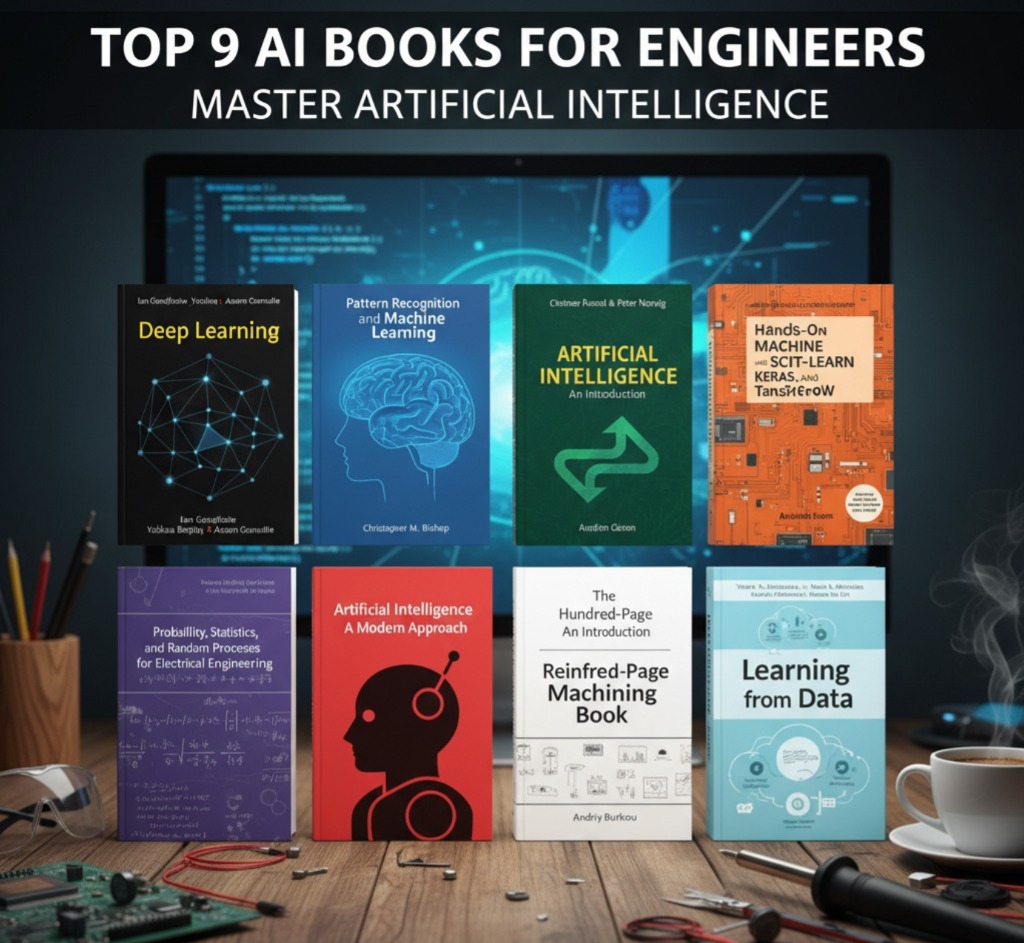
If you are searching for the top AI books for engineers, this expanded guide will help you better understand why these books are considered essential for mastering artificial intelligence in 2025. These expert-recommended resources cover machine learning, deep learning, reinforcement learning, AI mathematics, and practical engineering applications — all crucial for engineers aiming to grow professionally in the AI field.
1. Artificial Intelligence: A Modern Approach — Stuart Russell & Peter Norvig
Often called the AI Bible, this book provides a comprehensive introduction to artificial intelligence. It explains intelligent agents, search algorithms, knowledge representation, planning, reasoning, and machine learning fundamentals. Engineers benefit from its structured explanation of both theoretical AI and practical system design, making it one of the best starting points.
2. Deep Learning — Ian Goodfellow, Yoshua Bengio & Aaron Courville
This book dives deep into neural networks, optimization techniques, and deep learning architectures. It is widely respected in academia and industry. Engineers working on AI systems, computer vision, NLP, or speech recognition find this book extremely valuable because it explains both concepts and implementation challenges.
3. Hands-On Machine Learning with Scikit-Learn, Keras, and TensorFlow — Aurélien Géron
This is a practical guide designed for engineers who prefer learning by doing. It includes real Python examples, model-building workflows, and tutorials using popular frameworks. Engineers can quickly move from theory to actual AI project development with this resource.
4. Pattern Recognition and Machine Learning — Christopher Bishop
This book focuses heavily on mathematics, probability theory, and statistical modeling in AI. It is ideal for engineers who want strong theoretical foundations. Understanding these concepts helps build more accurate, reliable AI systems.
5. Machine Learning Yearning — Andrew Ng
Rather than coding details, this book teaches how to structure AI projects effectively. It explains dataset handling, evaluation strategies, and practical decision-making. Engineers working on real-world AI applications gain valuable strategic insights here.
6. Probabilistic Graphical Models — Daphne Koller & Nir Friedman
This advanced text explains Bayesian networks, probabilistic reasoning, and decision models. Engineers working in predictive analytics, robotics, or AI decision systems benefit greatly from understanding these probabilistic frameworks.
7. Python Machine Learning — Sebastian Raschka & Vahid Mirjalili
A practical guide focused on implementing machine learning algorithms using Python. It covers preprocessing, evaluation techniques, and pipeline creation — key skills engineers need for production AI systems.
8. Reinforcement Learning: An Introduction — Richard Sutton & Andrew Barto
This is the standard introduction to reinforcement learning. It explains how machines learn from interaction and feedback. Engineers working in robotics, automation, gaming AI, and adaptive systems find this especially useful.
9. Grokking Artificial Intelligence Algorithms — Rishal Hurbans
A beginner-friendly AI book that uses visual explanations and simple logic. It helps engineers quickly grasp AI algorithms without getting overwhelmed by complex mathematics.
Why These Books Matter for Engineers
Together, these books provide a complete AI learning path:
Strong theoretical foundations
Practical coding experience
Advanced AI mathematical understanding
Real-world project strategies
Exposure to modern AI research trends
By studying these resources, engineers can build both conceptual clarity and hands-on skills — which are essential for careers in artificial intelligence, data science, robotics, and intelligent automation.