
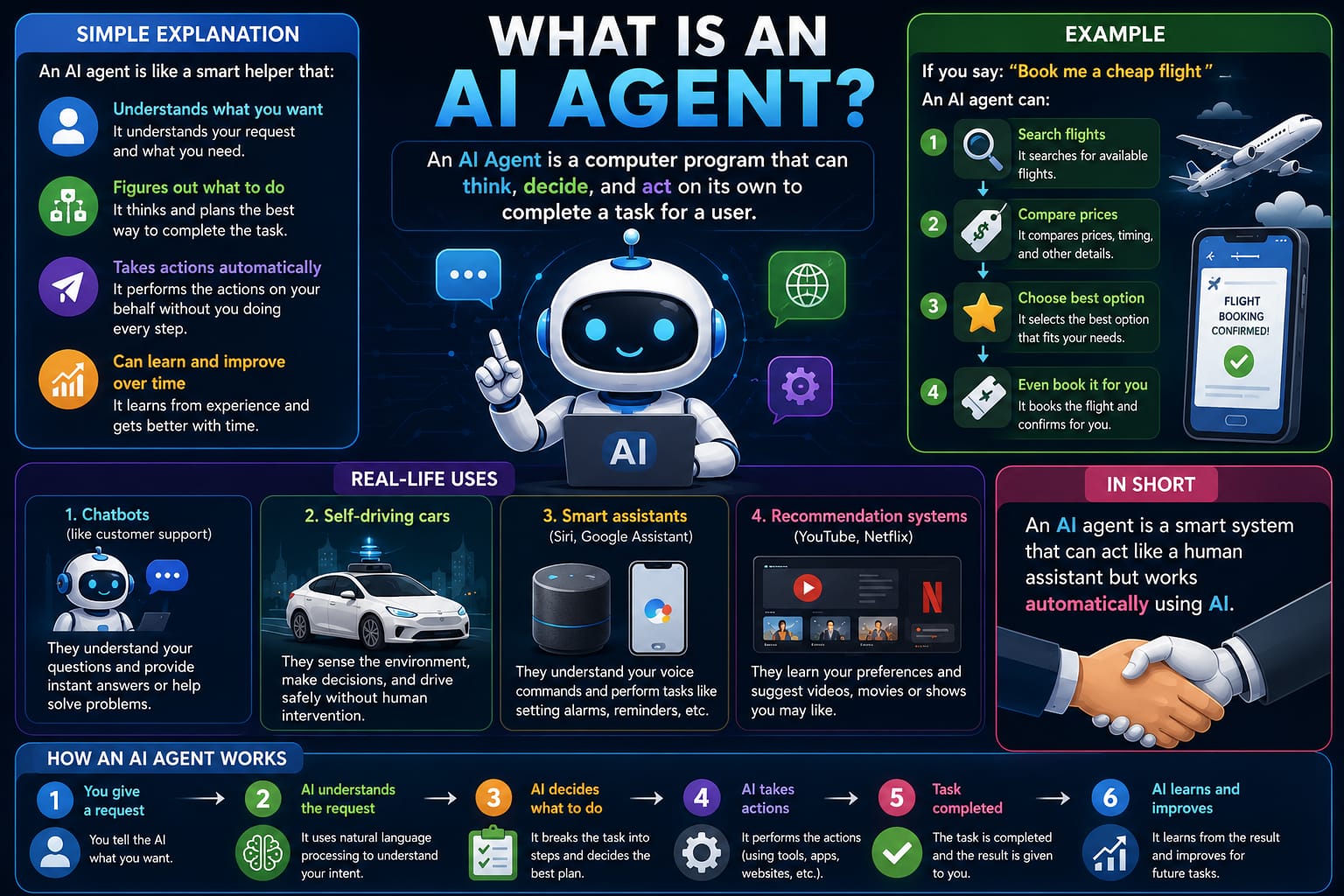
What is an AI Agent?
An AI Agent is a computer program that can think, decide, and act on its own to complete a task for a user.
Simple Explanation:
An AI agent is like a smart helper that:
Understands what you want
Figures out what to do
Takes actions automatically
Can learn and improve over time
Example:
If you say: “Book me a cheap flight to Travel Destination
An AI agent can:
Search flights
Compare prices
Choose best option
Even book it for you
Real-life uses:
Chatbots (like customer support)
Self-driving cars
Smart assistants (Siri, Google Assistant)
Recommendation systems (YouTube, Netflix)
In short:
👉 An AI agent is a smart system that can act like a human assistant but works automatically using AI.
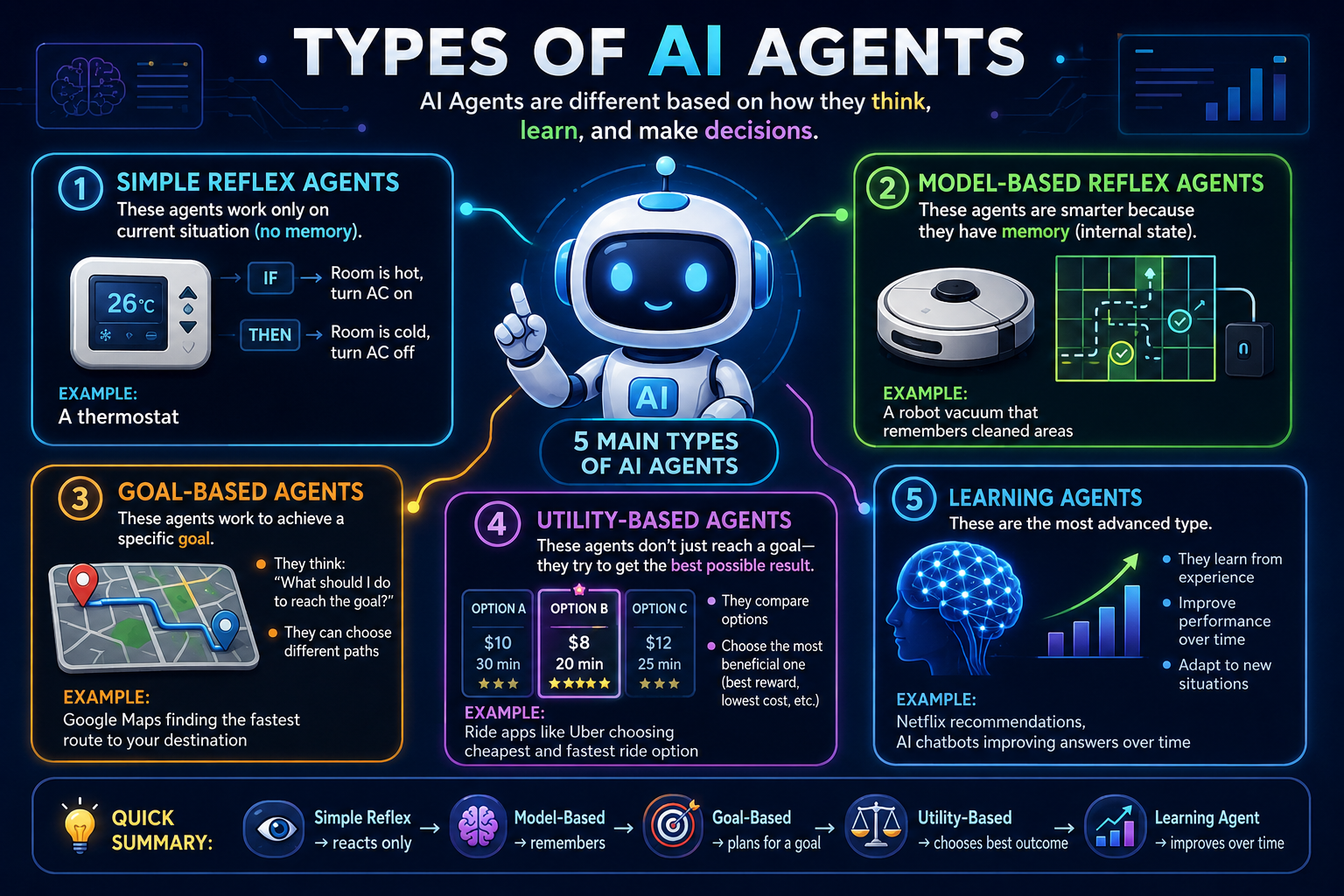
Types of AI Agents?
AI Agents are different based on how they think, learn, and make decisions. Here are the main types of AI agents explained in a simple way:
1. Simple Reflex Agents
These agents work only on current situation (no memory).
They follow IF → THEN rules
They don’t remember past events
Example:
A thermostat
→ If room is hot, turn AC on
→ If room is cold, turn AC off
2. Model-Based Reflex Agents
These agents are smarter because they have memory (internal state).
They remember past information
They understand the environment better
Example:
A robot vacuum that remembers cleaned areas
3. Goal-Based Agents
These agents work to achieve a specific goal.
They think: “What should I do to reach the goal?”
They can choose different paths
Example:
Google Maps finding the fastest route to your destination
4. Utility-Based Agents
These agents don’t just reach a goal—they try to get the best possible result.
They compare options
Choose the most beneficial one (best reward, lowest cost, etc.)
Example:
Ride apps like Uber choosing cheapest and fastest ride option
5. Learning Agents
These are the most advanced type.
They learn from experience
Improve performance over time
Adapt to new situations
Example:
Netflix recommendations
AI chatbots improving answers over time
Quick Summary:
Simple Reflex → reacts only
Model-Based → remembers
Goal-Based → plans for a goal
Utility-Based → chooses best outcome
Learning Agent → improves over time
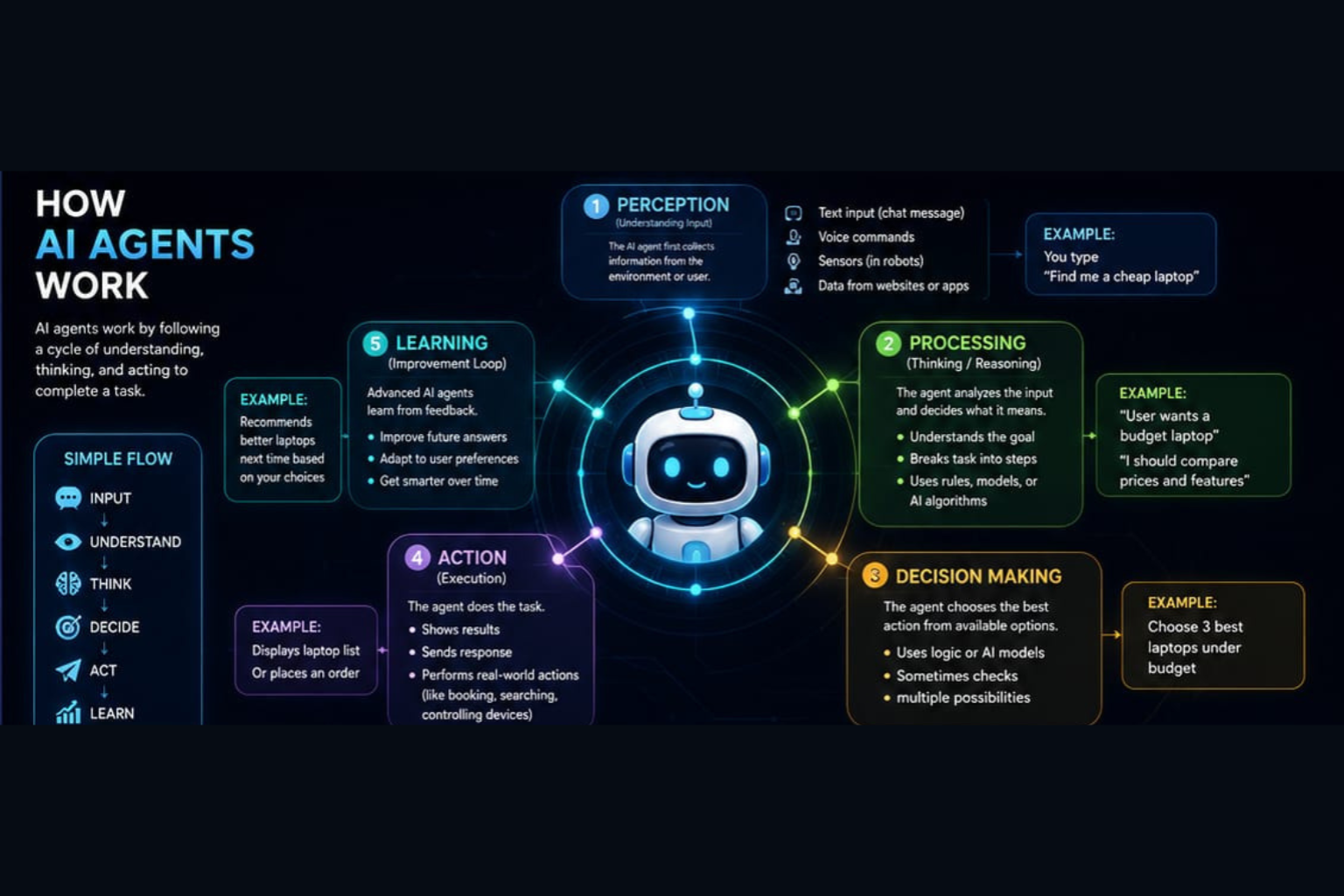
How AI Agents Work?
AI agents work by following a cycle of understanding, thinking, and acting to complete a task. Here’s a simple breakdown:
1. Perception (Understanding Input)
The AI agent first collects information from the environment or user.
Text input (chat message)
Voice commands
Sensors (in robots)
Data from websites or apps
Example: You type “Find me a cheap laptop”
2. Processing (Thinking / Reasoning)
Now the agent analyzes the input and decides what it means.
Understands the goal
Breaks task into steps
Uses rules, models, or AI algorithms
Example:
“User wants a budget laptop”
“I should compare prices and features”
3. Decision Making
The agent chooses the best action from available options.
Uses logic or AI models
Sometimes checks multiple possibilities
Example:
Choose 3 best laptops under budget
4. Action (Execution)
Now the agent does the task.
Shows results
Sends response
Performs real-world actions (like booking, searching, controlling devices)
Example:
Displays laptop list
Or places an order
5. Learning (Improvement Loop)
Advanced AI agents learn from feedback.
Improve future answers
Adapt to user preferences
Get smarter over time
Example:
Recommends better laptops next time based on your choices
Simple Flow:
Input → Understand → Think → Decide → Act → Learn
Easy Example (Chatbot AI Agent):
You ask a question
It understands your request
It searches knowledge
It generates best answer
It replies to you
It improves from feedback
In Short:
An AI agent works like a smart assistant that listens, thinks, decides, acts, and learns continuously.
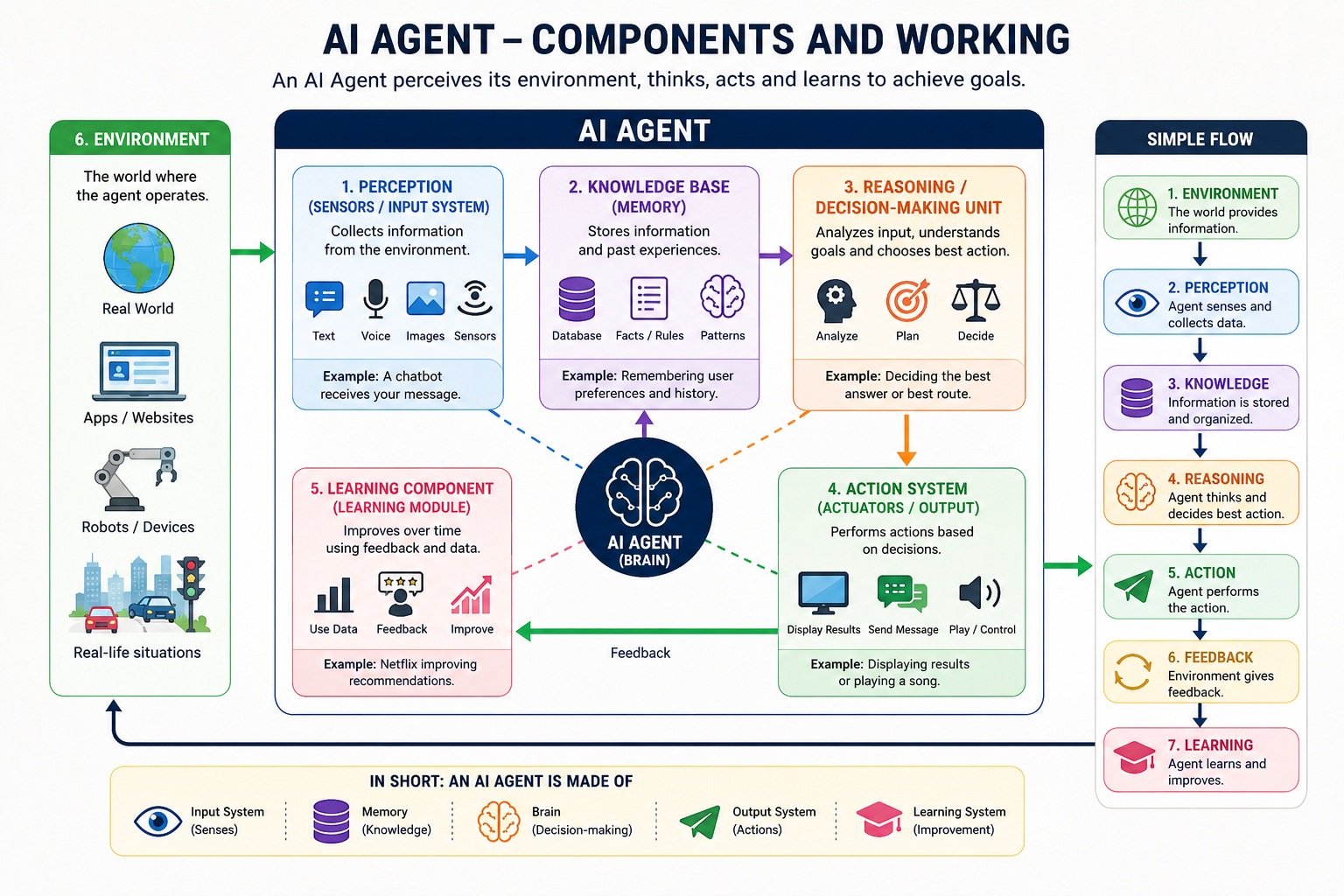
AI Agent Components
An AI Agent is built from several key components that work together to make it intelligent and autonomous.
1. Perception (Sensors / Input System)
This is how the agent collects information from the environment.
Text input (chat, commands)
Voice input
Images, video
Sensors (in robots)
Example: A chatbot receives your message.
2. Knowledge Base (Memory)
This is where the agent stores information.
Facts, rules, past experiences
Databases
Learned patterns (in AI models)
Example: Remembering user preferences like language or interests.
3. Reasoning / Decision-Making Unit
This is the brain of the AI agent.
Analyzes input
Understands goals
Chooses best action
Uses logic, rules, or machine learning models
Example: Deciding the best answer or best route on Google Maps.
4. Action System (Actuators / Output)
This component performs actions based on decisions.
Shows results
Sends messages
Controls devices or systems
Example: Displaying search results or playing a song.
5. Learning Component (Learning Module)
This allows the agent to improve over time.
Uses feedback
Learns from data
Improves accuracy
Example: Netflix improving recommendations based on your watching history.
6. Environment
This is the world where the agent operates.
Apps, websites, real world, robots, etc.
Example: A self-driving car operates in real traffic.
Simple Flow:
Environment → Perception → Knowledge → Reasoning → Action → Feedback → Learning
In Short:
An AI agent is made of:
Input system (senses)
Memory (knowledge)
Brain (decision-making)
Output system (actions)
Learning system (improvement)
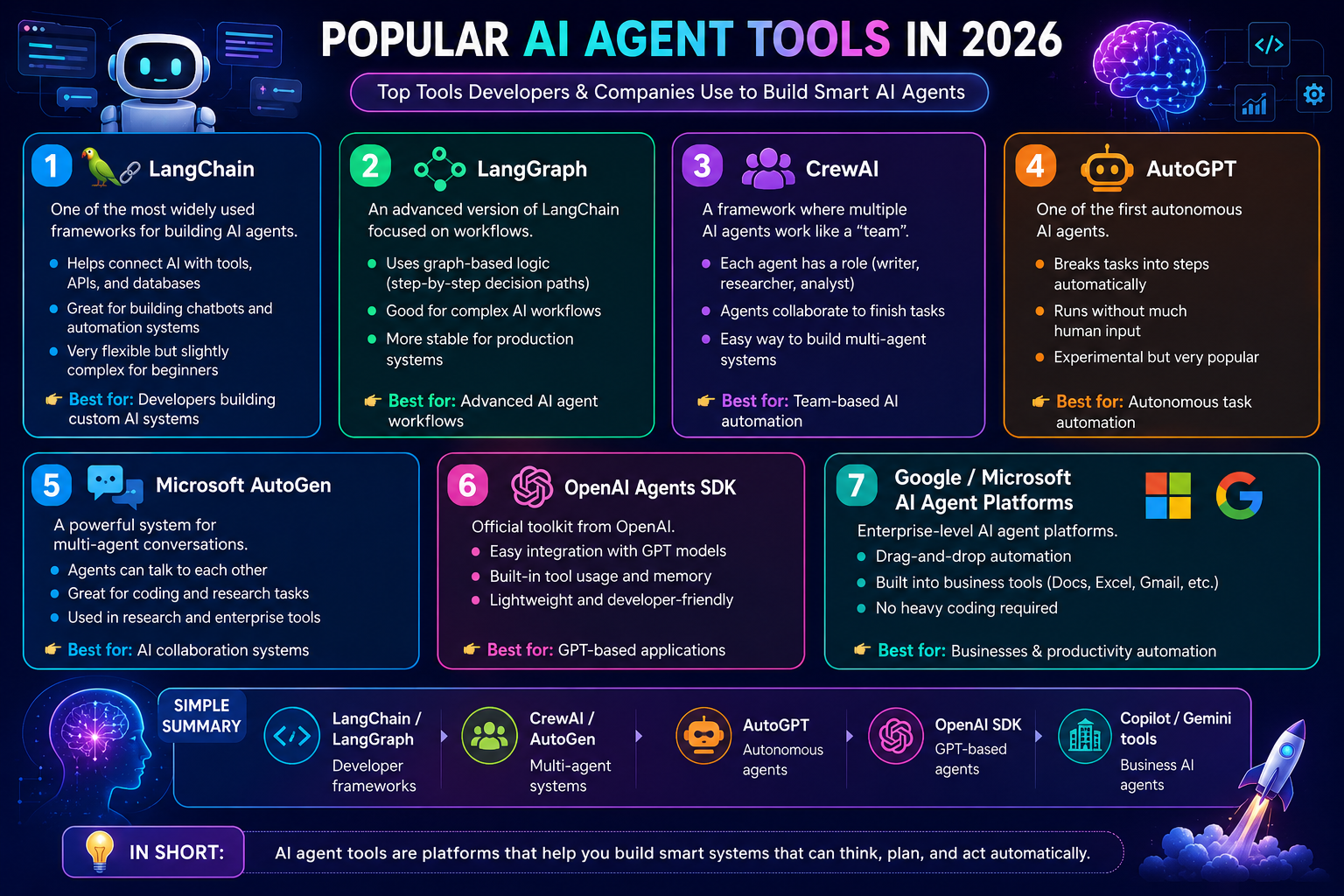
Popular AI Agent Tools
Here are the most popular AI Agent tools in 2026, used by developers, companies, and automation builders:
Popular AI Agent Tools
1. LangChain
LangChain
One of the most widely used frameworks for building AI agents.
Helps connect AI with tools, APIs, and databases
Great for building chatbots and automation systems
Very flexible but slightly complex for beginners
Best for: Developers building custom AI systems
2. LangGraph
LangGraph
An advanced version of LangChain focused on workflows.
Uses graph-based logic (step-by-step decision paths)
Good for complex AI workflows
More stable for production systems
Best for: Advanced AI agent workflows
3. CrewAI
CrewAI
A framework where multiple AI agents work like a “team”.
Each agent has a role (writer, researcher, analyst)
Agents collaborate to finish tasks
Easy way to build multi-agent systems
Best for: Team-based AI automation
4. AutoGPT
AutoGPT
One of the first autonomous AI agents.
Breaks tasks into steps automatically
Runs without much human input
Experimental but very popular
Best for: Autonomous task automation
5. Microsoft AutoGen
AutoGen
A powerful system for multi-agent conversations.
Agents can talk to each other
Great for coding and research tasks
Used in research and enterprise tools
Best for: AI collaboration systems
6. OpenAI Agents SDK
OpenAI Agents SDK
Official toolkit from OpenAI.
Easy integration with GPT models
Built-in tool usage and memory
Lightweight and developer-friendly
Best for: GPT-based applications
7. Google / Microsoft AI Agent Platforms
Microsoft Copilot Studio
Google Gemini
These are enterprise-level AI agent platforms:
Drag-and-drop automation
Built into business tools (Docs, Excel, Gmail, etc.)
No heavy coding required
Best for: Businesses & productivity automation
Simple Summary
LangChain / LangGraph → Developer frameworks
CrewAI / AutoGen → Multi-agent systems
AutoGPT → Autonomous agents
OpenAI SDK → GPT-based agents
Copilot / Gemini tools → Business AI agents
In Short:
AI agent tools are basically platforms that help you build smart systems that can think, plan, and act automatically.
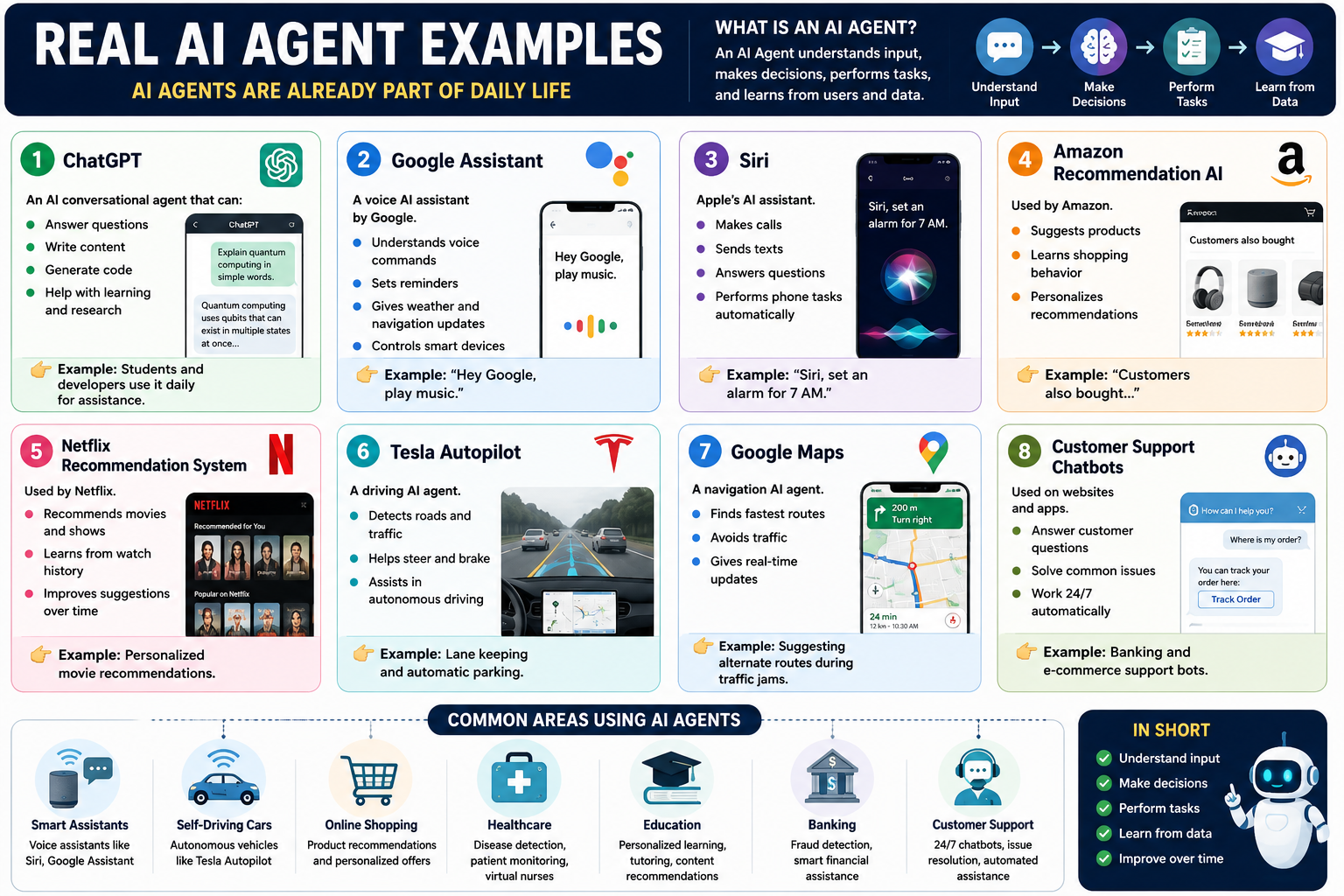
Real AI Agent Examples
Real AI Agent Examples
Here are some of the best real-world examples of AI agents used today:
1. ChatGPT
An AI conversational agent that can:
Answer questions
Write content
Generate code
Help with learning and research
Example: Students and developers use it daily for assistance.
2. Google Assistant
A voice AI assistant by Google.
Understands voice commands
Sets reminders
Gives weather and navigation updates
Controls smart devices
Example: “Hey Google, play music.”
3. Siri
Apple’s AI assistant.
Makes calls
Sends texts
Answers questions
Performs phone tasks automatically
Example: “Siri, set an alarm for 7 AM.”
4. Amazon Recommendation AI
Used by Amazon.
Suggests products
Learns shopping behavior
Personalizes recommendations
Example: “Customers also bought…”
5. Netflix Recommendation System
Used by Netflix.
Recommends movies and shows
Learns from watch history
Improves suggestions over time
Example: Personalized movie recommendations.
6. Tesla Autopilot
A driving AI agent.
Detects roads and traffic
Helps steer and brake
Assists in autonomous driving
Example: Lane keeping and automatic parking.
7. Google Maps
A navigation AI agent.
Finds fastest routes
Avoids traffic
Gives real-time updates
Example: Suggesting alternate routes during traffic jams.
8. Customer Support Chatbots
Used on websites and apps.
Answer customer questions
Solve common issues
Work 24/7 automatically
Example: Banking and e-commerce support bots.
In Short:
AI agents are already part of daily life. They:
Understand input
Make decisions
Perform tasks
Learn from users and data
Common Areas Using AI Agents
Smart assistants
Self-driving cars
Online shopping
Healthcare
Education
Banking
Customer support
AI Agents vs Automation
AI Agents and Automation may look similar, but they work very differently. Automation follows fixed rules, while AI agents can think, learn, and make decisions.
What is Automation?
Automation is a system that performs tasks automatically using pre-defined rules.
Works on fixed instructions
Repeats the same process every time
Cannot learn or think
Example:
An email system that sends the same message every Monday.
What is an AI Agent?
An AI agent is a smart system that can:
Understand information
Make decisions
Take actions
Learn from experience
Example:
A chatbot that answers different customer questions intelligently.
Main Differences
Feature AI Agents Automation
Intelligence Smart and adaptive Rule-based
Learning Can learn and improve Cannot learn
Decision Making Makes decisions Follows instructions
Flexibility Handles new situations Limited to programmed tasks
Human-like Thinking Yes No
Complexity Advanced Simple
R Automation Example
Auto email sender
Scheduled backups
Payroll processing
Social media post scheduler
These systems follow fixed workflows only.
AI Agent Example
ChatGPT answering questions
Google Maps changing routes based on traffic
Tesla self-driving features
Siri understanding voice commands
These systems analyze situations and respond intelligently.
Simple Analogy
Automation
AI Agent
Like a smart assistant that can think and adjust based on the situation.
In Simple Words
Automation = Do tasks automatically
AI Agents = Think + decide + act intelligently
Which is Better?
It depends on the task:
Use Automation for repetitive tasks
Use AI Agents for smart decision-making tasks
Today, many companies combine both together for powerful business systems.