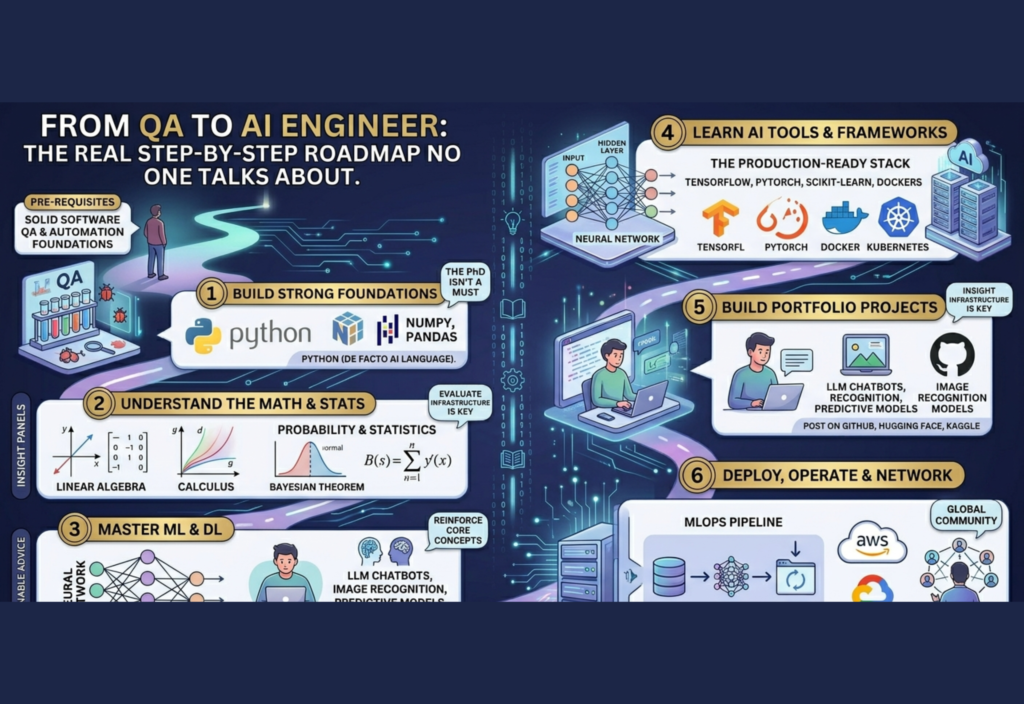
The tech industry is evolving faster than ever, and one of the most exciting transitions happening today is moving from Quality Assurance (QA) to becoming an AI Engineer. On the surface, it might look like a huge leap — testing software vs building intelligent systems — but in reality, QA professionals already have a strong foundation that makes this transition not only possible, but powerful.
What most guides don’t tell you is that this journey isn’t about starting from zero. It’s about stacking the right skills in the right order.
Let’s break down the real roadmap — practical, honest, and based on how people actually make this transition.
Why QA Engineers Have an Advantage
Before jumping into AI, it’s important to understand something: QA engineers are already problem-solvers.
You already:
- Understand how systems behave
- Think in edge cases
- Debug complex issues
- Work with developers closely
These skills are incredibly valuable in AI. In fact, many AI systems fail not because of poor models — but because of poor testing, validation, and real-world handling.
So you’re not behind. You’re just one pivot away.
Step 1: Shift Your Mindset (Testing → Building)
The biggest barrier is not technical — it’s mental.
In QA, you focus on:
- Finding bugs
- Breaking systems
In AI engineering, you focus on:
- Building systems
- Improving predictions
Start thinking like:
- “How does this work?” instead of “Why did this break?”
- “How can I improve it?” instead of “What’s wrong with it?”
This shift is critical.
Step 2: Learn Programming Properly (Python First)
Most QA engineers have some coding experience, but AI requires strong programming skills.
Start with:
- Python fundamentals
- Data structures (lists, dictionaries, sets)
- Functions and OOP
- File handling
Then move to:
- Writing clean, modular code
- Debugging logic, not just UI or APIs
Focus on practice — not just tutorials.
Step 3: Understand Data (This Is Where Most People Fail)
AI is not just about models — it’s about data.
Learn:
- Data cleaning
- Data preprocessing
- Handling missing values
- Basic statistics (mean, median, variance)
Tools to learn:
- Pandas
- NumPy
Most beginners skip this part and jump into models — that’s why they struggle later.
Step 4: Start with Machine Learning Basics
Now move into ML, but don’t rush into deep learning yet.
Start with:
- Linear regression
- Logistic regression
- Decision trees
- Random forests
Understand:
- Overfitting vs underfitting
- Training vs testing data
- Accuracy, precision, recall
Focus on why models work, not just how to run them.
Step 5: Build Small Real Projects
This is where your QA background helps the most.
Instead of just learning, build:
- Spam detection system
- Simple recommendation system
- Sentiment analysis tool
While building, apply your QA mindset:
- Test edge cases
- Validate outputs
- Handle bad inputs
This makes your projects stronger than most beginners.
Step 6: Learn APIs and Model Integration
AI Engineers don’t just train models — they deploy and use them.
Learn:
- REST APIs
- Flask or FastAPI
- How to connect frontend with AI backend
Example:
- Build a chatbot API
- Create an AI-powered tool
This step turns you from “learner” to “builder”.
Step 7: Enter the AI World (LLMs & Modern Tools)
Now move into modern AI:
- Prompt engineering
- Working with LLM APIs
- Fine-tuning basics
- Embeddings and vector databases
Build:
- AI chatbot
- Document analyzer
- AI content tool
This is where real career opportunities exist today.
Step 8: Learn Testing for AI (Your Secret Weapon)
Here’s something no one talks about:
AI systems also need testing — and most developers are bad at it.
You can specialize in:
- AI output validation
- Bias detection
- Model evaluation
- Edge-case handling
This makes you extremely valuable because you combine:
QA + AI = Rare Skillset
Step 9: Build a Strong Portfolio (Not Certificates)
Certificates don’t get you jobs — projects do.
Your portfolio should include:
- 3–5 real AI projects
- Clean GitHub code
- Live demos (if possible)
Each project should show:
- Problem
- Solution
- Results
Keep it simple but real.
Step 10: Apply Smartly (Not Randomly)
Don’t just apply everywhere.
Target:
- AI startups
- Automation companies
- SaaS tools using AI
Roles to search:
- Junior AI Engineer
- ML Engineer (Entry-level)
- AI Automation Developer
Also consider:
- Freelancing
- Building your own tools
The Reality No One Talks About
This journey is not instant.
You will face:
- Confusion
- Information overload
- Self-doubt
But here’s the truth:
You don’t need to know everything.
You just need:
- Consistency
- Real projects
- Clear direction
Final Thoughts
Moving from QA to AI Engineer is not about changing your identity — it’s about upgrading it.
Your QA experience is not a limitation. It’s your advantage.
If you follow the right path:
- Learn Python
- Understand data
- Build ML basics
- Create real projects
- Move into modern AI
You can realistically transition within months — not years.
The roadmap is simple.
What matters is execution.