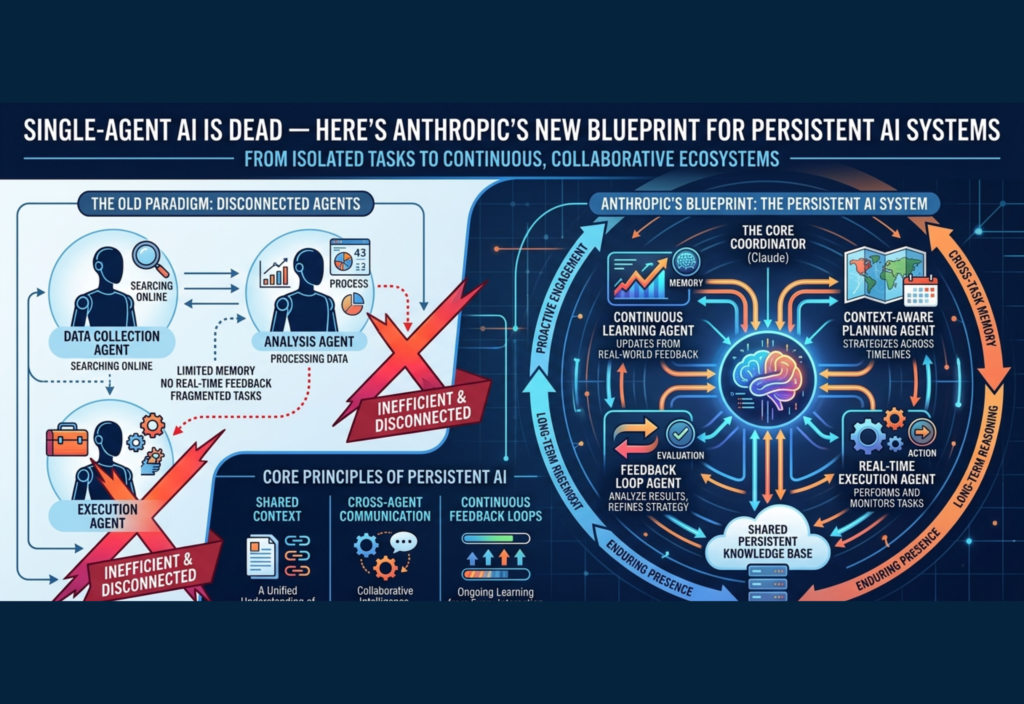
Persistent AI systems are transforming artificial intelligence beyond traditional limits. Instead of relying on single-agent models, AI is now shifting toward long-running, multi-agent systems that can think, plan, and operate continuously.
For the better part of a decade, the dominant paradigm in AI has been the single-agent model: one system, one prompt, one response. This approach fueled the explosive growth of generative AI, making powerful capabilities accessible to millions of users.
But beneath the surface, a structural limitation has always existed.
Single-agent AI was never designed for continuity, autonomy, or real-world complexity.
Now, that limitation is becoming impossible to ignore.
A new paradigm is taking shape—one that redefines AI from a reactive tool into a persistent, goal-driven, multi-agent system. This blueprint, strongly associated with emerging research directions from companies like Anthropic, represents a turning point in how intelligent systems are designed.
The message is clear:
The future of AI is not a single mind. It’s a coordinated system.
The Original Model: Why Single-Agent AI Worked (Until It Didn’t)
To understand why this shift matters, we need to examine why single-agent AI succeeded in the first place.
Simplicity and Scalability
Single-agent systems are elegant:
- Input → Processing → Output
- Stateless or minimally stateful
- Easy to deploy and scale
This simplicity allowed rapid adoption across industries.
From content creation to coding assistance, single-agent AI proved that machines could generate high-quality outputs in seconds.
The Illusion of Intelligence
These systems often feel intelligent because they:
- Generate coherent language
- Mimic reasoning
- Adapt to prompts
But this intelligence is largely context-bound and temporary.
Once the session ends, the “intelligence” resets.
The Breaking Point: Where the Model Fails
As users began pushing AI beyond simple tasks, cracks in the system became obvious.
1. No Continuity of Thought
Real intelligence requires continuity.
Single-agent AI lacks:
- Long-term memory
- Persistent identity
- Evolving understanding
Every interaction is disconnected from the last.
2. Prompt Dependency Bottleneck
Users must constantly:
- Re-explain context
- Guide the process step-by-step
- Correct mistakes manually
This creates friction and limits scalability.
3. Inability to Handle Complex Systems
Real-world workflows involve:
- Multiple steps
- Conditional logic
- Iterative refinement
- Parallel processes
A single agent struggles to manage all of this simultaneously.
4. Zero Autonomy
Single-agent AI cannot:
- Initiate tasks
- Monitor changes
- Adapt without input
It is fundamentally passive.
The Paradigm Shift: From Agents to Systems
The next generation of AI replaces the idea of “one agent” with something far more powerful:
An ecosystem of agents operating within a persistent system
This shift introduces a new design philosophy:
- Intelligence is distributed, not centralized
- Memory is continuous, not session-based
- Action is ongoing, not triggered
- Goals replace prompts as the primary interface
Inside the Blueprint: Anatomy of a Persistent AI System
Let’s break down what makes this new architecture fundamentally different.
1. Persistent Memory Architecture
At the core of the system is a layered memory structure:
Short-Term Memory
- Handles immediate context
- Similar to a conversation buffer
Long-Term Memory
- Stores structured knowledge
- Learns over time
Episodic Memory
- Tracks past actions and outcomes
- Enables reflection and improvement
Semantic Memory
- Builds generalized understanding
- Connects concepts across tasks
This multi-layered memory transforms AI into something that can learn continuously without retraining.
2. Multi-Agent Role Specialization
Instead of a monolithic system, tasks are distributed across agents:
Strategic Agents
- Define goals
- Plan long-term actions
Operational Agents
- Execute tasks
- Interact with tools and APIs
Analytical Agents
- Evaluate results
- Optimize decisions
Supervisory Agents
- Monitor system behavior
- Ensure alignment and safety
This mirrors organizational structures in human teams.
The key advantage?
Parallel intelligence with structured coordination
3. Orchestration and Coordination Layer
A persistent system requires a central mechanism to manage agents.
This orchestration layer:
- Assigns tasks
- Resolves conflicts
- Maintains priorities
- Synchronizes outputs
Without orchestration, multi-agent systems collapse into chaos.
With it, they become highly efficient autonomous systems.
4. Continuous Execution Loop
Unlike traditional AI, which operates in discrete steps, persistent systems run in loops:
- Observe environment
- Evaluate state
- Plan next actions
- Execute tasks
- Learn from outcomes
- Repeat
This creates a closed-loop intelligence system capable of adaptation.
5. Tool Integration and External Interaction
Persistent AI systems are not isolated.
They connect with:
- Databases
- APIs
- Software tools
- Real-time data sources
This allows them to:
- Take real actions
- Update systems
- Interact with the digital world
From Prompts to Goals: A Fundamental Interface Shift
One of the most important changes is how humans interact with AI.
Old Model:
- Write prompts
- Get outputs
New Model:
- Define goals
- AI manages execution
This shift introduces a new discipline:
Goal Engineering
Users specify outcomes, constraints, and priorities.
The AI system handles everything else.
Emergent Capabilities of Persistent Systems
When these components come together, entirely new capabilities emerge:
1. Self-Improvement
Systems can analyze their own performance and refine strategies.
2. Long-Term Planning
AI can think in terms of days, weeks, or months.
3. Contextual Awareness
Decisions are informed by accumulated knowledge.
4. Autonomous Adaptation
Systems adjust without human intervention.
Industry-Level Transformation
This architecture doesn’t just improve AI—it reshapes industries.
Enterprise Operations
Companies can deploy AI systems that:
- Manage supply chains
- Optimize logistics
- Automize decision-making
Content and Media
AI can:
- Plan content calendars
- Produce and update content
- Analyze audience engagement continuously
Finance
Persistent systems can:
- Monitor markets
- Adjust strategies
- Manage portfolios dynamically
Healthcare (Emerging Potential)
AI could:
- Track patient data over time
- Assist in long-term diagnostics
- Provide adaptive treatment insights
The Risks: Why This Isn’t Just an Upgrade
With greater power comes greater responsibility.
Autonomy Risks
Systems acting independently raise concerns:
- Misaligned actions
- Unexpected behaviors
- Over-automation
Coordination Failures
Multi-agent systems can:
- Conflict internally
- Duplicate efforts
- Enter feedback loops
Ethical and Control Challenges
Questions arise:
- Who is accountable?
- How do we enforce boundaries?
- How do we audit decisions?
Why Anthropic’s Direction Matters
Anthropic’s approach emphasizes:
- Safety-first system design
- Interpretable agent behavior
- Controlled autonomy
- Structured coordination
Rather than chasing raw capability, the focus is on reliable, aligned intelligence.
This is critical for real-world adoption.
The Road Ahead: What the Next 5 Years May Look Like
If this blueprint succeeds, we may see:
- AI “operating systems” managing daily life
- Fully autonomous startups run by AI agents
- Hybrid human-AI teams as the norm
- Continuous intelligence embedded into every workflow
Eventually, AI won’t feel like software.
It will feel like infrastructure.
Final Conclusion
Single-agent AI changed the world—but it was only the beginning.
Its limitations have paved the way for something far more powerful:
Persistent, multi-agent systems capable of continuous, coordinated intelligence.
This is not just a technological shift.
It’s a shift in how we think about intelligence itself.
From:
- Isolated → Connected
- Reactive → Proactive
- Temporary → Persistent
- Tools → Systems
The age of single-agent AI is ending.
And the age of intelligent systems has just begun.