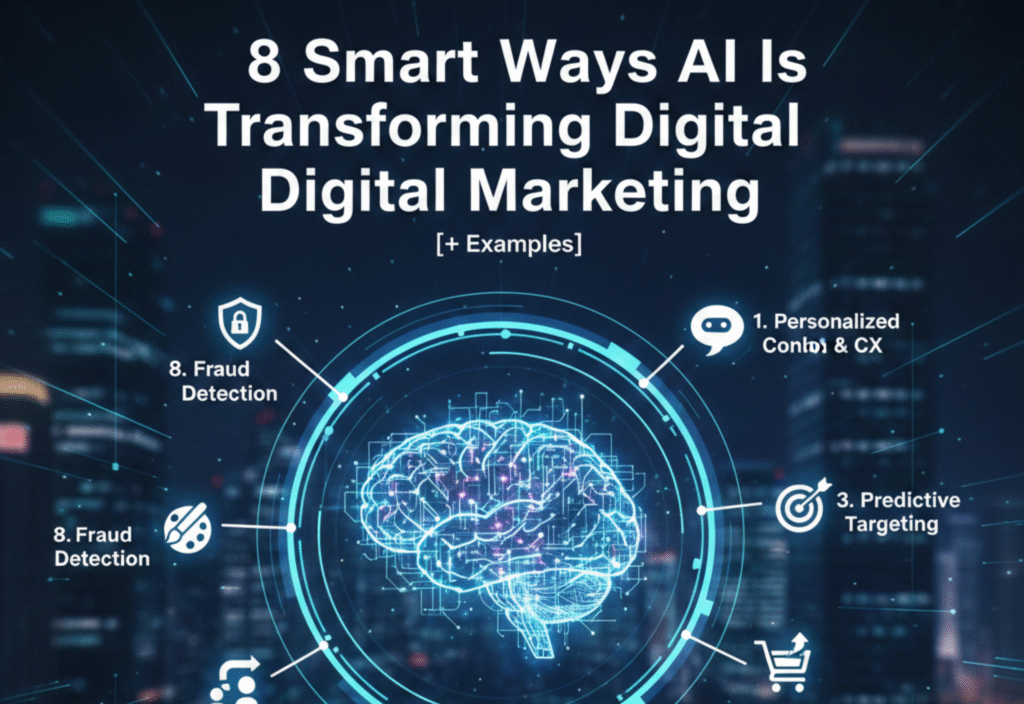
In the ever-evolving world of digital marketing, businesses constantly look for new strategies to connect with their audience more effectively. Artificial Intelligence (AI) is no longer a futuristic concept; it’s a practical tool that is reshaping how companies approach marketing campaigns, customer engagement, and data analysis. From automating repetitive tasks to predicting customer behavior, AI is revolutionizing the industry. Here are eight smart ways AI is transforming digital marketing, along with real-world examples.
1. Personalized Customer Experiences
One of the most powerful ways AI is changing digital marketing is through personalization. AI algorithms analyze user behavior, browsing history, and purchase patterns to deliver customized content. This ensures that each customer sees messages, offers, or products that are most relevant to them.
Example: Netflix uses AI to recommend shows and movies based on a user’s viewing history. Similarly, Amazon provides personalized product recommendations, increasing the likelihood of purchase.
2. Enhanced Email Marketing
AI improves email marketing by analyzing engagement metrics such as open rates, click-through rates, and user preferences. This allows marketers to send emails at the optimal time and with the most relevant content.
Example: Phrasee uses AI to generate subject lines and email content that resonate with specific audiences. Brands using AI-driven email strategies have seen higher engagement rates and improved ROI.
3. Intelligent Chatbots for Customer Support
AI-powered chatbots have transformed customer service by providing instant, round-the-clock support. These chatbots use natural language processing (NLP) to understand customer queries and deliver relevant answers or guide them through the sales funnel.
Example: Sephora’s chatbot on Facebook Messenger helps customers find products, book appointments, and get personalized beauty advice, enhancing the overall shopping experience.
4. Predictive Analytics and Forecasting
AI-driven predictive analytics helps marketers anticipate customer behavior, forecast trends, and make data-driven decisions. By analyzing historical data, AI predicts what products or services customers are likely to buy next.
Example: Starbucks uses predictive analytics to personalize marketing campaigns and suggest products to customers based on location, time of day, and past purchase behavior.
5. Content Creation and Curation
AI tools are increasingly capable of generating high-quality content, from blog posts to social media updates. AI can also curate content tailored to user interests, saving marketers time and effort.
Example: Tools like Jasper AI and Copy.ai help marketers generate blog articles, ad copies, and social media content efficiently, while platforms like Feedly use AI to curate relevant content for audiences.
6. Optimized Advertising Campaigns
AI enhances digital advertising by analyzing large datasets to determine which ads will perform best. It can automatically adjust targeting, bidding, and placement in real-time, ensuring maximum ROI.
Example: Google Ads uses AI to optimize bidding strategies, targeting the right audience at the right moment. Facebook Ads also leverage AI to show ads to users most likely to convert.
7. Voice Search and Conversational Marketing
The rise of voice assistants like Alexa, Siri, and Google Assistant has created new opportunities for marketers. AI optimizes content for voice search and enables conversational marketing strategies, making it easier for brands to engage with users naturally.
Example: Domino’s Pizza allows customers to order via voice commands through its app and smart assistants, improving convenience and user engagement.
8. Visual Recognition and AI-Driven Design
AI technologies like computer vision and image recognition are transforming how brands interact with visuals. AI can analyze images and videos to detect patterns, improve ad targeting, or even generate design suggestions.
Example: Pinterest’s visual search tool allows users to find products using images, while AI-driven platforms like Canva provide automated design suggestions based on user preferences.
Conclusion
Artificial Intelligence is no longer a supplementary tool—it is central to the future of digital marketing. By personalizing experiences, automating repetitive tasks, optimizing ad campaigns, and predicting customer behavior, AI enables marketers to work smarter and more efficiently. Businesses that adopt AI-driven strategies gain a competitive edge by providing more relevant, timely, and engaging experiences for their audience.