In today’s highly competitive digital landscape, consumers expect brands to understand their needs, preferences, and behavior. Generic marketing messages are no longer effective. This is where AI personalization is transforming modern marketing strategies. By using artificial intelligence, brands can deliver highly relevant, timely, and personalized experiences at scale.
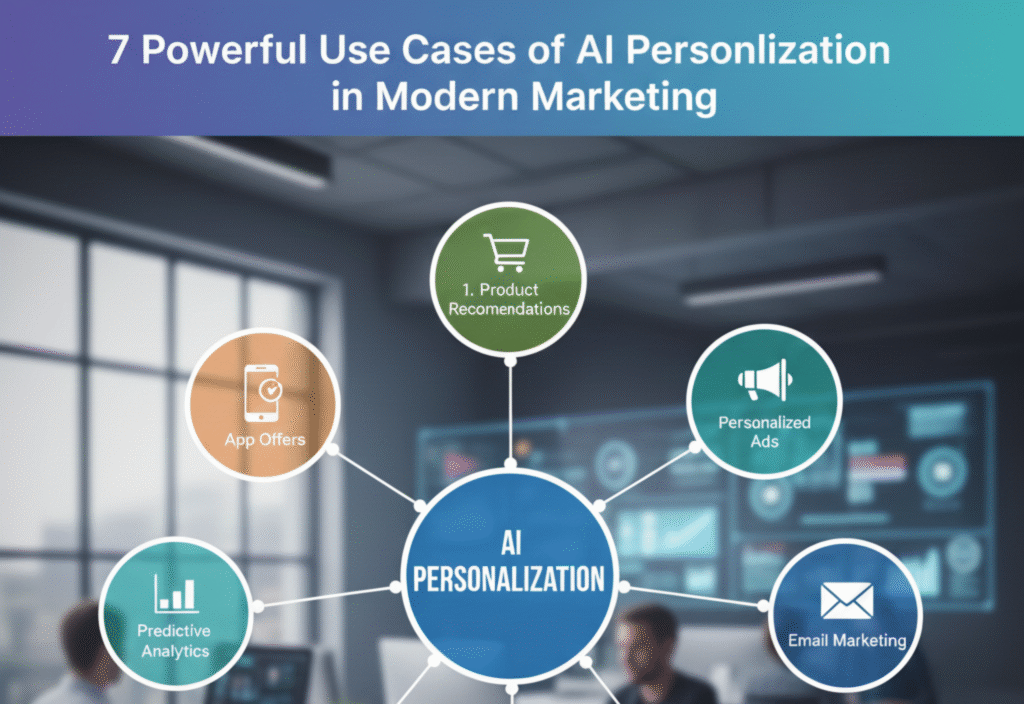
From eCommerce recommendations to personalized email campaigns, AI-powered personalization helps businesses increase engagement, conversions, and customer loyalty. Let’s explore seven powerful use cases of AI personalization in modern marketing and how they are shaping the future of customer experiences.
1. Personalized Product Recommendations
One of the most popular and effective use cases of AI personalization is product recommendations. AI analyzes customer data such as browsing behavior, purchase history, and preferences to suggest products that are most likely to convert.
How it works:
Tracks user activity across websites and apps
Uses machine learning algorithms to predict customer interests
Displays tailored product suggestions in real time
Marketing impact:
Higher conversion rates
Increased average order value
Improved customer satisfaction
Popular platforms like Amazon and Netflix have set the benchmark for AI-driven recommendations, making this strategy essential for eCommerce brands.
2. AI-Powered Personalized Email Marketing
Email marketing becomes significantly more effective when powered by AI personalization. Instead of sending the same email to everyone, AI tailors content, subject lines, and send times for each individual user.
Key personalization elements:
Dynamic email content based on user behavior
Personalized subject lines to improve open rates
Optimal send-time prediction using AI
Benefits:
Higher open and click-through rates
Reduced unsubscribe rates
Stronger customer relationships
AI ensures that users receive relevant messages at the right moment, increasing engagement and ROI.
3. Smart Chatbots and Virtual Assistants
AI-powered chatbots are redefining customer interaction by delivering personalized conversations in real time. Unlike traditional bots, AI chatbots understand user intent and respond accordingly.
Use cases in marketing:
Personalized product guidance
24/7 customer support
Lead qualification and nurturing
Why it matters:
Faster response times
Better user experience
Increased lead conversions
Modern AI chatbots can remember past interactions, making conversations more human-like and personalized.
4. Dynamic Website Content Personalization
AI personalization allows websites to change content dynamically based on visitor behavior, location, and preferences. This ensures that each user sees content most relevant to them.
Examples:
Personalized landing pages
Region-specific offers
Customized banners and CTAs
Marketing advantages:
Lower bounce rates
Higher engagement
Improved conversion performance
Dynamic content personalization makes websites feel more intuitive and user-centric.
5. Predictive Customer Behavior Analysis
AI helps marketers anticipate customer actions by analyzing large volumes of data. Predictive analytics enables brands to understand what customers are likely to do next.
Applications:
Predicting churn probability
Identifying high-value customers
Forecasting future purchases
Results:
Proactive marketing strategies
Improved customer retention
Better campaign planning
By predicting behavior, businesses can take action before customers lose interest or disengage.
6. Personalized Advertising and Retargeting
AI personalization plays a crucial role in creating highly targeted ads. It ensures ads are shown to the right audience, at the right time, on the right platform.
AI-driven ad personalization includes:
Audience segmentation
Behavioral retargeting
Personalized ad creatives
Benefits:
Reduced ad spend wastage
Higher click-through rates
Better return on ad investment (ROAS)
AI continuously optimizes campaigns by learning from user interactions and performance data.
7. Customized Customer Journeys Across Channels
Modern consumers interact with brands across multiple channels. AI personalization enables businesses to create seamless, personalized omnichannel experiences.
Channels include:
Websites
Social media
Email
Mobile apps
Why it’s powerful:
Consistent brand messaging
Personalized touchpoints across the journey
Stronger brand loyalty
AI connects data from different channels to deliver a unified and personalized customer journey.
The Future of AI Personalization in Marketing
AI personalization is no longer optional—it’s a necessity for modern marketers. As AI technologies continue to evolve, personalization will become more predictive, real-time, and human-centric.
Key trends to watch:
Hyper-personalization using real-time data
Voice and visual search personalization
Ethical and privacy-focused AI personalization
Brands that adopt AI personalization early will gain a competitive edge by delivering meaningful and memorable customer experiences.
Final Thoughts
The use of AI personalization in modern marketing is transforming how brands communicate with their audiences. From personalized product recommendations to intelligent chatbots and predictive analytics, AI empowers marketers to deliver relevant experiences at scale.