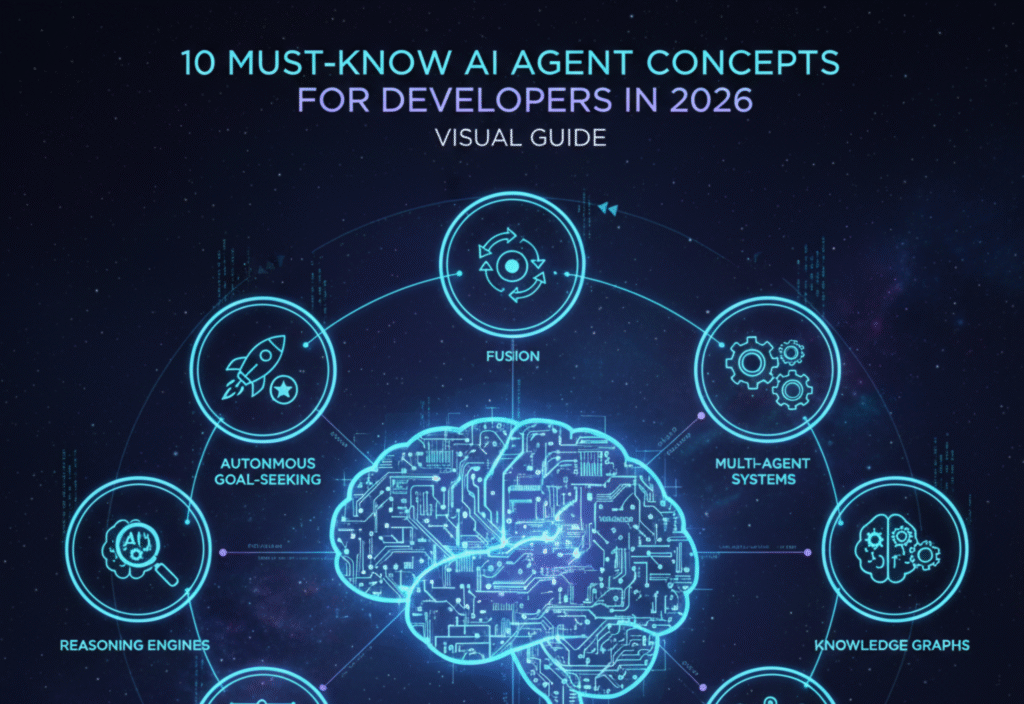
“Understanding AI agent concepts 2026 is essential for developers building intelligent and autonomous software. In this guide, we explore the top 10 AI agent concepts 2026 that every developer should master to create scalable, ethical, and context-aware AI solutions.”
1. Autonomous Agents
Autonomous agents are AI systems capable of operating independently to perform tasks, make decisions, and adapt to changes in real-time environments. Unlike traditional software, these agents do not rely solely on human inputs; they can learn from data, evaluate options, and execute strategies.
Key points for developers:
Use cases include robotics, virtual assistants, and game AI.
Integration with APIs and IoT devices enhances autonomy.
Frameworks like LangChain and AutoGPT provide templates for creating autonomous agents efficiently.
2. Multi-Agent Systems (MAS)
In complex environments, single AI agents are often insufficient. Multi-agent systems (MAS) involve multiple AI agents working collaboratively or competitively to solve problems.
Developer considerations:
Ensure communication protocols between agents (message passing, shared knowledge bases).
Manage conflict resolution and coordination for collaborative tasks.
MAS is widely used in logistics, simulations, and decentralized AI networks.
3. Reinforcement Learning Agents
Reinforcement learning (RL) agents learn by trial and error, optimizing actions based on rewards and penalties. These agents are crucial in dynamic, unpredictable environments.
For developers:
RL is popular in game development, autonomous vehicles, and robotics.
Reward functions must be carefully designed to align agent behavior with desired outcomes.
Open-source libraries like Stable Baselines3 and RLlib simplify RL implementation.
4. Context-Aware Agents
Context-aware agents adapt their behavior based on the environment, user preferences, or historical data. This is especially important in 2026 as AI becomes personalized and hyper-intelligent.
Implementation tips:
Integrate sensor data or user behavior analytics for real-time context detection.
Use memory and state management for agents to retain context across sessions.
Examples include smart home systems, AI assistants, and personalized content recommendation.
5. Conversational AI Agents
These agents are designed for natural language understanding and generation, forming the backbone of chatbots, virtual assistants, and customer support AI.
Developer focus areas:
Implement LLM-based agents that can reason, summarize, and answer questions dynamically.
Ensure context retention across multi-turn conversations.
Popular frameworks include OpenAI GPT APIs, Claude by Anthropic, and Rasa.
6. Agent-Oriented Programming (AOP)
Agent-oriented programming introduces specialized languages and frameworks for developing agents rather than traditional object-oriented programming.
Key aspects:
Focus on goals, beliefs, and behaviors rather than just methods and objects.
Languages like Jason and JADE are widely used for MAS and simulation tasks.
Encourages modular, scalable, and self-organizing AI architectures.
7. Ethical and Safe AI Agents
By 2026, safety and ethics are non-negotiable for AI developers. Agents must act responsibly and avoid harmful behaviors.
Guidelines for developers:
Implement guardrails, value alignment, and transparency mechanisms.
Use explainable AI (XAI) techniques to audit agent decisions.
Ensure compliance with global AI regulations and privacy standards.
8. Hybrid AI Agents
Hybrid AI agents combine multiple AI techniques, such as symbolic reasoning, neural networks, and reinforcement learning, to leverage the strengths of each.
Developer tips:
Use hybrid approaches for complex problem-solving, e.g., combining rule-based logic with LLM reasoning.
Helps improve accuracy, efficiency, and robustness of AI solutions.
Increasingly applied in finance, healthcare, and predictive analytics.
9. Collaborative Human-AI Agents
Human-AI collaboration is key in 2026 development. Agents that work alongside humans augment human capabilities rather than replace them.
Best practices:
Design interfaces that allow human feedback and intervention.
Agents can suggest actions, automate repetitive tasks, and provide insights.
Tools like Claude Cowork or AI copilots exemplify collaborative AI.
10. Visual and Multi-Modal AI Agents
Modern AI agents can process not just text but images, video, and audio to make decisions—these are multi-modal agents.
Developer insights:
Integrate computer vision, audio processing, and natural language processing for richer interaction.
Examples include AI-powered design tools, autonomous vehicles, and surveillance systems.
Multi-modal agents require efficient data handling and model optimization to scale effectively.
Conclusion
AI agents in 2026 are more intelligent, autonomous, and versatile than ever. Developers who master these 10 concepts will be equipped to create highly adaptive, ethical, and scalable AI solutions. Whether you are building chatbots, autonomous systems, or collaborative AI tools, understanding these fundamentals will keep you ahead in the rapidly evolving AI landscape.